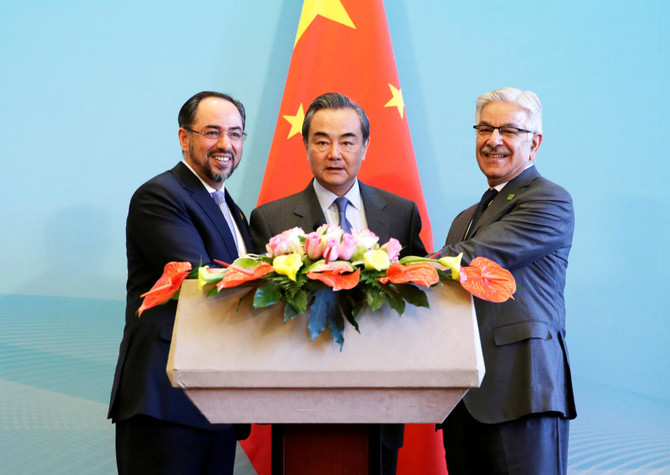
BEIJING: China and Pakistan will look at extending their $57 billion China-Pakistan Economic Corridor to Afghanistan, Chinese Foreign Minister Wang Yi said on Tuesday, part of China’s ambitious Belt and Road plan linking China with Asia, Europe and beyond.
China has tried to position itself as a helpful party to promote talks between Pakistan and Afghanistan, both uneasy neighbors ever since Pakistan’s independence in 1947.
Their ties have been poisoned in recent years by Afghan accusations that Pakistan is supporting Taliban insurgents fighting the US-backed Kabul in order to limit the influence of its old rival, India, in Afghanistan.
Pakistan denies that and says it wants to see a peaceful, stable Afghanistan.
Speaking after the first trilateral meeting between the foreign ministers of China, Pakistan and Afghanistan, Wang said China hoped the economic corridor could benefit the whole region and act as an impetus for development.
Afghanistan has urgent need to develop and improve people’s lives and hopes it can join inter-connectivity initiatives, Wang told reporters, as he announced that Pakistan and Afghanistan had agreed to mend their strained relations.
“So China and Pakistan are willing to look at with Afghanistan, on the basis of win-win, mutually beneficial principles, using an appropriate means to extend the China-Pakistan Economic Corridor to Afghanistan,” he added.
How that could happen needs the three countries to reach a gradual consensus, tackling easier, smaller projects first, Wang said, without giving details.
Pakistani Foreign Minister Khawaja Asif said his country and China were “iron brothers,” but did not directly mention the prospect of Afghanistan joining the corridor.
“The successful implementation of CPEC (China-Pakistan Economic Corridor) projects will serve as a model for enhancing connectivity and cooperation through similar projects with neighboring countries, including Afghanistan, Iran and with central and west Asia,” he said.
India has looked askance at the project as parts of it run through Pakistan-administered Kashmir that India considers its own territory, though Wang said the plan had nothing to do with territorial disputes.
China has sought to bring Kabul and Islamabad together partly due to Chinese fears about the spread of Islamist militancy from Pakistan and Afghanistan to the unrest-prone far western Chinese region of Xinjiang.
As such, China has pushed for Pakistan and Afghanistan to improve their own ties so they can better tackle the violence in their respective countries, and has also tried to broker peace talks with Afghan Taliban militants, to limited effect.
A tentative talks process collapsed in 2015.
Wang said China fully supported peace talks between the Afghan government and Taliban and would continue to provide “necessary facilitation.”
The Belt and Road infrastructure drive aims to build a modern-day “Silk Road” connecting China to economies in Southeast and Central Asia by land and the Middle East and Europe by sea.


![]()
China, Pakistan to look at including Afghanistan in $57 bln economic corridor
China, Pakistan to look at including Afghanistan in $57 bln economic corridor

Latest updates


© 2026 SAUDI RESEARCH & PUBLISHING COMPANY, All Rights Reserved And subject to Terms of Use Agreement.