Premier League’s winter wonderland is part of the sport’s soul

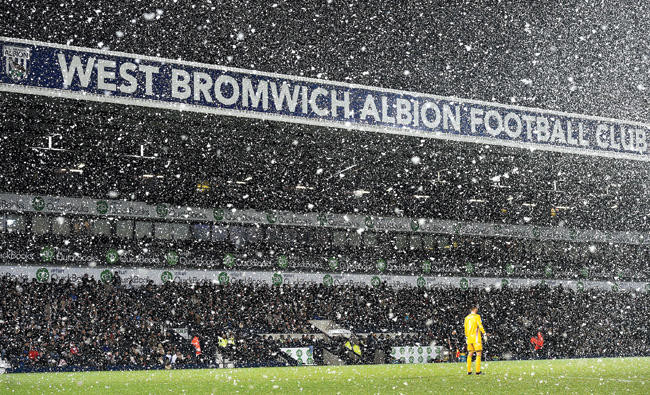
LET IT SNOW: The English top flight sees a packed festive schedule unlike most of the rest of Europe’s other major leagues. (AFP)
Updated 25 December 2017
Follow

Premier League’s winter wonderland is part of the sport’s soul

LONDON: Every time England go out of a major tournament early — which has been every tournament since Euro 96 — some new solution is raised. They need to be more like the Dutch. Or more like the French. Or more like the Spanish. Or more like the Germans. We need to hold the ball more. We
need to remain true to our traditional strengths. We need a quota on foreign players. Our players need to go abroad more. Recently, a new panacea has been suggested: A winter break.
Germany has a winter break and they are world champions. Spain has a winter break and they were dominant before the Germans. The Premier League, the argument runs, is uniquely tiring. Our players are exhausted by the time they get to a major tournament. If they have a break midway through the season, it would give them a chance to recover, so they could attack the World Cup or the European Championship refreshed.
It is an appealing argument. After all, numerous coaches have blamed the wearying nature of England’s top flight — more competitive, fewer easy games, a more aggressive, physically demanding style of football — for the relative underperformance of English clubs in European
competition over the past few seasons. There is some — although not unanimous — medical evidence that players would be less susceptible to injury with a couple of weeks off.
Set against that is the fact that for many fans, Christmas football is the best football. Crowds are bigger and infused with festive spirit. Because so many people in the UK go back to their family homes for the festive season, games become annual reunions with old friends, people who perhaps live on the other side of the world who you see once a year.
Football in Britain has always had a community aspect and this is perhaps the strongest remaining example of that.
This is a subjective point, I realize, but for me one of the joys of English football is the range of conditions as the seasons pass, from the bright optimism of August to the sun-drenched despair or joy of May, through the dark and misty nights of the autumn and the collective breath of the crowd steaming in the crisp air of December and January. To take away the Christmas programme would be to remove a large part of what soul English football has left — and frankly, if that is tough on players, they are well enough remunerated to deal with
it. Nobody these days is expected to play through a quagmire or on a frozen surface that might directly contribute to injury.
And then there are the practical considerations. Give clubs a break and would the players really rest? Or would they be flogged around the world for a series of money-spinning friendlies? The English calendar is packed anyway: Where would the games go? Do we really want a shorter summer break with the season beginning in July? Much of English football’s wealth is derived from broadcast rights: Would
television companies really accept a blank couple of weeks in December or January?
And would it, anyway, really work? After all, there was no winter break when English clubs dominated European competition between 1977 and 1984, or between 2005 and 2012. Has the game really changed so much in five or six years? If anything the trend has been the increasing power of the super-clubs and, for a whole host of socio-economic reasons, the Premier League big six, powerful as they
are, are not quite as powerful as Barcelona and Real Madrid.
But what about the national team? What about the examples of Germany and Spain? Well, yes, but what about Italy, who have a winter break but have not even qualified for the next World Cup. What about all those years before 2008 when Spain had a winter break and won nothing.
Short-term correlation is not cause. And besides, the nature of modern football is that plenty of non-English players play in the Premier League. Was Mesut Ozil any less effective in 2014 for the want of a winter break?
The winter break has become a fetish, an easy answer to a more difficult question of English underachievement. There is very little evidence it would do any good, and the cost to the game’s soul would be enormous. Jingle on.


Own goal enough for Al-Ahli as Matchday 24 win keeps pressure on Al-Nassr

Updated 27 February 2026
Follow

Own goal enough for Al-Ahli as Matchday 24 win keeps pressure on Al-Nassr

  • Al-Ahli eke out 1-0 win over Al-Riyadh to keep pressure on Al-Nassr
  • Milan Borjan own goal separated the sides at Prince Faisal bin Fahd Stadium

RIYADH: Matchday 24 of the Saudi Pro League kicked off on Thursday, less than 24 hours after the conclusion of the delayed Matchday 10. With the FIFA Arab Cup, World Cup Qualifiers and FIFA World Cup sandwiching the 2025/26 campaign, resting periods have been few and far between outside the international breaks.

With fixtures coming thick and fast, Al-Ahli opted to rest Riyad Mahrez and Enzo Millot for their clash with Al-Riyadh in the capital. Ramadan has further challenged the league schedule, with Matthias Jaissle’s side only arriving in Riyadh at 5:30pm — just hours before kick-off.

With their previous outing against Damac still dominating conversation, Jaissle was keen to ensure his players did not fall into the same trap — namely, being caught off guard by an opponent’s unexpectedly proactive style.

To his relief, Al-Ahli were largely in control this time. Yet the absence of Mahrez limited their creative spark. Relying heavily on Wenderson Galeno down the left, Al-Riyadh did well to crowd the Brazilian and deny him space to operate.

The bane of any expansive side is a compact 5-4-1, and that is precisely how Al-Riyadh’s recently appointed Brazilian manager Mauricio Dulac set his team up. A long-time assistant to former Al-Riyadh coach Odair Hellmann, this marks Dulac’s first managerial role.

Al-Ahli’s attacking routes were severely restricted throughout the first half. Al-Riyadh denied them the opportunity to press high, Mahrez’s trademark diagonals were absent, and finding Ivan Toney in the six-yard box proved a difficult task.

On the rare occasions the visitors broke the defensive line, Milan Borjan stood firm in goal — there was no getting past the Canadian.

That was until first-half stoppage time. Al-Ahli had one more weapon in their arsenal: set-pieces. A lofted delivery from Galeno’s free-kick met the head of Roger Ibañez, who nodded the ball towards goal. Borjan pushed it away, but it was too late — the ball crossed the line.

VAR intervened within seconds. Ibañez was a shoulder offside, and the opener was chalked off. It was a notable twist, particulary as the simultaneous fixture between Al-Fateh and Damac in Al-Ahsa featured a celebration aimed squarely at Al-Ahli and VAR.

Earlier in the week, Damac equalised late against Al-Ahli via Yakou Méïté, only for the goal to be overturned. Méïté reacted angrily and lashed out at referees, but Al-Ahli escaped with the three points. Méïté followed up with a goal against Al-Fateh, and celebrated by mimicking the referee’s VAR signal.

Back in Riyadh, Al-Ahli returned for the second half with renewed intensity. Zakaria Hawsawi grew more adventurous from left-back, threading lofted balls over the Al-Riyadh defence.

In the 53rd minute, he found Toney behind the last defender, but the Englishman’s volley was adeptly saved by Borjan. Five minutes later, Galeno latched onto Hawsawi’s cross and thought he had broken the deadlock — only for the linesman’s flag to rise once again.

Al-Ahli pushed, but as time ticked away, it seemed the coveted winner would elude them. However, once again, set pieces proved decisive.

In the 75th minute, a corner from Saleh Abu Al-Shamat was parried by Borjan, only for his effort to be bundled into his own net, sending the travelling supporters into a frenzy.

After last week’s scare, Al-Ahli knew they had to finish the job. Cue Ibañez, who surged forward from deep before slipping the ball through to Toney to seal the game with what would have been his 24th goal of the season. The run itself deserved a goal, but Toney was flagged inches offside.

Despite another difficult outing, Al-Ahli did enough to secure a clean sheet and grind out a 1-0 victory to move top on 59 points — one ahead of Al-Nassr, who are yet to play this weekend.

Elsewhere, Méïté’s equaliser was later cancelled out by a 77th-minute Mourad Batna penalty, in a match that saw fans commemorate him for surpassing 100 goal contributions with Al-Fateh.

Batna had earlier missed from the spot to the frustation of the home fans, but Al-Fateh’s undefeated streak against Damac at home remains intact as the encounter ended 1-1.

Saudi Pro League action resumes on Friday, with Al-Hazem hosting Al-Ettifaq, Al-Ittihad welcoming Al-Khaleej, and one of Riyadh’s top derbies in Al-Shabab and Al-Hilal. All games kick-off at 10:00pm, in the league’s unified Ramadan schedule.