Philippines’ Duterte’s son quits as vice mayor of hometown Davao

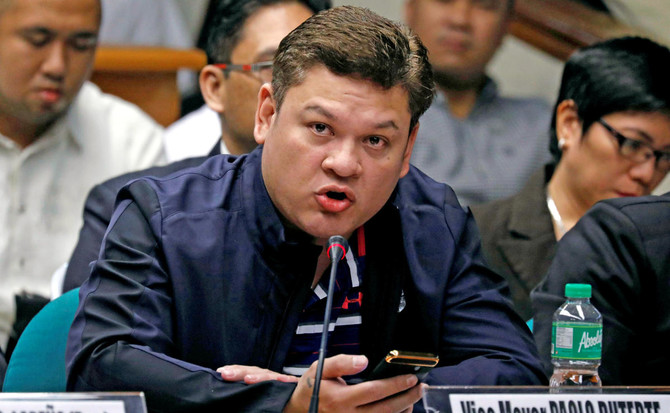
This file photo shows Paolo Duterte, Davao’s Vice Mayor and son of President Rodrigo Duterte, testifies at a Senate hearing on drug smuggling in Pasay, Metro Manila, Philippines, Sept.7, 2017. (REUTERS)
Updated 25 December 2017
Follow

Philippines’ Duterte’s son quits as vice mayor of hometown Davao

MANILA: Philippine President Rodrigo Duterte’s eldest son quit as vice mayor of the southern city of Davao on Monday, citing his being linked to a drug smuggling case by opponents and personal problems from a failed marriage as reasons for the move.
Paolo Duterte announced his resignation during a special session of the Davao City Council. Davao is President Duterte’s hometown and its mayor is Paolo’s younger sister, Sara Duterte-Carpio.
“There are recent unfortunate events in my life that are closely tied to my failed first marriage,” the vice mayor said, in a statement made available to media.
“These, among others, include the maligning of my reputation in the recent name dropping incident in the Bureau of Customs’ smuggling case and the very public squabble with my daughter.”
Paolo testified at a senate investigation in September into a seized shipment of around $125 million worth of narcotics from China after opponents of the president, who has instigated a fierce crackdown on the drugs trade, said they believe his son may have helped ease the entry of the shipment at the port in Manila, the Philippine capital. Paolo has denied any involvement.
More recently, he has been involved in an online spat with Isabelle, his 15-year-old daughter from his first wife. Paolo has called her “embarrassing” on Facebook after she complained on Twitter about being treated badly by her father.
The president’s office, the mayor’s office and other members of Paolo’s family did not immediately respond to Reuters’ requests for comments.
($1 = 50.0630 Philippine pesos)


Trump administration expands ICE authority to detain refugees

Updated 2 sec ago
Follow

Trump administration expands ICE authority to detain refugees

  • Under US law, refugees must apply for lawful permanent resident status one year after their arrival in the country
WASHINGTON: The Trump administration has given immigration officers broader powers to detain legal refugees awaiting a green card to ensure they are “re-vetted,” an apparent expansion of ​the president’s wide-ranging crackdown on legal and illegal immigration, according to a government memo.
The US Department of Homeland Security, in a memo dated February 18 and submitted in a federal court filing, said refugees must return to government custody for “inspection and examination” a year after their admission into the United States.
“This detain-and-inspect requirement ensures that refugees are re-vetted after one year, aligns post-admission vetting with that ‌applied to ‌other applicants for admission, and promotes public ​safety,” ‌the ⁠department said ​in ⁠the memo.
Under US law, refugees must apply for lawful permanent resident status one year after their arrival in the country. The new memo authorizes immigration authorities to detain individuals for the duration of the re-inspection process.
The new policy is a shift from the earlier 2010 memorandum, which stated that failure to obtain lawful permanent resident status ⁠was not a “basis” for removal from the country ‌and not a “proper basis” for ‌detention.
The DHS did not respond to ​a Reuters request for comment outside ‌regular business hours.
The decision has prompted criticism from refugee advocacy groups.
AfghanEvac’s ‌president Shawn VanDiver called the directive “a reckless reversal of long-standing policy” and said it “breaks faith with people the United States lawfully admitted and promised protection.”
HIAS, formerly known as the Hebrew Immigrant Aid Society, said the “move ‌will cause grave harm to thousands of people who were welcomed to the United States after ⁠fleeing violence ⁠and persecution.” Under President Donald Trump, the number of people in ICE detention reached about 68,000 this month, up about 75 percent from when he took office last year.
Trump’s hard-line immigration agenda was a potent campaign issue that helped him win the 2024 election.
A US judge in January temporarily blocked a recently announced Trump administration policy targeting the roughly 5,600 lawful refugees in Minnesota who are awaiting green cards.
In a written ruling, US District Judge John Tunheim in Minneapolis said federal agents likely violated multiple federal statutes by ​arresting some of these refugees ​to subject them to additional vetting.