PRETORIA: South Africa’s President Jacob Zuma challenged on Friday a court ruling which ordered him to launch a legal probe into corruption allegations against him, according to legal documents.
The North Gauteng High Court last week ordered Zuma to appoint a judicial inquiry within 30 days to investigate graft allegations that have dogged him and his associates in recent years.
It said the country’s chief justice, not Zuma, should choose a judge to preside over the inquiry to avoid a conflict of interest.
But in court papers seen by local media on Friday, Zuma’s lawyers challenged the order on 20 grounds, arguing that it “offends the separation of powers doctrine” which governs the relationship between the executive and the judiciary.
In its ruling last week, the court also reprimanded the president for being “seriously reckless” by defying the recommendations of the country’s graft watchdog which proposed the judicial inquiry.
Judge Dunstan Mlambo said the watchdog had “uncovered worrying levels of malfeasance and corruption” and yet Zuma was “delaying the resolution” of the allegations.
He also ruled that Zuma should personally pay the litigation costs, including one in which he had sought to halt the publication last year of the graft watchdog’s scathing report linking him to the wealthy Gupta family.
The Indian-origin business family is accused of having undue power over Zuma’s government, including influence over the appointment of some Cabinet ministers.
Zuma had tried to block the publication of the report arguing that he had not been granted enough time to respond to the allegations.
He stepped down this week as president of the ruling African National Congress (ANC) party after a 10 year term marked by numerous damning court judgments against him.
Zuma was succeeded by his deputy Cyril Ramaphosa in a tightly fought contest in which his former wife Nkosazana Dlamini-Zuma also ran.
He is due to resign as state president after general elections in 2019.
The main opposition Democratic Alliance party said Zuma is “simply playing for time” so that “evidence can be destroyed” before he appoints the commission of inquiry.


Zuma challenges SA court over graft inquiry order
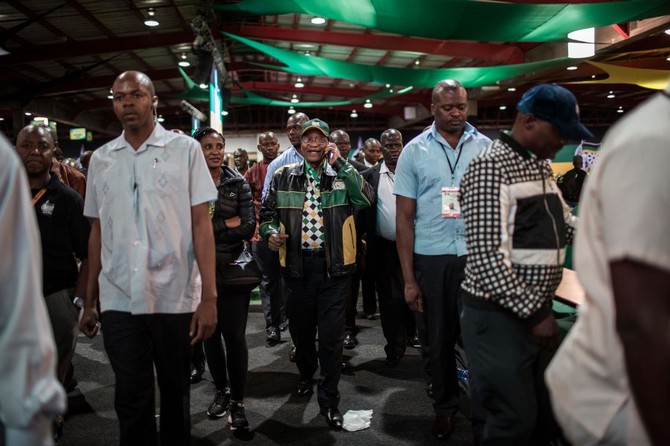
Zuma challenges SA court over graft inquiry order

WHO warns of health risks from ‘black rain’ in Iran
- “The black rain and the acidic rain coming with it is indeed a danger for the population, respiratory mainly,” WHO spokesperson Christian Lindmeier told a press briefing in Geneva, adding that Iran had advised people to stay indoors
GENEVA: The World Health Organization warned on Tuesday that the “black rain” falling in Iran after strikes on oil facilities could cause respiratory problems, and it backed Iran’s advisory urging people to remain indoors.
The UN health agency, which has an office in Iran and works with authorities on health emergencies, said it has received multiple reports of oil-laden rain this week.
HIGHLIGHT
Tehran was choked in black smoke on Monday after an oil refinery was hit, in an escalation in strikes on Iran’s domestic energy supplies as part of the US-Israeli campaign.
Tehran was choked in black smoke on Monday after an oil refinery was hit, in an escalation in strikes on Iran’s domestic energy supplies as part of the US-Israeli campaign.
“The black rain and the acidic rain coming with it is indeed a danger for the population, respiratory mainly,” WHO spokesperson Christian Lindmeier told a press briefing in Geneva, adding that Iran had advised people to stay indoors.
Asked whether the WHO backed that advice, he said: “Given what is at risk right now, the oil storage facilities, the refineries that have been struck, triggering fires, bringing serious air quality concerns, that is definitely a good idea.”
One video sent to Reuters by a WHO staff member showed what they said was a cleaner mopping up black liquid at its office entrance in Tehran on March 8.


