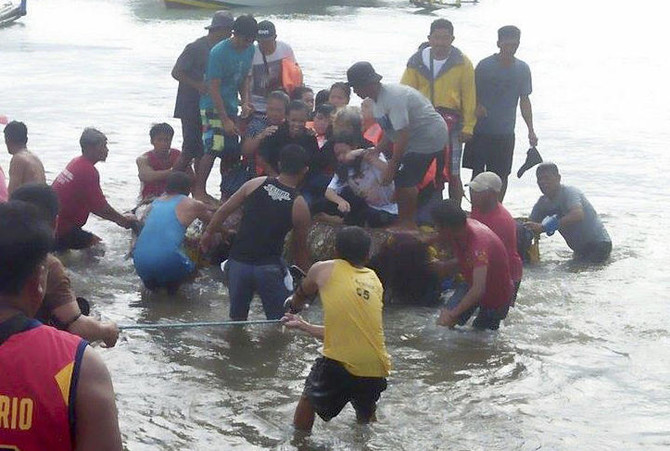
MANILA: Four people died, 217 were rescued and 30 are missing after a passenger vessel capsized off Infanta, Quezon near Manila on Thursday, Navy Commander Commodore Adeluis Bordado told Arab News.
The MV Mercraft III reportedly left the port of Real, Quezon at around 8.30 a.m. en route to Polilio Island.
After an hour’s travel the ferry encountered large waves, and capsized near Barangay Dinahican in Infanta town at around 11.30 a.m.
The vessel has a capacity of 286 passengers. At the time of the incident, it was carrying 251 people. The coast guard and navy search-and-rescue teams were immediately dispatched to the area.
Bordado said search-and-rescue operations were called off at around 4.00 p.m. due to rough sea conditions.
In the wake of the incident, Sen. Grace Poe is urging the creation of the National Transportation Safety Board (NTSB) to ensure better safety standards to prevent disasters.
“The first order of the day is the immediate rescue of the passengers from the capsized ship,” she said.
“Rescue teams with adequate equipment should be deployed at once to ensure all lives are saved.” Authorities should investigate whether the cause was natural or man-made, Poe said.

4 dead, 30 missing after passenger vessel capsizes in Philippines
Portugal far-right hopeful enters vote as favorite
LISBON: A far-right candidate in Portugal’s presidential election, Andre Ventura, has emerged as the favorite for Sunday’s first round of voting, according to polls.
But regardless of whom the president of the Chega (“Enough“) party encounters in the second-round runoff in February, he has very little chance of carrying the day to succeed conservative incumbent Marcelo Rebelo de Sousa.
Some polls point to a second-round duel between Ventura and Socialist Antonio Jose Seguro, while others suggest that Luis Marques Mendes, who has the support of conservative Prime Minister Luis Montenegro, could make the run-off.
Among the 11 candidates, a record number, two others also stand a chance to win a spot in the second round. They are Henrique Gouveia e Melo, a retired admiral who led Portugal’s vaccination campaign during the Covid epidemic, and Joao Cotrim Figueiredo, a liberal member of the European Parliament.
While Ventura’s chances of moving past the first round are slim, the election marks an important step in his electoral fortunes that have improved at lightning pace since he founded Chega in 2019.
His party, highly centered on its leader, won 22.8 percent of the vote and 60 seats in a general election in May of last year, turning it into the biggest opposition party.
The head of state’s role in Portugal is mostly ceremonial, although the president has the power in times of crisis to dissolve parliament, call elections or dismiss the prime minister.
Ventura has expressed his desire to eventually run the country as prime minister, with experts saying that he sees Sunday’s vote mainly as a test of his popularity.
“Andre Ventura is running to keep his voter base,” said Antonio Costa Pinto, a political scientist at Lisbon University. “There could be a surprise increase,” he told AFP.
A stronger far right would add pressure on the minority government of Montenegro who relies on Chega for support for the implementation of some of his policies.
Portugal, a country of nearly 11 million inhabitants, is a member of the European Union and the eurozone. It accounts for around 1.6 percent of the EU’s gross domestic product (GDP).
But regardless of whom the president of the Chega (“Enough“) party encounters in the second-round runoff in February, he has very little chance of carrying the day to succeed conservative incumbent Marcelo Rebelo de Sousa.
Some polls point to a second-round duel between Ventura and Socialist Antonio Jose Seguro, while others suggest that Luis Marques Mendes, who has the support of conservative Prime Minister Luis Montenegro, could make the run-off.
Among the 11 candidates, a record number, two others also stand a chance to win a spot in the second round. They are Henrique Gouveia e Melo, a retired admiral who led Portugal’s vaccination campaign during the Covid epidemic, and Joao Cotrim Figueiredo, a liberal member of the European Parliament.
While Ventura’s chances of moving past the first round are slim, the election marks an important step in his electoral fortunes that have improved at lightning pace since he founded Chega in 2019.
His party, highly centered on its leader, won 22.8 percent of the vote and 60 seats in a general election in May of last year, turning it into the biggest opposition party.
The head of state’s role in Portugal is mostly ceremonial, although the president has the power in times of crisis to dissolve parliament, call elections or dismiss the prime minister.
Ventura has expressed his desire to eventually run the country as prime minister, with experts saying that he sees Sunday’s vote mainly as a test of his popularity.
“Andre Ventura is running to keep his voter base,” said Antonio Costa Pinto, a political scientist at Lisbon University. “There could be a surprise increase,” he told AFP.
A stronger far right would add pressure on the minority government of Montenegro who relies on Chega for support for the implementation of some of his policies.
Portugal, a country of nearly 11 million inhabitants, is a member of the European Union and the eurozone. It accounts for around 1.6 percent of the EU’s gross domestic product (GDP).
© 2026 SAUDI RESEARCH & PUBLISHING COMPANY, All Rights Reserved And subject to Terms of Use Agreement.