Baby panda makes press debut at Japan zoo

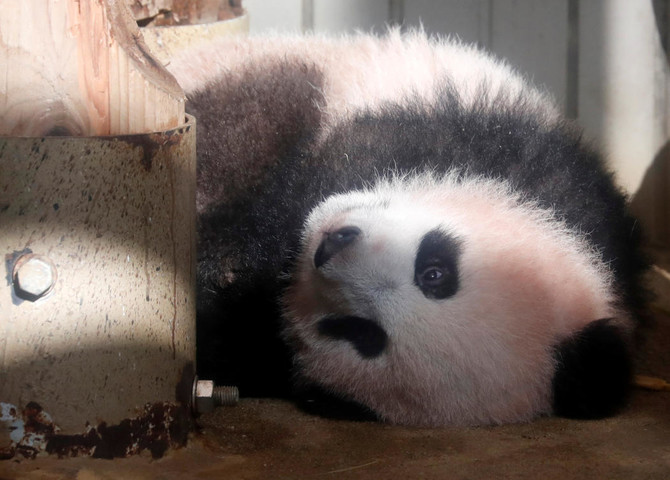
A baby panda Xiang Xiang, born from mother panda Shin Shin on June 12, 2017, is seen during a press preview ahead of the public debut at Ueno Zoological Gardens in Tokyo, Japan December 18, 2017. (Reuters)
Updated 18 December 2017
Follow

Baby panda makes press debut at Japan zoo

TOKYO: A baby panda born six months ago made its debut before the cameras in Japan Monday, a day before a doting public gets an eagerly-awaited glimpse of the cuddly animal.
The panda named Xiang Xiang — derived from the Chinese character for “fragrance” — has sparked a media frenzy since its birth on June 12 at Tokyo’s Ueno Zoo.
Broadcasters aired live footage of the cub nimbly climbing a tree and chomping on bamboo in a special cage.
Along with local schoolchildren, selected media were permitted to watch and film the panda through a glass shield.
The public will get their first chance to see Xiang Xiang on Tuesday, the zoo’s first baby panda exhibition since 1988.
“Xiang Xiang has been thriving with the loving nurturing by mum Shin Shin,” Tokyo Governor Yuriko Koike said at a ceremony, describing the baby as “a new treasure of Tokyo.”
The panda cub weighs 12.3 kilos (27 pounds) and is the size of a medium-sized dog, zoo officials said, adding that it is in good health.
In order to reduce stress on the panda and avoid crowds, the zoo will limit the maximum number of visitors to 2,000 a day for a one- to two-minute slot until the end of January.
The zoo received nearly 250,000 applications for a lottery to see Xiang Xiang.
For avid panda fans who miss out, the zoo will offer a live stream of Xiang Xiang’s daily life from Tuesday for a year.

Mum Shin Shin, which mated with Ri Ri in February, had previously given birth in 2012 — the zoo’s first panda delivery in 24 years — only for the cub to die from pneumonia six days later.
Zookeepers have since given the adult pandas some private space in a bid to create an environment for the bashful creatures to mate successfully — a notoriously difficult process.
Until recently considered an endangered species, it is estimated that around 2,000 giant pandas remain in the wild, in three provinces in central China.


Cambodia takes back looted historic artifacts handled by British art dealer

Updated 28 February 2026
Follow

Cambodia takes back looted historic artifacts handled by British art dealer

  • The objects were returned under a 2020 agreement between the Ministry of Culture and Fine Arts and the family of the late Douglas Latchford, a British art collector and dealer who allegedly had the items smuggled out of Cambodia

PHNOM PENH, Cambodia: Cambodian officials on Friday received more than six dozen historic artifacts described as part of the country’s cultural heritage that had been looted during decades of war and instability.
At a ceremony attended by Deputy Prime Minister Hun Many, the 74 items were unveiled at the National Museum in Phnom Penh after their repatriation from the United Kingdom.
The objects were returned under a 2020 agreement between the Ministry of Culture and Fine Arts and the family of the late Douglas Latchford, a British art collector and dealer who allegedly had the items smuggled out of Cambodia.
“This substantial restitution represents one of the most important returns of Khmer cultural heritage in recent years, following major repatriations in 2021 and 2023 from the same collection,” the Culture Ministry said in a statement. “It marks a significant step forward in Cambodia’s continued efforts to recover, preserve, and restore its ancestral legacy for future generations.”
The artifacts were described as dating from the pre-Angkorian period through the height of the Angkor Empire, including “monumental sandstone sculptures, refined bronze works, and significant ritual objects.” The Angkor Empire, which extended from the ninth to the 15th century, is best known for the Angkor Wat archaeological site, the nation’s biggest tourist attraction.
Latchford was a prominent antiquities dealer who allegedly orchestrated an operation to sell looted Cambodian sculptures on the international market.
From 1970 to the 1980s, during Cambodia’s civil wars and the communist Khmer Rouge ‘s brutal reign, organized looting networks sent artifacts to Latchford, who then sold them to Western collectors, dealers, and institutions. These pieces were often physically damaged, having been pried off temple walls or other structures by the looters.
Latchford was indicted in a New York federal court in 2019 on charges including wire fraud and conspiracy. He died in 2020, aged 88, before he could be extradited to face charges.
Cambodia, like neighboring Thailand, has benefited from a trend in recent decades involving the repatriation of art and archaeological treasures. These include ancient Asian artworks as well as pieces lost or stolen during turmoil in places such as Syria, Iraq and Nazi-occupied Europe. New York’s Metropolitan Museum of Art is one of the prominent institutions that has been returning illegally smuggled art, including to Cambodia.
“The ancient artifacts created and preserved by our ancestors are now being returned to Cambodia, bringing warmth and joy, following the country’s return to peace,” said Hun Many, who is the younger brother of Prime Minister Hun Manet.