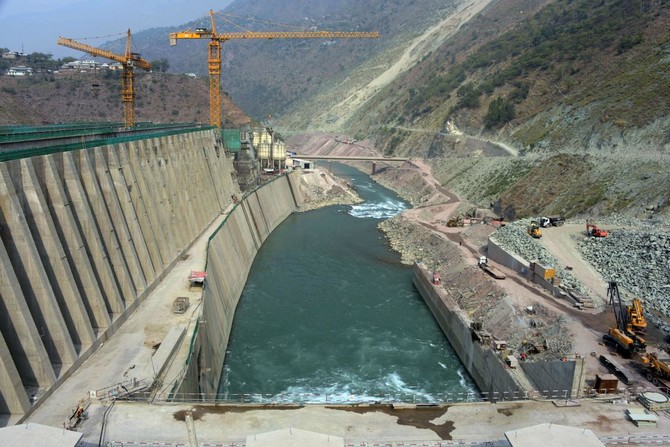
MUZAFFARABAD: Several hundred meters underground, thousands of laborers grind away day and night on a mammoth hydroelectric project in contested Kashmir, where India and Pakistan are racing to tap the subcontinent’s diminishing freshwater supplies.
The arch rivals have been building duelling power plants along the banks of the turquoise Neelum River for years.
The two projects, located on opposite sides of the Line of Control — the de facto border in Kashmir — are now close to completion, fueling tensions between the neighbors with Pakistan particularly worried their downstream project will be deprived of much-needed water by India.
The Himalayan region of Kashmir is at the heart of a 70-year conflict between the nuclear-armed foes, with both sides laying claim to the conflict-riven territory.
The rivalry on the Neelum is underlined by both countries’ unquenchable need for freshwater, as their surging populations and developing economies continue to stress already diminished waters tables.
This situation represents a serious challenge to Pakistan’s food security and long-term growth, its central bank recently warned in a report.
The geography of the wider region only exacerbates the problem.
The Indus River — into which the waters of the Neelum ultimately flow — is one of the longest on the continent, cutting through ultra-sensitive borders in the region.
It rises in Tibet, crosses Kashmir and waters 65 percent of Pakistan’s territory, including the vast, fertile plains of Punjab province — the country’s bread basket — before flowing into the Indian Ocean.
The Indus Water Treaty, painfully ratified in 1960 under the auspices of the World Bank, theoretically regulates water allocation between the countries and is considered a rare diplomatic success story amid a bitter history.
It provides India with access to three eastern rivers (the Beas, Ravi and Sutlej) and Pakistan with three in the west (the Indus, Chenab and Jhelum), while setting the conditions for water usage.
As a tributary of the Jhelum River, the Neelum theoretically falls into Pakistan’s sphere, which launched the Neelum-Jhelum power plant project a quarter of a century ago to counter the legal, but competing Kishanganga project in Indian Kashmir.
At the confluence of the Neelum and Jhelum, the gigantic underground cathedral of concrete and steel is near completion — the four generators are in place, waiting for the transformers and the network to be connected.
More than 6,000 Pakistani and Chinese workers busy themselves in the 28 kilometers (17 miles) of underground tunnels or in the power station itself, buried under 400 meters of rock in the heart of the Himalayas.
After completion, the dam is expected to churn out 969 MW of electricity by mid-2018.
“It is a fantastic feeling to see the outcome of such a historic project,” enthused Arif Shah, an engineer working on the site for eight years.
“We hope to finish our hydroelectric plant before the Indians,” he smiles, while acknowledging that the real pressure comes from Islamabad, which has promised to end the debilitating power cuts nationwide ahead of the the 2018 elections.
On the Indian side, the Kishanganga power station is also in its final phase, but has delayed its late 2017 completion date, according to an official, in part because of ongoing unrest in the Kashmir valley.
Pakistan has filed cases at the World Bank against India and the Neelum dam, which it says will unfairly restrict the amount of water headed downstream.
According to the plant’s director Nayyar Aluddin, the production of electricity could shrink by 10-13 percent because of the Indian project.
But the hydroelectric projects on the Neelum River are only one of several points of friction between the two countries as the Indus Treaty faces increasingly pressing disputes.
Beyond the technical bickering, Islamabad is especially afraid of India cutting into its precious water supplies during strategic agricultural seasons that are key to feeding the country’s 207 million residents.
The possibility of hitting Pakistan’s food supply is regularly amped up by both Indian and Pakistani media, stretching perennially taut relations.
India’s Prime Minister Narendra Modi hinted at such reprisals following an attack in Indian Kashmir blamed on Pakistani insurgents in September 2016.
“Blood and water can’t flow together,” he said.
However, a blockade of any significant magnitude is not really technically feasible, while neither party has seriously sought to challenge the Treaty of the Indus.
“The disputes over the barrages are mostly symptoms of poor bilateral relationships,” said Gareth Price, a researcher at Chatham House.
The problem is that the rival countries conceive water as a zero-sum game — if one taps the resource, it means they are lost to the other.
But Islamabad must do its part, wrote Neil Buhne, UN coordinator in Pakistan, in an op-ed calling for the country to diversify “its water resources” while reigning in inefficiencies that wastes water.


![]()
In Kashmir, Pakistan and India race to tap the Himalayas with hydroelectric projects
In Kashmir, Pakistan and India race to tap the Himalayas with hydroelectric projects


Latest updates





© 2026 SAUDI RESEARCH & PUBLISHING COMPANY, All Rights Reserved And subject to Terms of Use Agreement.