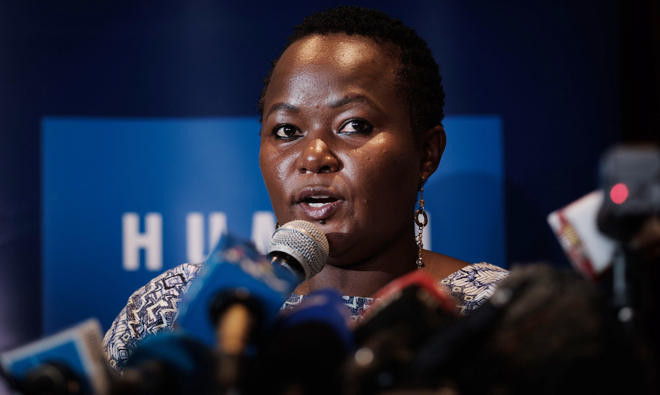
KAMPALA: Kenya’s opposition leader was targeted in a virulent online campaign created by a US-based company during the recent election turmoil, a privacy watchdog said Thursday, while another rights group reported multiple gang-rapes by men in uniform in opposition strongholds.
The reports highlight the volatility of the months during which the Supreme Court nullified the re-election of President Uhuru Kenyatta and ordered a new vote that opposition leader Raila Odinga boycotted and Kenyatta won. Anger remains high among Odinga supporters; scores were killed in clashes with security forces.
The data-driven social media campaigns allegedly created by Texas-based Harris Media contributed to one of the most divisive votes in the East African nation’s history, the London-based Privacy International said. One campaign attacked Odinga and the other praised Kenyatta, both on behalf of the president’s re-election campaign.
The campaign against Odinga included a claim that he would “remove whole tribes” if elected, the report said. Voting in Kenya is often along ethnic lines, and previous elections have led to deadly violence.
The social media campaigns “relied on ad words in Google search and apparently targeted advertising on a range of social media platforms,” the report said. “This raises serious concerns about the role and responsibility of companies working for political campaigns in Kenya’s volatile political climate ... It also highlights the risks inherent to voter profiling and micro-targeting in a country with no data protection laws.”
The report does not allege any crime was committed. Harris Media did not claim responsibility for the campaigns, the report said. The company did not immediately respond to a request for comment.
The separate report by Human Rights Watch described rapes of men and women and cited victims and witnesses in the slums of the capital, Nairobi, and the opposition strongholds of Kisumu and Bungoma.
“Some were raped in the presence of family members, including young children,” the report said. “Most women said they were raped by policemen or men in uniform, many of whom carried guns, batons, tear gas canisters, whips, and wore helmets and other anti-riot gear.”
In at least one case a girl died after being raped, said Human Rights Watch, which accused Kenya’s government of often ignoring election-related sexual violence.
Kenya’s police chief Joseph Boinnet rejected the allegations in the report as “utter falsehoods” and challenged Human Rights Watch to produce evidence.

Rapes, other new allegations in Kenya’s election unrest
Mexico and El Salvador make big cocaine seizures at sea as US continues lethal strikes
MEXICO CITY: The navies of El Salvador and Mexico announced drug seizures in the Pacific Ocean this week of more than 10 tons of cocaine, in contrast to deadly strikes by the US government that just this week left 11 people dead on three boats suspected of carrying drugs in Latin American waters.
The latest announcement came Thursday, when Mexico said it had seized nearly four tons of suspected drugs and detained three people from a semisubmersible craft, 250 nautical miles (463 kilometers) south of the port of Manzanillo.
Mexican Security Secretary Omar García Harfuch said via X that the seizure from the sleek, low-riding boat with three visible motors brought the weekly total to nearly 10 tons, but he did not provide detail on the other seizures.
Mexican authorities said the seizure was made with intelligence shared US Northern Command and the US Joint Interagency Task Force South.
On Sunday, El Salvador’s navy announced the largest drug seizure in the country’s history of 6.6 tons of cocaine. The navy had intercepted a 180-foot boat registered to Tanzania, 380 miles (611 kilometers) southwest of the coast. Navy divers found 330 packages of cocaine hidden in the boat’s ballast tanks. Ten men were arrested from Colombia, Nicaragua, Panama and Ecuador.
On Thursday, Salvadoran authorities gave access to the seized ship FMS Eagle, which had just arrived in the port of La Union. More than 200 wrapped bundles were lined up on the deck.
The Trump administration has pressured Mexico to make more drug seizures over the past year. The trafficking of drugs like fentanyl was the president’s justification for tariffs on Mexican imports.
Mexican President Claudia Sheinbaum has responded with a more aggressive stance toward drug cartels than her predecessor, that has included sending dozens of drug trafficking prisoners to the United States for prosecution.
Sheinbaum has also expressed her disagreement with strikes by the US military in the Caribbean Sea and Pacific Ocean against boats suspected of carrying drugs.
At least 145 people have been killed in those strikes since the US government began targeting those it calls “narcoterrorists” last September.
The US strikes this week included two vessels carrying four people each in the eastern Pacific Ocean and another boat in the Caribbean carrying three people. The administration provided images of the boats being destroyed, but not evidence they were carrying drugs.
The latest announcement came Thursday, when Mexico said it had seized nearly four tons of suspected drugs and detained three people from a semisubmersible craft, 250 nautical miles (463 kilometers) south of the port of Manzanillo.
Mexican Security Secretary Omar García Harfuch said via X that the seizure from the sleek, low-riding boat with three visible motors brought the weekly total to nearly 10 tons, but he did not provide detail on the other seizures.
Mexican authorities said the seizure was made with intelligence shared US Northern Command and the US Joint Interagency Task Force South.
On Sunday, El Salvador’s navy announced the largest drug seizure in the country’s history of 6.6 tons of cocaine. The navy had intercepted a 180-foot boat registered to Tanzania, 380 miles (611 kilometers) southwest of the coast. Navy divers found 330 packages of cocaine hidden in the boat’s ballast tanks. Ten men were arrested from Colombia, Nicaragua, Panama and Ecuador.
On Thursday, Salvadoran authorities gave access to the seized ship FMS Eagle, which had just arrived in the port of La Union. More than 200 wrapped bundles were lined up on the deck.
The Trump administration has pressured Mexico to make more drug seizures over the past year. The trafficking of drugs like fentanyl was the president’s justification for tariffs on Mexican imports.
Mexican President Claudia Sheinbaum has responded with a more aggressive stance toward drug cartels than her predecessor, that has included sending dozens of drug trafficking prisoners to the United States for prosecution.
Sheinbaum has also expressed her disagreement with strikes by the US military in the Caribbean Sea and Pacific Ocean against boats suspected of carrying drugs.
At least 145 people have been killed in those strikes since the US government began targeting those it calls “narcoterrorists” last September.
The US strikes this week included two vessels carrying four people each in the eastern Pacific Ocean and another boat in the Caribbean carrying three people. The administration provided images of the boats being destroyed, but not evidence they were carrying drugs.
© 2026 SAUDI RESEARCH & PUBLISHING COMPANY, All Rights Reserved And subject to Terms of Use Agreement.