

US provides proof of Iran arming Houthis

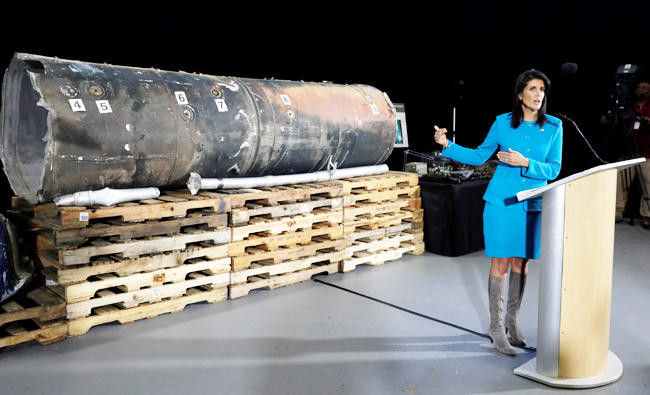
US Ambassador to the United Nations Nikki Haley briefs the media in front of remains of Iranian "Qiam" ballistic missile provided by Pentagon at Joint Base Anacostia-Bolling in Washington. (Reuters)
Updated 15 December 2017
Follow

US provides proof of Iran arming Houthis

JEDDAH: The US envoy to the UN, Nikki Haley, on Thursday unveiled declassified evidence that Iran is violating international law by funneling missiles to Houthi militias in Yemen.

The evidence included segments of missiles launched at Saudi Arabia from Houthi-controlled territory in Yemen. She displayed the missile parts in a hangar at a military base in Washington.

Haley said the parts bear markings showing that they originate in Iran, and have technical specifications that are specific to Iranian-manufactured weapons.

She said it was proof of “blatant violations” of UN Security Council resolutions while the international community was “looking the other way” because of the nuclear deal.

The US will “build a coalition to really push back against Iran and what they’re doing,” Haley told a news conference.

Pentagon spokeswoman Laura Seal said: “The US has long believed that Iran is providing weaponry to proxies and partners and militias throughout the region, and what we have here to show you today is proof.”

Saudi Arabia and the UAE had recovered the arms and loaned them to Washington, she added.

The unprecedented presentation by the Pentagon is part of its follow-through on President Donald Trump’s new Iran policy, which promises a far harder line toward Tehran.

Katie Wheelbarger, principal deputy assistant secretary of defense for international security affairs, said there could be implications of an accumulation of evidence against Iran.

“You could see future sanctions... but the first step is at least to bring awareness and understanding, and to have a similar picture of what we’re looking at,” Wheelbarger was quoted as saying by The Associated Press.

The Pentagon offered a detailed explanation of all the reasons why it believed the arms came from Iran, noting Iranian corporate logos on arms fragments and the unique nature of the designs of Iranian weaponry.

That included the designs of short-range Qiam ballistic missiles. The Pentagon said it had obtained fragments of two Qiam missiles, one fired on Nov. 4 and another on July 22.

The Pentagon cited corporate logos of Iranian defense firms on jet vanes that help steer the missile’s engine, and on the circuit board that helps drive its guidance system. It said the missile’s unique valve design is only found in Iran.

Tehran, the Pentagon said, appeared to have tried to cover up the shipment by disassembling the missile for transport, given the crude welding used to stitch it back together.

“The point of this entire display is that only Iran makes this missile. They haven’t given it to anybody else,” Seal said. “We haven’t seen this in the hands of anyone else except Iran and the Houthis.”

Earlier in the day, UN Secretary-General Antonio Guterres warned that Iran may be defying a UN call to halt ballistic missile development.

He said in a report to the Security Council that the UN is investigating Iran’s possible transfer of ballistic missiles to Houthi militias in Yemen that may have been used in launches aimed at Saudi Arabia on July 22 and Nov. 4.

The report on implementation of a UN resolution that endorsed the July 2015 nuclear deal was obtained Wednesday by AP.

In the report, Guterres said the UN is studying debris from missiles fired at Yanbu in Saudi Arabia on July 22 and at Riyadh on Nov. 4, and is reviewing other information.

He said France, Germany, Britain and the US sent a letter saying the Simorgh Space Launch Vehicle that Iran launched on July 27, if configured as a ballistic missile, is “inherently capable of delivering nuclear weapons.”

Saudi Arabia welcomed the UN report and US stand on Iran’s weapons supplies to the Houthis.

The Kingdom demanded immediate action to implement UN Security Council resolutions and hold Iran accountable for its actions, the Saudi Press Agency (SPA) reported.

"Iran's support for Houthi terrorist militias constitutes a flagrant violation of UN Security Council Resolutions No. 2216 and No. 2231, and has disrupted the political process and prolonged the crisis in Yemen," said an official statement on the Saudi Press Agency.

"Saudi Arabia calls upon the international community to take immediate action to implement the above-mentioned UN Security Council resolutions and to hold the Iranian regime accountable for its aggressive actions," the statement said. "Saudi Arabia reiterates the need to tighten the UN Verification and Inspection Mechanism (UNVIM) to prevent smuggling."

Gerald Feierstein, former US ambassador to Yemen and director for Gulf affairs and government relations at the Middle East Institute, told Arab News: “The fact that Iran has provided the Houthis with materiel support as well as training and assistance for at least the past five years is well-established.

“But providing the Houthis with the means to threaten major Saudi and perhaps Emirati population centers with missile attacks marks a serious escalation in the Yemen civil war, and reflects the desire of the Houthis and their Iranian patrons to draw Saudi Arabia more deeply into the conflict and regionalize it.”

Feierstein added: “The international community needs to redouble its efforts to prevent the flow of arms and support from Iran to the Houthis in order to bring this conflict to an end.”

 

Ramadan brings a season of grief after an Israeli strike wiped out most of a Gaza family

Updated 4 sec ago
Follow

Ramadan brings a season of grief after an Israeli strike wiped out most of a Gaza family

  • In the Gaza Strip, Ramadan has become a season when wartime losses hit especially deep for the many families grieving loved ones killed by Israeli forces
GAZA CITY, Gaza Strip: As the sun sets, Saddam Al-Yazji, his wife and their daughter sip a noodle soup, breaking their daily Ramadan fast in Gaza City. They sit around a folding table set up in the dirt at the foot of a towering pile of rubble, twisted metal and concrete slabs that was once their home.
Buried under the debris are the bodies of much of their family.
The three are virtually the family’s only survivors. Al-Yazji’s parents, his three brothers and his sister, along with most of their children, and his wife’s parents and siblings — 40 relatives in total — were all killed in a single strike when Israeli forces bombed the house in December 2023.
The Islamic holy month of Ramadan is traditionally a time for family, with large, festive gatherings for iftar, the sunset meal that ends the daily fast. In the Gaza Strip, it has become a season when wartime losses hit especially deep for the many families grieving loved ones killed by Israeli forces, which have been fighting Hamas for more than two years.
“I look at photos of our gatherings in Ramadan and cry,” the 35-year-old Al-Yazji said. “Where is my family? All are wiped out.”
“It’s the third Ramadan without them.”
Family once had large Ramadan meals
During Ramadans before the war, Al-Yazji’s father, Kamel Al-Yazji, brought all his children and grandchildren together for iftar around a large table piled with meat and rice and other dishes, recalled Saddam’s wife, Heba Al-Yazji.
Ramadan, when Muslims fast from dawn to dusk, is a month dedicated to religious reflection and worship. It also builds community, with the giving of charity.
The elder Al-Yazji was a former judge with the Palestinian Authority and a well-known sports figure in Gaza, serving as chairman of the Palestinian Athletics Federation. Saddam Al-Yazji earned a living running a supermarket on the ground floor of the four-story family home in Gaza City’s Rimal neighborhood.
The airstrike came only a few months into the ferocious Israeli bombardment that was launched after the Hamas-led attack on southern Israel in October 2023. The house was leveled on top of everyone inside.
“We were in the same house, in other part of the house,” Saddam Al-Yazji said. “We survived miraculously.”
The only other survivors were the daughter and the pregnant wife of one of his brothers. Among the dead were 22 children.
Some of the bodies were retrieved at the time. One of Al-Yazji’s brothers is buried in a grave marked with sticks at the foot of the destroyed house. Around 20 relatives remain buried under the rubble.
After the strike, the couple and their daughter, 11-year-old Maryam, lived in a tent elsewhere in Gaza City for much of the war. During the previous two Ramadans, they tried as much as possible to come visit the rubble of their home and have iftar there.
When a ceasefire deal came into effect in October, the three moved to a tent next to their old home.
“Life is empty,” Heba Al-Yazji said. “The war took everything from me. We wish we had died with them rather than remain alone.”
Most families feel a loss
Throughout the war, Israel has struck homes and tent camps sheltering Palestinians, often killing large numbers of families at once. Israel says it targets Hamas militants, though it rarely says who were the specific targets.
Israel’s campaign has killed more than 72,000 people, nearly half of them women and children, according to the Gaza Health Ministry. The ministry, which is part of the Hamas-led government, maintains detailed casualty records seen as generally reliable by UN agencies and independent experts, though it does not give a breakdown of civilians and militants.
Around 8,000 more are still buried under the rubble of destroyed homes, according to the ministry. Retrieving most of those bodies was out of the question when airstrikes and ground assaults were raging. Under the ceasefire, recovery efforts have increased, though they are still hampered by a lack of heavy equipment.
The Israeli campaign was triggered by the Hamas attack that killed some 1,200 people in Israel and took more than 250 others hostage. The hostages have been released, mostly as part of ceasefire agreements.
Almost everyone in Gaza has lost at least extended family members. Nearly the entire population of 2.1 million is homeless, with most living in vast tent camps. More than 80 percent of the strip’s buildings have been damaged or destroyed.
A landscape of rubble that was once the Rimal district extended all around the small Ramadan table where the three surviving Al-Yazjis ate their meal.
Saddam Al-Yazji recalled the “great dining table” of his family’s past Ramadan gatherings and how they all looked forward to it every year.
“I feel like I have betrayed them by being alive,” he said.