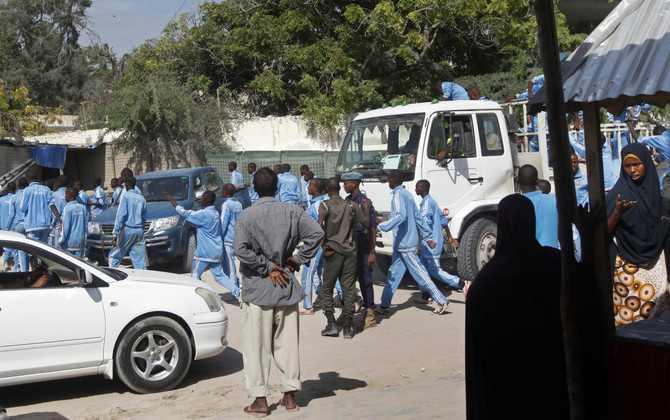
MOGADISHU: A suicide bomber disguised as a policeman blew himself up inside a police training camp in Somalia’s capital Mogadishu on Thursday and killed at least 18 officers, officials said.
Police spokesman Maj. Mohamed Hussein said the attacker strapped explosives to his body and infiltrated the General Kahiye Police Training Academy during an early morning parade.
“Police were preparing for the 74th anniversary of police day. As they wanted to start exercise, a suicide bomber came in and blew up himself. We lost 18 police officers and 15 others were injured,” Muktar Hussein Afrah, Somalia’s deputy police commander, told reporters at the blast scene.
“Police will always continue their work despite death.”
Police earlier put the death toll at 15.
Reuters witnesses who attempted to visit the site of the blast said police had sealed it off. Hours later when they were allowed in, a witness saw body parts suspected to be from the bomber on the ground in the field where police officers had been training.
The witness said the ground nearby had also been washed to remove blood stains and people were burying bodies at the police academy.
The militant group Al-Shabab claimed responsibility for the attack and gave a higher death toll.
“We killed 27 police (officers) and injured more,” Abdiasis Abu Musab, the group’s military operations spokesman, told Reuters. Al-Shabab carries out frequent bombings in Mogadishu and other towns.
The group, which is allied to Al-Qaeda, is waging an insurgency against the UN-backed government and its African Union (AU) allies in a bid to topple the weak administration.
The militants were driven out of Mogadishu in 2011 and have since been steadily losing territory to the combined forces of AU peacekeepers and Somali security forces.
On Tuesday, the US Africom said the US military had conducted an air strike on a vehicle they said was strapped with explosives some 65km southwest of Mogadishu.
Thursday’s attack comes at a time when the AU is finalizing plans to trim its peacekeeping mission called AMISOM.
The 22,000-strong AU force is scheduled to leave by 2020 and some security experts say Al-Shabab could find it easier to stage attacks as the peacekeeping forces are reduced because government forces will find it hard to replicate their work.
At the same time, Somalia could become a safe haven for militants linked to Al-Qaeda currently in Yemen, the experts said.
The peacekeepers were deployed to help secure a government that has struggled to establish central control in a country that plunged into civil war in the early 1990s.


18 police officers killed in Somalia suicide bomb attack
18 police officers killed in Somalia suicide bomb attack


Hungary to release 1.8 million barrels of crude oil from strategic reserves
- Croatia’s JANAF pipeline operator, however, said there was no need for Budapest to tap its reserves
- Hungary and Slovakia have been trying to secure supply since flows were halted on January 27
BUDAPEST: Hungary’s government will release about 1.8 million barrels of crude oil from its strategic reserves after a drone attack on the Druzhba pipeline late last month stopped oil flow, according to a government decree published late on Thursday.
Croatia’s JANAF pipeline operator, however, said there was no need for Budapest to tap its reserves after Hungary’s oil company MOL said on Friday JANAF must allow transit of Russian seaborne oil to Hungary and Slovakia during the Druzhba outage.
“At this moment, a significant quantity of non-Russian crude oil is being transported via JANAF’s pipeline for MOL Group, while three additional tankers carrying non-Russian oil, also for MOL Group, are on their way to the Omisalj Terminal,” JANAF said in a statement.
“There was no need to tap into (their) reserves since oil transport via the JANAF pipeline toward MOL’s refineries is being carried out continuously and without delays.”
Hungary and Slovakia, which have the only remaining refineries in the EU using Russian oil through Druzhba, have been trying to secure supply since flows were halted on January 27 following what Ukraine said was a Russian drone attack that damaged pipeline infrastructure.
Both countries have blamed Ukraine for the delay in restarting the flows for political reasons.
SCRAMBLE FOR CRUDE SUPPLIES
MOL is entitled to priority access to released crude oil reserves, and it will have access to the freed reserves until April 15 and has to return them by August 24, the Hungarian government decree said.
At the end of January, Hungary had enough crude oil and petroleum product reserves to cover 96 days, according to data on the Hungarian Hydrocarbon Stockpiling Association’s website.
As the two countries scramble to ensure supplies, MOL ordered tankers delivering Saudi, Norwegian, Kazakh, Libyan and Russian oil to supply its Hungarian and Slovak refineries and halted diesel deliveries to Ukraine earlier this week.
MOL said that first shipments were expected to arrive at the port of Omisalj in Croatia in early March. After that, it will take a further 5-12 days for the crude oil to reach its refineries.
The Slovak government has also declared an oil emergency situation and has pledged to release 1.825 million barrels of oil following a request from Slovakia’s Slovnaft refinery, which is owned by MOL.


