JERUSALEM: Pedestrians walk on a thick layer of soot from tires set ablaze in frequent clashes with Israeli troops. Cars navigate around potholes in streets littered with garbage. Motorists honk in a traffic jam near an Israeli checkpoint that is framed by the towering cement slabs of Israel’s separation barrier.
It’s morning rush hour in Ras Khamis, a neglected, restive Arab neighborhood of Jerusalem where President Donald Trump’s recent recognition of the contested city as Israel’s capital has been met by cynicism, defiance and new fears that Palestinians will increasingly be marginalized.
Trump’s pivot on Jerusalem “is regrettable, saddening and unfair,” said Yasser Khatib, 42, who runs a supermarket across the street from the barrier that separates several Arab neighborhoods of Jerusalem from the rest of the city.
Khatib said he has strong religious ties to the city and that his family’s roots go back generations. “We have no life without Jerusalem,” he said as he sold snacks to school children. “Trump can say whatever he wants.”
Palestinians make up 37 percent of Jerusalem’s population of 866,000, up from 26 percent in 1967 when Israel captured east Jerusalem, expanded the city’s boundaries into the West Bank and annexed the enlarged municipal area to its capital.
The international community says east Jerusalem is occupied territory and that the city’s fate must be determined in negotiations with the Palestinians who seek a capital in the eastern sector.
Trump couched his Jerusalem comments — viewed in the Arab world as a show of pro-Israel bias — by saying he is not taking a position on the boundaries of Israeli sovereignty in the city.
Yet he made no specific mention of the city’s large Palestinian population, which could reach 44 percent by 2040, according to the Jerusalem Institute for Policy Research think tank.
Despite Israel’s portrayal of Jerusalem as united, there are stark differences between Arab and Jewish areas after what critics say is half a century of neglect and discrimination.
“On the ground, Israel is not investing much in developing the Arab neighborhoods of Jerusalem,” said Yitzhak Reiter, in charge of the Jerusalem Institute’s mapping of the physical and social infrastructure of Arab neighborhoods.
In many spheres, “the city is still divided, with two different transport systems, two different policies on building and construction.”
Israel would have to invest billions of dollars in Arab areas to reach parity with Jewish neighborhoods, he said.
For now, 79 percent of Arab residents fall below the poverty line, compared to 27 percent of Jews, according to Jerusalem Institute figures.
Welfare services maintain four offices in the Arab east, compared to 19 offices in Jewish areas, said the Association for Civil Rights in Israel. Arab schools have a shortage of hundreds of classrooms, ACRI said. The west has 34 post offices, compared to nine in the east.
Mayor Nir Barkat’s office said he developed a plan “unprecedented in scope and budget allocation to reduce gaps in east Jerusalem” and made progress in alleviating “50 years of neglect” inherited from predecessors. Among other things, the city opened more than 800 classrooms in Arab schools, with 1,000 more in the pipeline, the statement said.
ACRI said the added classrooms included many spaces rented in existing residential buildings.
Jerusalem is the largest mixed city in the Holy Land, and Arabs and Jews interact in daily life, including in malls and hospitals. Many Palestinians work in shops and restaurants in west Jerusalem, typically earning more there than on the east side.
Yet east-west infrastructure gaps remain wide.
Israel may be unwilling to invest heavily in areas that could one day come under Palestinian rule, said Reiter, adding that efforts to maintain a strong Jewish majority may also play a role.
Palestinians claim Israel is trying to drive Arabs out of Jerusalem.
Ziad Hammouri, a community organizer, said Trump’s new position on Jerusalem boosts Israel’s attempts to “control east Jerusalem and to exclude Palestinians from Jerusalem.”
One plan floated by a Cabinet minister — and opposed by Barkat — would place tens of thousands of Palestinians who live inside the municipal boundaries but beyond the separation barrier under a new Israeli-run municipality, thus sharply reducing the number of Palestinians counted as Jerusalemites.
These areas, including Ras Khamis, have seen apartment towers rise in recent years as Israel stopped enforcing building restrictions there.
East Jerusalemites desperate for housing moved there in large numbers, despite fears that they would eventually be “zoned out” of Jerusalem.
On the “Jerusalem side” of the barrier, it’s difficult for Palestinians to obtain building permits, because of lack of outline plans or discriminatory zoning, said Israeli rights groups. Many Palestinians built without permits, and 88 homes were demolished in 2016, the most in a decade, ACRI said.
Barkat’s office said a low share of permit application come from Arab neighborhoods, and that a high percentage of those are approved.
Since 1967, Israel has built large neighborhoods for Jews in the annexed east, now home to 212,000 Israelis.
Palestinian Ismail Siam said a one-story home he built on his land for two adult children was demolished by Israel twice in 14 months, on grounds that he did not have a building permit.
“They want to expel us from the city,” said Siam, 54, standing near patches of floor tiles left from the demolished house.
The plot faces large construction sites for Jewish neighborhoods across a ravine.
Most Palestinians in Jerusalem have residency status.
After 1967, most Palestinians didn’t consider the more secure citizenship option, which would have meant recognizing Israeli rule. In recent years, growing numbers have applied, but increasingly encountered bureaucratic hurdles.
Prolonged absence can put Palestinian residents at risk of expulsion; close to 15,000 have been stripped of residency rights since 1967.
Palestinians in the city can vote in local elections, but have largely refrained from doing so, to avoid the perception that they accept Israeli rule.
East Jerusalem residents also feel increasingly abandoned by Palestinian President Mahmoud Abbas’s West Bank self-rule government. Israel clamps down on Palestinian Authority activities in Jerusalem, limiting Abbas’ influence in the city.
The leadership vacuum was briefly filled over the summer when Muslim clerics led a successful grassroots campaign against metal detectors Israel had installed at east Jerusalem’s Al-Aqsa Mosque compound. Islam’s third-holiest shrine, built on the remnants of Judaism’s holiest site, is a frequent flashpoint of violence.
After Trump’s decision, city residents mounted only small protests, compared to larger marches in the West Bank and elsewhere.
Activist Yara Hawari said rallying large crowds is difficult when there is no narrow objective, such as removing the metal detectors.
“What we are asking is simple, an end to colonization,” she said. “But it’s not as tangible.”


![]()
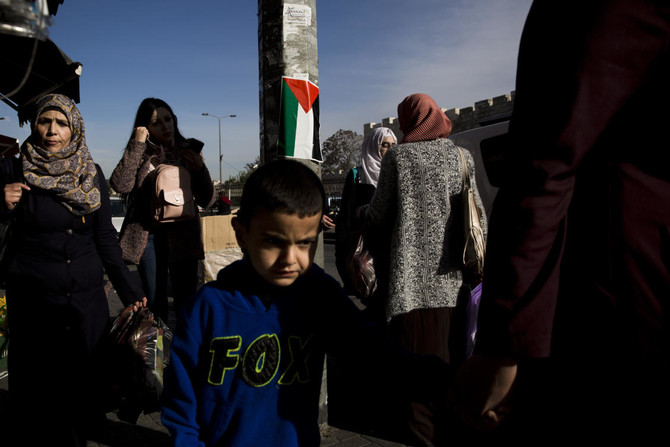
Palestinians, a large Jerusalem minority, feel Trump snub
Palestinians, a large Jerusalem minority, feel Trump snub
Latest updates




© 2026 SAUDI RESEARCH & PUBLISHING COMPANY, All Rights Reserved And subject to Terms of Use Agreement.