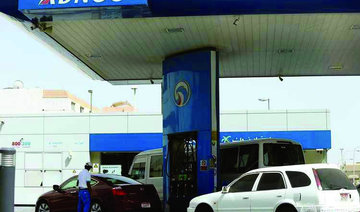
ABU DHABI: Investor interest was strong Wednesday as Abu Dhabi’s state energy company listed a stake in its retail distribution arm, the first time the emirate has sold shares in one of its oil firms.
The Abu Dhabi National Oil Company said it had raised $845 million by floating 10 percent of its subsidiary ADNOC Distribution, a landmark share offering as Gulf energy firms open up to outside investments.
The initial public offering price for the shares was at 2.5 dirhams (68 US cents) and by 9:15 a.m. GMT they were trading at 73 cents.
ADNOC said the IPO brought the subsidiary’s market capitalization to $8.5 billion, making it the fourth-largest firm on the Abu Dhabi Securities Exchange.
The statement said the IPO was oversubscribed several times and that 90 percent of the shares were sold to institutional investors, a third of them international, and the rest to individual investors.
Abu Dhabi, the UAE capital which holds more than 90 percent of the country’s 98 billion barrels of crude reserves, has never before offered public shares in one of its oil companies.
Hit hard by the sharp drop in oil prices, energy-dependent Gulf states have resorted to a string of reforms including hiking fuel and power prices, imposing taxes and selling off part of their strategic assets to raise funds.
Neighboring oil kingpin Saudi Arabia is planning to eventually float up to 5 percent of its national oil company Aramco, in what many expect would be the biggest IPO in history.
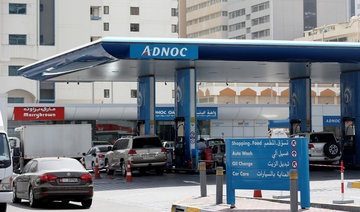
With 360 fuel stations and more than 235 stores, ADNOC Distribution is the UAE’s largest operator of petrol stations and the sole retail fuel operator in the emirates of Abu Dhabi and Sharjah.
“We were extremely pleased with the demand for this landmark IPO. We received substantial interest from the international investment community, as well as an overwhelming response from investors in the UAE,” ADNOC CEO Sultan Al-Jaber said in the statement.
Established in 1973, ADNOC Distribution posted net profits of $485 million in 2016.
ADNOC has recently renewed concession rights and offered new joint ventures to a number of international oil companies as it bids to raise UAE output to 3.5 million barrels per day next year, from the current 3.2 million bpd.

Strong interest as UAE oil giant lists retail arm
Egypt’s annual inflation falls to 10.3% in December: CAMPAS
RIYADH: Egypt’s annual headline inflation rate slowed sharply to 10.3 percent in December, down from 23.4 percent in the same month a year earlier, official data showed.
According to the Central Agency for Public Mobilization and Statistics, the overall consumer price index reached 264.2 points in December. On a monthly basis, inflation rose marginally by 0.1 percent.
CAPMAS attributed the annual deceleration primarily to a decline in food prices, including a 1.1 percent drop in meat and poultry, 1.2 percent in dairy, cheese and eggs, 1 percent in fruits, 2 percent in vegetables, and 0.1 percent in sugar and sugary products.
Prices of household appliances, audio-visual equipment and information technology devices also declined by 0.5 percent and 0.4 percent, respectively.
However, other categories recorded increases, including grains and bread by 0.1 percent, oils and fats by 0.3 percent, and beverages such as coffee, tea and cocoa by 0.1 percent.
Month-on-month inflation showed limited movement, with food and beverage prices falling by 0.8 percent due to similar declines in meat, dairy, fruit and vegetable prices. In contrast, modest cost increases were recorded in grains, oils and beverages.
Alcohol and tobacco prices rose by 0.2 percent, while clothing and footwear increased by 0.7 percent, driven by higher prices for fabrics, up 1.6 percent, ready-made garments, up 0.4 percent, and footwear, up 1.6 percent.
Housing and utilities recorded an increase of 1.5 percent, reflecting a 1.9 percent rise in actual rents, a 1.6 percent increase in electricity, gas and other fuels, and a 0.5 percent rise in maintenance costs.
Furniture and household equipment prices climbed 0.9 percent, while healthcare rose by 0.5 percent, led by outpatient services, up 1 percent, and hospital services, up 1.8 percent. Transport costs increased by 0.2 percent, and recreational and cultural services rose by 0.6 percent, including a 1.5 percent increase in organized travel.
Annual inflation data showed a broad-based increase across most sectors. Food and beverages rose by 0.9 percent year on year, with fruits up 22.6 percent, despite a 4.1 percent decline in meat and poultry and a 4.8 percent drop in vegetables.
Alcohol and tobacco prices jumped 18.2 percent, while clothing and footwear climbed 14 percent. Housing and utilities surged 22.5 percent, largely due to higher rents and energy prices.
Healthcare recorded one of the highest annual increases at 23.9 percent, driven by a 28.9 percent rise in medical equipment prices and a 21 percent increase in hospital services. Transport costs rose by 21.1 percent, education by 10 percent, and restaurants and hotels by 13 percent.
The category of miscellaneous goods and services registered a 12.2 percent annual increase, with personal care products rising 13 percent and personal belongings up 27.2 percent.