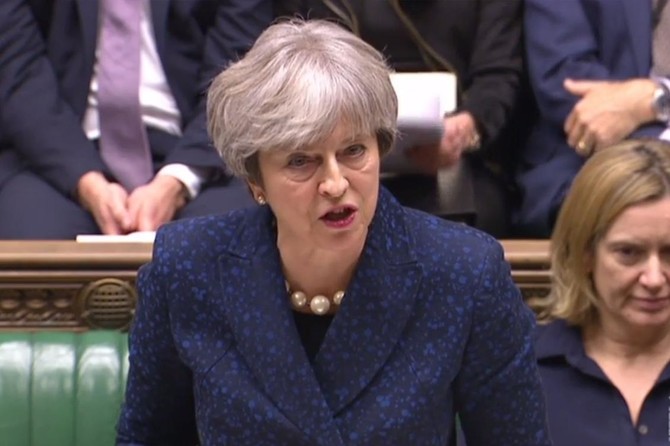
LONDON: UK Prime Minister Theresa May and her Kurdish counterpart Nechirvan Barzani discussed a range of issues Tuesday morning, including the September referendum and the restarting of international flights into Kurdistan’s two main airports.
According to a statement from 10 Downing Street, the UK prime minister and Barzani discussed the referendum, with May saying that “the UK would continue to fight to protect the identity and rights of the Kurdish people under the Iraqi constitution.”
The prime minister’s office added that May welcomed “Barzani’s government’s recognition of the Iraqi Federal Supreme Court’s ruling that Iraq is unified and indivisible.”
The non-binding referendum on the independence of Kurdistan took place on Sept. 25, resulting in 93 percent support for independence. Its legality was however rejected by the government of Iraq, and led to retaliatory measures such as the closure of Kurdistan’s Irbil and Sulaimaniya airports to international flights.
According to May’s office, the two leaders also discussed a resumption of international flights to the two airports. “They both said that they hoped to see progress on this soon,” it added.
Previous to the September referendum, airlines such as Dubai’s Emirates and Flydubai, along with European carriers Lufthansa and Austrian Airlines flew direct to Irbil Airport. A Flydubai spokesperson told Arab News via email that “flights to Irbil have been temporarily suspended. Passengers booked on a flight between Sept. 30, 2017 and March 24, 2018 can rebook on a flight to another destination in Iraq or receive a refund to the original form of payment. For flights after this date further updates will be provided nearer the time.”
In the phone call May discussed the UK’s determination to see reform in Iraq. She “underlined the UK’s continued support for the Kurdistan region and Kurdish people within a unified Iraq, while urging continued reform in the political, economic and security sectors to strengthen Kurdistan’s institutions and deliver for the Kurdish people,” Downing Street said.
May also said that “she would be pleased to see Prime Minister Barzani in London in due course to make further progress on these matters.” Her office confirmed to Arab News that no official visit to the UK by Barzani is currently planned.

Theresa May backs unified Iraq in call to Kurdish PM
China FM tells EU diplomats not to blame Beijing for bloc’s problems
BEIJING: China’s foreign minister told his French and German counterparts that Beijing was not to blame for Europe’s economic and security problems as he pushed for more cooperation at a summit in Munich, a foreign ministry statement said Saturday.
Wang Yi made the comments at a meeting with France’s Jean-Noel Barrot and Germany’s Johann Wadephul on the sidelines of the Munich Security Conference on Friday.
He sought to promote China as a reliable partner of the European Union at a time when the bloc is trying to reduce its dependence on both Beijing and an increasingly unpredictable Washington.
“China’s development is an opportunity for Europe, and Europe’s challenges do not come from China,” Wang said, according to the statement.
Warning that “unilateralism, protectionism, and power politics” were on the rise globally, he said he hoped Europe would “pursue a rational and pragmatic policy toward China.”
“The two sides are partners, not adversaries; interdependence is not a risk; intertwined interests are not a threat; and open cooperation will not harm security.”
The meeting came against the backdrop of trade tensions between the two giant economies and disputes over what the EU sees as China’s support for Russia’s war in Ukraine.
The EU is seeking to cut its reliance on China for strategic goods like rare earths while also rebalancing a trade relationship that sees it run a large deficit with the world’s second-largest economy.
In recent years, the two sides have clashed over Chinese electric-vehicle exports, which threaten Europe’s car industry and which Brussels argues are based on unfair subsidies, and Chinese tariffs on EU goods ranging from cheese to cognac.
Wang urged Germany and France to help “give a clear direction for the development of China-Europe relations.”
In a separate meeting with Wadephul — also on Friday — Wang touted economic and trade cooperation as “the cornerstone of China-Germany ties,” according to a foreign ministry readout.
Wang also met Britain’s foreign minister Yvette Cooper, telling her that Beijing and London should “explore more potential for cooperation,” while the two sides also discussed Ukraine and Iran.
Wang Yi made the comments at a meeting with France’s Jean-Noel Barrot and Germany’s Johann Wadephul on the sidelines of the Munich Security Conference on Friday.
He sought to promote China as a reliable partner of the European Union at a time when the bloc is trying to reduce its dependence on both Beijing and an increasingly unpredictable Washington.
“China’s development is an opportunity for Europe, and Europe’s challenges do not come from China,” Wang said, according to the statement.
Warning that “unilateralism, protectionism, and power politics” were on the rise globally, he said he hoped Europe would “pursue a rational and pragmatic policy toward China.”
“The two sides are partners, not adversaries; interdependence is not a risk; intertwined interests are not a threat; and open cooperation will not harm security.”
The meeting came against the backdrop of trade tensions between the two giant economies and disputes over what the EU sees as China’s support for Russia’s war in Ukraine.
The EU is seeking to cut its reliance on China for strategic goods like rare earths while also rebalancing a trade relationship that sees it run a large deficit with the world’s second-largest economy.
In recent years, the two sides have clashed over Chinese electric-vehicle exports, which threaten Europe’s car industry and which Brussels argues are based on unfair subsidies, and Chinese tariffs on EU goods ranging from cheese to cognac.
Wang urged Germany and France to help “give a clear direction for the development of China-Europe relations.”
In a separate meeting with Wadephul — also on Friday — Wang touted economic and trade cooperation as “the cornerstone of China-Germany ties,” according to a foreign ministry readout.
Wang also met Britain’s foreign minister Yvette Cooper, telling her that Beijing and London should “explore more potential for cooperation,” while the two sides also discussed Ukraine and Iran.
© 2026 SAUDI RESEARCH & PUBLISHING COMPANY, All Rights Reserved And subject to Terms of Use Agreement.