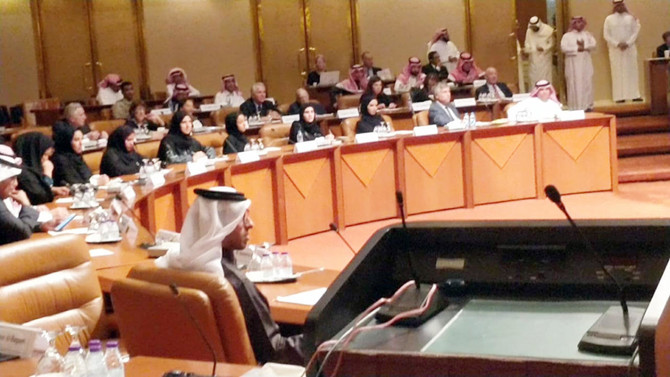
RIYADH: The Prince Saud Faisal Institute for Diplomatic Studies held a cordial discussion on Thursday about Middle East issues with a delegation from the Washington Institute for Near East Policy.
Saudi-US relations are “becoming stronger, as we’re talking about the biggest oil producer and the largest oil consumer in the world,” said Shoura Council member Dr. Raeda Abu Nayan.
“Deals signed in May during President Donald Trump’s visit are evidence of these close ties,” she added.
“Saudi Arabia has strong confidence in the US business environment, and I think the US believes in the economic reforms that Saudi Arabia is pursuing,” she said.
“Saudi Arabia has shifted from a government-led economy to a market-based one. The government believes all stakeholders should be involved (the government, the private sector, NGOs and foreign investors).”
Shoura Council member Dr. Hanan Al-Ahmadi said: “The meeting with the delegates of the Washington Institute was a great opportunity to exchange views and information on issues of mutual interest between the US and Saudi Arabia.”
She added: “Such meetings are useful to enhance communication between the people of the two countries, who have been allies for decades and have extended relations and cooperation in various fields.”
She said: “We had a very good discussion on the impact of Vision 2030 on all aspects of Saudi life, focusing on the economy, education, the role of youth, women and regional issues.”
Al-Ahmadi added: “We shed light on the achievements of Saudi women and our pride in where we are at this moment in our country’s history.”
She said: “Women represent a higher proportion of university graduates, an increasing percentage of the labor market, and are entering decision-making circles.”
She added: “The movement to improve public sector performance and counter terrorism is a relief to us, as we know that this time the government is determined to succeed.”
The Saudi delegation “emphasized the Kingdom’s role in supporting US counterterrorism efforts,” Al-Ahmadi said.
“We expressed concerns about the fact that American media doesn’t reflect accurately the Saudi role in global efforts to counter terrorism, and the long partnership between our two nations in the fight against terror.”
Shoura Council member Dr. Modi Al-Khalafi said: “We touched upon several critical topics: Social, economic and religious reforms; unacceptable Iranian involvement in the region and proxy wars resulting from it; and US-Saudi collaboration on counterterrorism.”
Many US delegates said they were impressed and surprised that Saudi women’s voices were articulated loudly, clearly and in partnership with their male colleagues.
“We’re proud of our traditional role as mothers and housewives, as it’s important for the family and society, as much as we’re proud of being working mothers,” said Abu Nayan.
“Our vision is to increase the contribution of women in the workforce from 22 to 30 percent by 2030,” she added.
“We’re breaking the glass ceiling, and we’re going to increase the percentage of women in higher positions from 1.27 now to 5 percent.”
A participant at the dialogue, Susan Wang, said she thought wearing the abaya would be constricting, but “I’m surprised by how liberated I feel wearing it.”
Abu Nayan replied: “We’re proud of our abayas, and you shouldn’t judge us by what we’re wearing on our heads, but what we have in our minds.”
Al-Khalafi said: “As a Saudi woman, there’s always a lot to say about our history, challenges, achievements and hopes for the future.”
She added: “More often than not, exchanges like this, especially among knowledgeable scholars who are candid with each other, result in tangible steps that can bridge a gap or pave the way for further collaboration.”