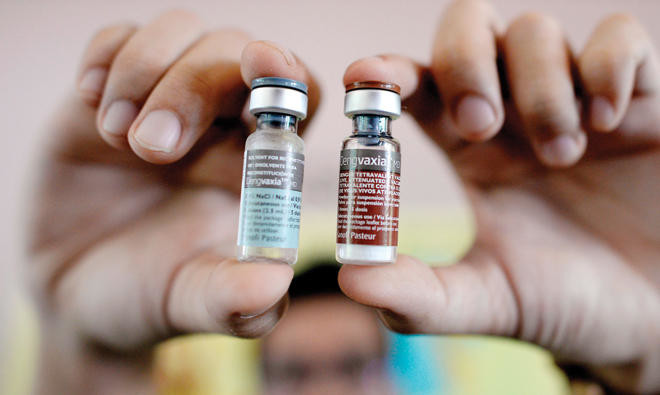
MANILA: The Philippines intends to sue Sanofi after authorities suspended the pharmaceutical giant’s anti-dengue vaccine in response to the company warning the drug could lead to severe infections in some cases, the health secretary said Thursday.
Regulators froze the Philippines’ world-first public dengue immunization program last week and suspended all sales of the vaccine on Monday after Sanofi said Dengvaxia could worsen symptoms for vaccinated people who contracted the disease for the first time.
“Eventually it’s the court of law that is going to decide in so far as the liability of Sanofi is concerned,” Health Secretary Francisco Duque said on ABS-CBN television
The previous administration of president Benigno Aquino launched the vaccination program last year, making the Philippines the first nation to use Dengvaxia on a mass scale.
About 830,000 schoolchildren had received at least one dose of the vaccine, Duque said on Thursday. Previously the government said more than 733,000 people had been vaccinated.
Sanofi’s announcement last week caused great concern in the Philippines — where the mosquito-born disease is extremely prevalent.
The French company on Monday sought to allay concerns, saying Dengvaxia would not cause anyone who was immunized to die and would not cause a dengue infection.
However, Duque said Thursday Sanofi’s recent statements on Dengvaxia were “confusing.”
Duque said he may ask Sanofi to refund 1.4 billion pesos ($27.6 million) worth of unused Dengvaxia supplies.
He added the government might also demand Sanofi set up an “indemnity fund” to cover the hospitalization cost for children vaccinated under the public program who would fall ill.
Asked if the government would sue Sanofi if allegations of a lack of transparency were proved, Duque said: “I’m sure it’s going to get there.”
He added: “If it’s found out that (Sanofi) withheld material information that would have changed the outcome of all of these problems and the decision makers of the Department of Health in the previous administration, then they are liable.”
Duque said congressional hearings into the issue would start next week.
Sanofi said Thursday it was surprised by Duque’s remarks, adding it would continue to comply with Philippine authorities’ legal directives.
“Sanofi is a responsible company that has acted according to Philippine laws and regulations for the supply and sale of the vaccine according to the approved label in the country,” the company said in a statement emailed to AFP.

Philippines plans to sue Sanofi over dengue vaccine

Russia strikes power plant, kills four in Ukraine barrage
KHARKIV: Russia battered Ukraine with more than two dozen missiles and hundreds of drones early Tuesday, killing four people and pummelling another power plant, piling more pressure on Ukraine’s brittle energy system.
An AFP journalist in the eastern Kharkiv region, where four people were killed, saw firefighters battling a fire at a postal hub and rescue workers helping survivors by lamp light in freezing temperatures.
Ukrainian President Volodymyr Zelensky said “several hundred thousand” households near Kyiv were without power after the strikes, and again called on allies to bolster his country’s air defense systems.
“The world can respond to this Russian terror with new assistance packages for Ukraine,” President Volodymyr Zelensky wrote on social media.
“Russia must come to learn that cold will not help it win the war,” he added.
Authorities in Kyiv and the surrounding region rolled out emergency power cuts in the hours after the attack, saying freezing temperatures were complicating their work.
DTEK, Ukraine’s largest energy provider, said Russian forces had struck one of its power plants, saying it was the eighth such attack since October.
The operator did not reveal which of its plants was struck, but said Russia had attacked its power plants over 220 times since Moscow invaded Ukraine in 2022.
Daily attacks
Moscow has pummelled Ukraine with daily drone and missile barrages in recent months, targeting energy infrastructure and cutting power and heating in the frigid height of winter.
The Ukrainian air force said that Tuesday’s bombardment included 25 missiles and 247 drones.
The Kharkiv governor gave the death toll and added that six people were wounded in the overnight hit outside the region’s main city, also called Kharkiv.
White helmeted emergency workers could be seen clambering through the still-smoking wreckage of a building occupied by postal company Nova Poshta, in a video posted by the regional prosecutor’s office.
Within Ukraine’s second city, Kharkiv Mayor Igor Terekhov said a Russian long-range drone struck a medical facility for children, causing a fire. No casualties were reported.
The overnight strikes hit other regions as well, including southern city Odesa.
Residential buildings, a hospital and a kindergarten were damaged, with at least five people wounded in two waves of attacks, regional governor Sergiy Lysak said.
Russia’s use last week of a nuclear-capable Oreshnik ballistic missile on Ukraine sparked condemnation from Kyiv’s allies, including Washington, which called it a “dangerous and inexplicable escalation of this war.”
Moscow on Monday said the missile hit an aviation repair factory in the Lviv region and that it was fired in response to Ukraine’s attempt to strike one of Russian President Vladimir Putin’s residences — a claim Kyiv denies and that Washington has said it does not believe happened.