KARACHI: Sardar Uzair Jan Baloch, a gang leader in Karachi’s infamous Lyari Town, and his comrade Noor Muhammad are playing football with the severed head of rival gang leader Arshad Pappu.
Pappu is taken from a posh neighborhood while partying with friends. He is tortured, tied to a car and dragged through Lyari’s narrow streets.
His corpse is thrown on a donkey cart and paraded around before it is burnt and flung into a gutter.
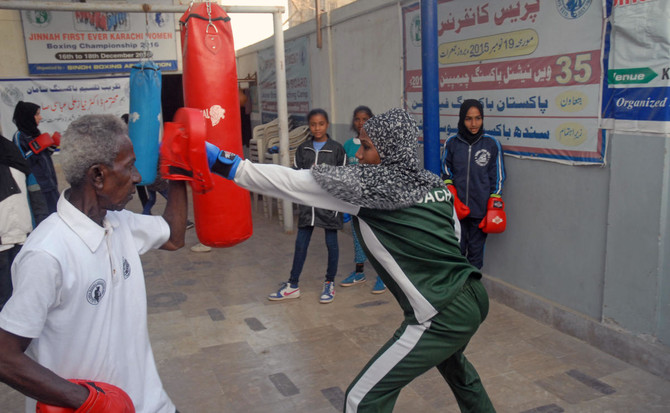
Just 1 km away from where this savagery is perpetrated, Nawab Ali Baloch, a former international boxer, is training nearly a dozen of his female family members.
“There was no concept of women boxing in Pakistan before 2013, when I started training female members of my family,” he told Arab News.
He joined the Pak National Boxing Club in 1952, but left after 20 years to pursue other employment prospects.
Yet he never stopped training boxers, and when no one was around to attend his camp due to fierce gang warfare in the town, he started training his female relatives.
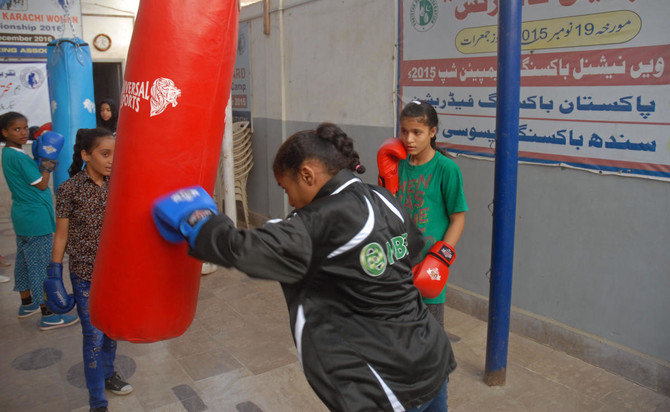
When the number of his students grew, he took them to the Young Boxing Club, where he now trains 48 females aged between 7 and 30.
His club secured eight gold and silver medals in the first boxing championship for women on Nov. 5.
“These girls have never given up. Even when the gangs were fighting, they always attended the classes on time,” he said, adding that there are four boxing clubs in Lyari.
In April 2015, a local female member of Sindh’s provincial assembly, Sania Baloch, suggested that there should be a proper focus on women’s boxing.
Asghar Baloch, general secretary of the Pakistan Boxing Association (PBA), told Arab News: “In May 2015, we announced the Women Boxing Camp in collaboration with the provincial sports department. The response was overwhelming.”
Maria Baloch, 12, has only been participating in the sport for two and a half years, but has already won seven gold medals.
“I used to watch Mohammed Ali on YouTube,” she said. “He inspired me to become a boxer.”
Recalling the challenges she faced, she added: “Although my family supported me from day one, many of my relatives talked about my passion negatively. They thought it wasn’t right for a girl.”
She said her father also opposed the idea since he thought she might get hurt. “I was taught to give equal importance to education, and I try to focus on both,” she added.
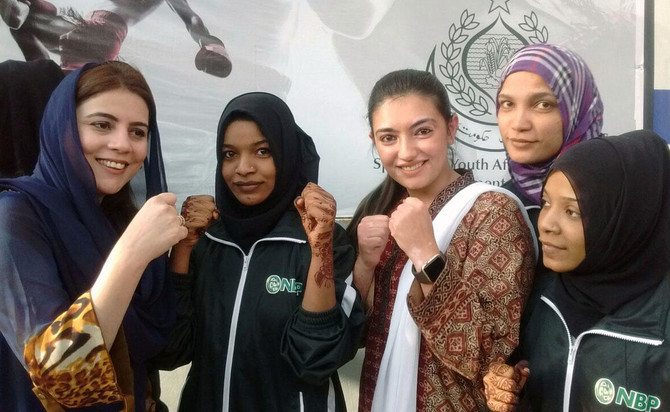
Aseefa Bhutto Zardari, daughter of Pakistan’s former Prime Minister Benazir Bhutto and the UN ambassador for polio eradication, recently visited the Young Lyari Boxing Club.
“I can’t tell you how happy she was to meet with these girls,” Naz Baloch, leader of the Pakistan People’s Party, told Arab News. “Her presence also increased the motivation of the boxers.” Zardari said she was going to provide the girls with equipment and other resources.
Maria said it was an unforgettable moment for the girls, adding: “We had attracted an important political figure to our town.”
Rauf Baloch, former president of the Karachi Boxing Association, said terrorism had caused a lot of damage to the town.
“It ended our education and destroyed our social values,” he said. “Our sports activities also came to a standstill. Fortunately, peace has now been restored to this place and good things are happening to its people.”
He added: “In the good old days, this town was known for football, boxing and other sports. It produced international players, and our clubs provided sports and ethical training to our children.
“In boxing, you get punched and you hit others. It’s not an easy game, but the way our girls are playing is simply awesome. I’m confident we’re gradually reclaiming our old Lyari.”


Lyari’s female boxers: Punching their way out of fear and taboos


Lyari’s female boxers: Punching their way out of fear and taboos

Pakistan says Indian minister initiated handshake in Dhaka, first contact since May conflict
- Pakistan’s Ayaz Sadiq and India’s Subrahmanyam Jaishankar met on the sidelines of Khaleda Zia’s funeral
- The National Assembly of Pakistan says Islamabad has consistently emphasized dialogue with New Delhi
ISLAMABAD: Pakistan said on Wednesday Indian External Affairs Minister Subrahmanyam Jaishankar initiated a brief handshake with Speaker of the National Assembly Sardar Ayaz Sadiq in Dhaka, marking the first high-level contact between the two nuclear-armed rivals since their military conflict in May.
The encounter took place on the sidelines of the funeral of former Bangladeshi prime minister Khaleda Zia, attended by senior officials and diplomats from multiple countries.
Ties between India and Pakistan have remained frozen since a four-day military confrontation in May, during which both sides exchanged missile, drone and air strikes before a ceasefire brokered by Washington.
“During Speaker NA Sardar Ayaz Sadiq’s visit to the Parliament of Bangladesh ... the Indian External Minister Dr. S. Jaishankar approached the Speaker National Assembly and [shook] hands,” Pakistan’s National Assembly said in a post on social media platform X.
It added that Jaishankar introduced himself to Sadiq during the brief interaction. India has not commented publicly on the exchange.
“It is noteworthy that Pakistan has consistently emphasized dialogue, restraint, and cooperative measures, including proposals for peace talks,” the post continued.
Tensions between the two neighbors escalated in April after a militant attack in Indian-administered Kashmir killed more than 20 tourists. New Delhi blamed Pakistan for supporting the attack, an allegation Islamabad denied, calling instead for an independent and transparent investigation.
Officials from both countries have largely avoided public interactions since the conflict, with senior figures refraining from handshakes or exchanges at international gatherings.
Sadiq was in Dhaka to attend Zia’s funeral and to convey condolences from Pakistan’s leadership and people. He also met Zia’s son Tarique Rahman, the acting chairman of the Bangladesh Nationalist Party, according to Pakistan’s high commission in Bangladesh.
Speaking to Pakistan’s Geo TV, Sadiq confirmed that Jaishankar approached him in full media glare and exchanged pleasantries.
Responding to a question about being photographed with the Indian minister, he said: “Cameras arrived with them. Our people took the photographs later.”


