ANKARA: With a newly announced roadmap that outlines the technical steps that Turkey will take for meeting EU criteria on the visa liberalization agreement, Ankara is showing its renewed commitment to the process.
The roadmap document, prepared by the Foreign, Justice, EU and Interior Ministries of Turkey, will begin to be implemented after final approval from President Recep Tayyip Erdogan. It will be presented at the EU’s foreign ministers summit in Brussels on Dec. 12.
Among the 72 criteria for visa liberalization, the introduction of biometric passports, a cooperation agreement with the EU’s police service Europol and changes to Turkey’s anti-terror law remain the most controversial areas.
In March 2016, Turkey and the EU reached an agreement, known as the “refugee deal,” to stop illegal migrants crossing into Europe through Turkish territories, in exchange for financial aid for refugees and significant trade-offs such as visa-free travel for Turkish nationals within the Schengen area as well as an acceleration in Turkey’s accession talks with the EU.
The refugee deal has led to a significant reduction in the number of illegal crossings and deaths in the Aegean Sea in recent months.
However, talks on a visa-free regime to the EU have since been delayed over a disagreement on anti-terrorism legislation and on democratic backsliding in Turkey since the failed coup attempt in July 2016.
Having witnessed an increased frequency of terror threats and acts in its territories, Ankara wants any EU-induced changes in its anti-terror law not to weaken its counterterrorism efforts.
Turkish officials have repeatedly warned Brussels that Turkey could give up its commitment to stem the flow of refugees to Europe if the EU fails to keep its promises in granting Turks visa-free travel.
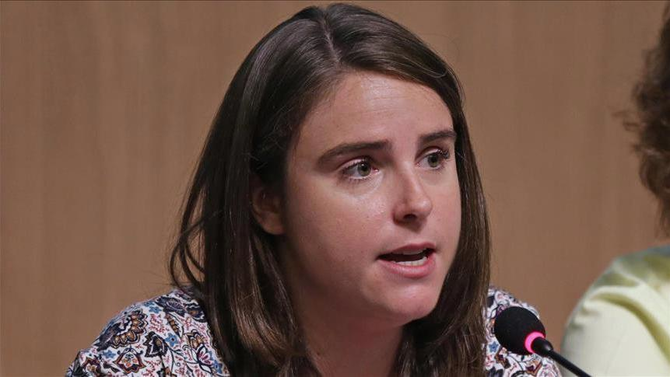
Laura Batalla, secretary-general of the European Parliament Turkey Forum, told Arab News that recently announced efforts by Ankara to meet the remaining seven criteria for visa liberalization were very welcome and encouraging.
“The revision of Turkey’s anti-terror law is of critical importance. The EU does not demand that Turkey softens its definition of terrorism but brings it into line with European norms to prevent its political instrumentalization,” Batalla told Arab News.
“Both sides need to find a mutual agreement and move forward with the talks,” she said, adding that Turkey is the only candidate country whose citizens are required to apply for a visa to enter the EU.
“Even non-candidate countries, such as Moldova, are currently negotiating the removal of the visa regime with the EU, while the Ukraine and Georgia have recently been granted visa-free travel to the EU,” Batalla said.
If Turkish citizens were finally granted free entry to the EU, Batalla noted that it would not only break down a psychological wall but help to boost EU-Turkey relations, which are at one of their lowest points ever.
Turkey applied for EU membership in 1987 and was declared eligible in 1997. Accession talks began in 2005, but the negotiations have proceeded very slowly.
Erhan Akdemir, EU expert at Anadolu University in Eskisehir, said the new roadmap shows Ankara’s commitment to re-energizing its ties with Europe.
“And now European politicians should demonstrate the will to take decisions on the much-awaited visa-free travel regime,” Akdemir told Arab News. “There is a lack of trust toward the EU in Turkey, and the European decision-makers should overcome this climate by taking reassuring steps,” he said.
Akdemir noted that Turkey-EU relations have been the victim of domestic politics on both sides in recent times.
“While the election campaigns in Turkey and Europe are over, the parties should focus on reaching a win-win situation and sticking to their commitments because it is a climate favorable for further cooperation,” he said.
Noting that Ankara and Europe have been at odds over the definition of terrorism for some time, Akdemir thinks that with the rising number of terror attacks in Europe, the EU has begun to understand Turkey’s red lines and priorities on anti-terrorism legislation, helping to overcome one of the main bottlenecks on the visa-free travel talks.


![]()
Ankara prepares new roadmap for visa-free travel to Europe
Ankara prepares new roadmap for visa-free travel to Europe


Latest updates


© 2026 SAUDI RESEARCH & PUBLISHING COMPANY, All Rights Reserved And subject to Terms of Use Agreement.