ISLAMABAD: Military experts have poured cold water on Pakistani government plans to move the army’s general headquarters from the garrison city of Rawalpindi to a proposed new Rs.100 billion ($950 million) defense complex next to the air force and navy HQs in Islamabad.
“This seems impossible because the costs are too high,” Shaukat Qadir, a security analyst and former Pakistani infantry officer, told Arab News. Even if it were a serious plan it would take years to materialize, he said.
Rahat Latif, a retired major general, said: “My information is that the GHQ is not going to be shifted from the present location.
“It requires a colossal amount of money, and it is not a joke to shift the GHQ when the country does not have enough resources to finance it.” About 2,450 acres of land acquired for the project was likely to be used for army administration and logistics, he said.
“There is no timeframe given, but this year it’s impossible,” a defense ministry official said, and even 2018 was unlikely.
Defense Secretary Zamir Ul Hassan Shah briefed the Senate Standing Committee on the plan in October. He said an estimated 5,000 families living on their ancestral land were moved when the area became the army’s property in 2005. However, a report based on a city development authority document claimed the land was actually allocated in 1981.
Hassan said the defense complex would be financed by the army, but military analyst Dr. Ayesha Siddiqa said the army may ask the government to bankroll the project. “This money could be used … for repaying the country’s debt,” she told Arab News.
Inter-Services Public Relations (ISPR), the army’s media arm, declined to comment. The ISPR building itself has been magnificently rebuilt, leaving no trace of its previous colonial era architecture. “Not sure, can’t say anything about it,” an army officer said when asked if ISPR would be moving along with the GHQ.
Reports from 2005, citing the then-ISPR Director General, say the decision to build the new military headquarters in Islamabad was ordered by Prime Minister Zulfiqar Ali Bhutto on March 29, 1972, a matter which was raised following the communication breakdown between the combined military services during the 1965 India-Pakistan war.
The idea was to build a “Pentagon kind of a structure,” which would make it easy to pass files, but “if you don’t have conceptual clarity … and conceptual integration then physical proximity is not going to change things,” said Siddiqa. The army considered itself superior to the other two defense services and was usually not willing to share information with them, she said. “The other problem I see is that there would be so much security around the GHQ, it would make life for the people in Islamabad quite difficult.”
The move from the inadequate and aging GHQ facility, built in 1852, was originally envisaged by the mid-1990s. However, delays and unknown issues hampered the plan.
Work on the defense complex was suspended indefinitely by the then army chief Gen. Ashfaq Pervez Kayani in October 2008, owing to a cash-strapped economy. Pakistan’s economic situation has worsened since then.


Experts dismiss $950m plan for new Pakistan army GHQ
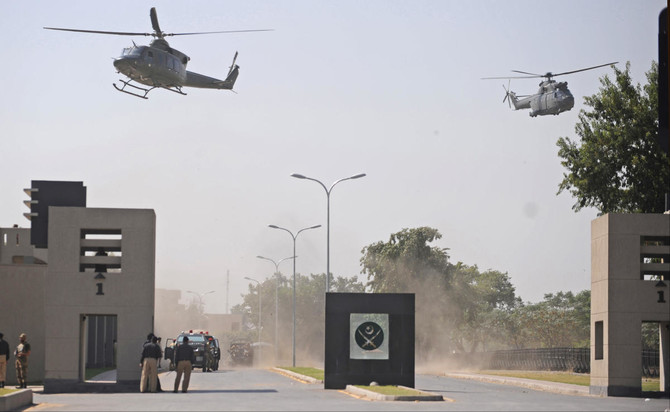
Experts dismiss $950m plan for new Pakistan army GHQ

Pakistan finance chief says country leveraging AI to boost tax compliance, revenu
- Aurangzeb says AI-driven systems are cutting leakages, discretionary intervention in tax administration
- He tells a national workshop the government must focus on applied AI, not technology for its own sake
KARACHI: Pakistan is deploying artificial intelligence-driven systems to strengthen tax compliance and enforcement as part of a broader reform push, Finance Minister Muhammad Aurangzeb said on Tuesday, adding the country must focus on applied AI solutions.
He was speaking during a panel discussion at the National Artificial Intelligence Workshop in the capital, as Pakistan undertakes sweeping fiscal and structural reforms under a $7 billion International Monetary Fund loan program aimed at stabilizing the economy and boosting revenue collection.
The government has pledged to widen the tax base, curb leakages and digitize administration, with technology playing a central role in its tax transformation agenda.
“AI-enabled systems are playing an increasingly important role in strengthening compliance, enforcement, and decision-making,” Aurangzeb said, according to a statement released by the finance division.
“The Government’s ongoing tax transformation, anchored in reforms to people, processes, and technology, is leveraging AI-led CRM [Customer Relationship Management] systems, AI-led production monitoring, risk-based compliance tools, and faceless customer processes to enhance transparency, reduce leakages, and improve revenue outcomes,” he added.
The finance minister said the focus for a country like Pakistan must remain on applied AI solutions that deliver measurable gains in efficiency, transparency and productivity, rather than on adopting technology for its own sake.
Reducing discretionary human intervention through technology was central to curbing inefficiencies and corruption, he said, adding that AI-led systems had generated tangible fiscal gains that would not have been achievable through manual processes alone.
Aurangzeb said investing in human capital and skills development was essential to enable Pakistan’s youth to participate in higher-value segments of the global technology ecosystem, noting that technologies such as blockchain and data analytics could support productivity-led growth.
He maintained artificial intelligence offered opportunities in revenue mobilization, public service delivery and climate and population management, adding that realizing those gains would require clear policy direction, institutional readiness and a coordinated, whole-of-government approach.


