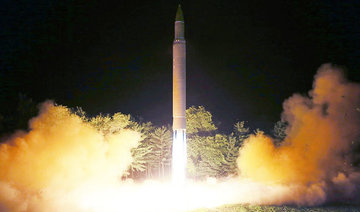
SEOUL/WASHINGTON: North Korea said it successfully tested a powerful new intercontinental ballistic missile (ICBM) on Wednesday that put the entire US mainland within range of its nuclear weapons.
North Korea’s first missile test since mid-September came a week after US President Donald Trump put North Korea back on a US list of countries it says support terrorism, allowing it to impose more sanctions.
North Korea, which also conducted its sixth and largest nuclear test in September, has tested dozens of ballistic missiles under its leader, Kim Jong Un, in defiance of international sanctions. The latest was the highest and longest any North Korean missile had flown, landing in the sea near Japan.
North Korea said the new missile reached an altitude of about 4,475 km (2,780 miles) — more than 10 times the height of the International Space Station — and flew 950 km (590 miles) during its 53-minute flight.
“After watching the successful launch of the new type ICBM Hwasong-15, Kim Jong Un declared with pride that now we have finally realized the great historic cause of completing the state nuclear force, the cause of building a rocket power,” according to a statement read by a television presenter.
North Korea described itself as a “responsible nuclear power,” saying its strategic weapons were developed to defend itself from “the US imperialists’ nuclear blackmail policy and nuclear threat.”
The UN Security Council was scheduled to meet on Wednesday to discuss the launch.
Many nuclear experts say the North has yet to prove it has mastered all technical hurdles, including the ability to deliver a heavy nuclear warhead reliably atop an ICBM, but it was likely that it soon would.
“We don’t have to like it, but we’re going to have to learn to live with North Korea’s ability to target the United States with nuclear weapons,” said Jeffrey Lewis, head of the East Asia Nonproliferation Program at the Middlebury Institute of Strategic Studies.
US, Japanese and South Korean officials all agreed the missile, which landed within Japan’s exclusive economic zone, was likely an ICBM. The test did not pose a threat to the US, its territories or allies, the Pentagon said.
“It went higher, frankly, than any previous shot they’ve taken, a research and development effort on their part to continue building ballistic missiles that can threaten everywhere in the world, basically,” US Defense Secretary Jim Mattis told reporters at the White House.
Trump spoke by phone with Japanese Prime Minister Shinzo Abe and South Korean President Moon Jae-In, with all three reaffirming their commitment to combat the North Korean threat.
“It is a situation that we will handle,” Trump told reporters.
Trump, who was briefed on the missile while it was in flight, said it did not change his administration’s approach to North Korea, which has included new curbs to hurt trade between China and North Korea.
Abe and Moon, in a separate telephone call, said they would “no longer tolerate” North Korea’s increasing threats and would tighten sanctions, the South’s presidential office said.
Washington has said repeatedly that all options, including military ones, are on the table in dealing with North Korea while stressing its desire for a peaceful solution.
“Diplomatic options remain viable and open, for now,” US Secretary of State Rex Tillerson said.
Other than enforcing existing UN sanctions, “the international community must take additional measures to enhance maritime security, including the right to interdict maritime traffic” traveling to North Korea, Tillerson said in a statement.
UN Secretary-General Antonio Guterres strongly condemned the launch.
“This is a clear violation of Security Council resolutions and shows complete disregard for the united view of the international community,” his spokesman said in a statement.
China, North Korea’s lone major ally, expressed “grave concern” at the test, while calling for all sides to act cautiously.
In Moscow, Kremlin spokesman Dmitry Peskov also urged all sides to stay calm, saying this was necessary to avoid a worst-case scenario on the Korean peninsula.
The new Hwasong-15, named after the planet Mars, was a more advanced version of an ICBM tested twice in July, North Korea said. It was designed to carry a “super-large heavy warhead.”
Based on its trajectory and distance, the missile would have a range of more than 13,000 km (8,100 miles) — more than enough to reach Washington D.C. and the rest of the United States, the US-based Union of Concerned Scientists said.
However, it was unclear how heavy a payload the missile was carrying, and it was uncertain if it could carry a large nuclear warhead that far, the nonprofit science advocacy group added.
Minutes after the North fired the missile, South Korea’s military said it conducted a missile-firing test in response.
Moon said the launch had been anticipated. There was no choice but for countries to keep applying pressure, he added.
“The situation could get out of control if North Korea perfects its ICBM technology,” Moon said after a national security council meeting.
“North Korea shouldn’t miscalculate the situation and threaten South Korea with a nuclear weapon, which could elicit a possible pre-emptive strike by the United States.”
The test comes less than three months before South Korea hosts the Winter Olympics at a resort just 80 km (50 miles) from the heavily fortified border with the North.
US stocks briefly pared gains on the news but the S&P 500 index closed up almost 1 percent and Asian markets largely shrugged off the news.
North Korea has said its weapons programs are a necessary defense against US plans to invade. The US, which has 28,500 troops in South Korea as a legacy of the 1950-53 Korean war, denies any such intention.
Last week, North Korea denounced Trump’s decision to relist it as a state sponsor of terrorism, calling it a “serious provocation and violent infringement.”
Trump has traded insults and threats with Kim and warned in September that the US would have no choice but to “totally destroy” North Korea if forced to defend itself or its allies.


![]()
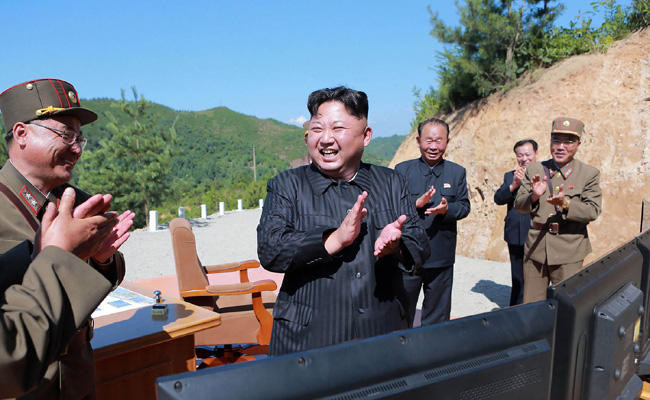
North Korea says new long-range missile puts US mainland within range of nuclear weapons
North Korea says new long-range missile puts US mainland within range of nuclear weapons


Latest updates


© 2026 SAUDI RESEARCH & PUBLISHING COMPANY, All Rights Reserved And subject to Terms of Use Agreement.