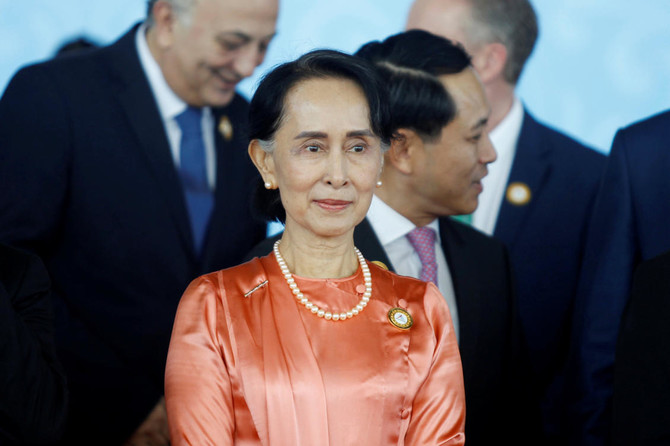
YANGON: Myanmar’s civilian leader, Aung San Suu Kyi, will soon visit Beijing, state media said on Monday, as the southeast Asian nation appears to draw closer to its northern neighbor, China, amid global criticism over an exodus of Rohingya refugees.
Myanmar has bristled at pressure from Western nations over its armed forces’ brutal response to August attacks on security posts by Rohingya Muslim militants in the western state of Rakhine.
The United States and the United Nations have accused Myanmar of “ethnic cleansing” and called for the military to be held accountable over allegations of killings, rape and arson that sent more than 620,000 Rohingya fleeing to Bangladesh.
China, however, has backed what Myanmar officials call a legitimate counter-insurgency operation in Rakhine, and stepped in to prevent a resolution on the crisis at the UN Security Council.
News of Suu Kyi’s visit comes after Chinese President Xi Jinping and Chinese military leaders welcomed Myanmar’s powerful army chief Min Aung Hlaing last week and pledged closer cooperation.
The state-run daily Global New Light of Myanmar said Nobel Peace laureate Suu Kyi would “soon” depart to attend a Communist Party of China-hosted forum of world political leaders in Beijing.
Suu Kyi’s spokesman Zaw Htay could not be reached for more details, but the meeting begins on Thursday and runs until Dec. 3, according to China’s official news agency Xinhua.
Myanmar is in the international spotlight this week as Pope Francis makes the first visit by a head of the Roman Catholic church to the Buddhist-majority country.
He has previously spoken out about the treatment of minority Muslims to whom Myanmar denies citizenship, but some Christians fear doing so in the country could provoke a backlash.
Many in Myanmar refuse to recognize the name Rohingya, preferring to call them “Bengalis” to suggest they belong in neighboring Bangladesh.

Myanmar’s Suu Kyi to visit China amid Western criticism over Rohingya exodus

Britain needs ‘AI stress tests’ for financial services, lawmakers say
- Lawmakers urge AI-specific stress tests for financial firms
LONDON: Britain’s financial watchdogs are not doing enough to stop artificial intelligence from harming consumers or destabilising markets, a cross-party group of lawmakers said on Tuesday, urging regulators to move away from what it called a “wait and see” approach.
In a report on AI in financial services, the Treasury Committee said the Financial Conduct Authority and the Bank of England should start running AI-specific stress tests to help firms prepare for market shocks triggered by automated systems.
The committee also called on the FCA to publish detailed guidance by the end of 2026 on how consumer protection rules apply to AI, and on the extent to which senior managers should be expected to understand the systems they oversee.
“Based on the evidence I’ve seen, I do not feel confident that our financial system is prepared if there was a major AI-related incident and that is worrying,” committee chair Meg Hillier said in a statement.
TECHNOLOGY CARRIES ‘SIGNIFICANT RISKS’
A race among banks to adopt agentic AI, which unlike generative AI can make decisions and take autonomous action, runs new risks for retail customers, the FCA told Reuters late last year.
About three-quarters of UK financial firms now use AI. Companies are deploying the technology across core functions, from processing insurance claims to performing credit assessments.
While the report acknowledged the benefits of AI, it warned the technology also carried “significant risks” including opaque credit decisions, the potential exclusion of vulnerable consumers through algorithmic tailoring, fraud, and the spread of unregulated financial advice through AI chatbots.
Experts contributing to the report also highlighted threats to financial stability, pointing to the reliance on a small group of US tech giants for AI and cloud services. Some also noted that AI-driven trading systems may amplify herding behavior in markets, risking a financial crisis in a worst-case scenario.
An FCA spokesperson said the regulator welcomed the focus on AI and would review the report. The regulator has previously indicated it does not favor AI-specific rules due to the pace of technological change.
The BoE did not respond to a request for comment.
Hillier told Reuters that increasingly sophisticated forms of generative AI were influencing financial decisions. “If something has gone wrong in the system, that could have a very big impact on the consumer,” she said.
Separately, Britain’s finance ministry appointed Starling Bank CIO Harriet Rees and Lloyds Banking Group ‘s Rohit Dhawan as “AI Champions” to help steer AI adoption in financial services.