The rise of the Arab superhero — It all started with ‘The 99’

1 / 9
2 / 9
Dr. Naif Al-Mutawa
3 / 9
Audience are thrilled to play at a locally designed table by REteam, a local group of four guys interested in old-fashioned video game console.
4 / 9
Floor plan for ComiCon Arabia exhibition in Riyadh.
5 / 9
Aseel Al-Yaagoub, an amateur artist, drawing her favorite portraits.
6 / 9
7 / 9
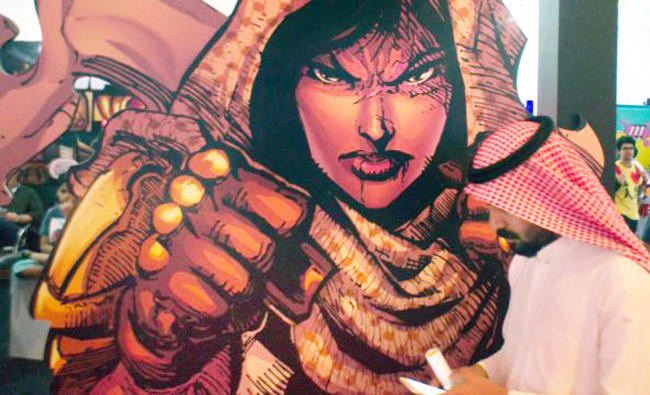
Saudi-themed superhero graphics have seen a spur inrecent years, mainly focusing on shimagh (the headdress)and the hijab.
8 / 9
Yusuf, 9, and Abdullah, 6, dressed as Captain America and Thor. Yusuf said he chose Captain America because ‘he leads the Avengers.’
9 / 9
Ahmad Farhar sits on his throne — a replica of the throne depicted in ‘Game of Thrones.’ It cost Farhar SR7,000. He worked on it daily for four hours for one month. And, he told fellow geeks, it is not for sale.
Updated 25 November 2017
Follow

The rise of the Arab superhero — It all started with ‘The 99’

RIYADH: The first modern Arab comic, “The 99,” created by Kuwaiti psychiatrist Dr. Naif Al-Mutawa and featuring a team of superheroes with special abilities based on the 99 attributes of God, was published by Teshkeel Comics in October 2010.
Al-Mutawa was not the first to create superheroes in this way. A number of modern superheroes are based on Greek and Norse mythological figures such as Heracles and Thor while others are built on action heroes gifted with special powers such as Superman or Batman.
The characters in “The 99” include Dr. Ramzi, a scholar and social activist, and the 99 youngsters with special abilities given to them by the “Noor” gemstones, which were lost during the Mongolian invasion of Baghdad.
The evil characters are led by the power-hungry Rughal, who tries to steal the power of the Noor stones for himself. The storyline shows the 99 characters led by Dr. Ramzi in pursuit of social justice and peace against the forces of evil.
The adaptation of superheroes in Arab culture is considered by many to be modest, apart from a few examples such as “One Thousand and One Nights,” “Sinbad the Sailor” and “Aladdin,” which had the usual stereotypes of turban-wearing Arabs riding camels and fighting with curved swords.
In spite of this stereotyping in the entertainment industry, Arabs and Muslims do exist in American comics as superheroes, such as Kamala Khan, who is a Pakistani American superhero known as “Ms. Marvel,” Simon Baz, the Lebanese American who becomes the first Arab member of the Green Lantern Corps, and Sooraya Qadir (Dust), a mutant from Afghanistan who becomes a member of the X-Men.


Saudi Arabia announces new financial support to the Yemeni government

Updated 16 January 2026
Follow

Saudi Arabia announces new financial support to the Yemeni government

RIYADH: Saudi Ambassador to Yemen and Supervisor of the Saudi Program for the Development and Reconstruction of Yemen Mohammed Al-Jaber announced that the Kingdom, under the directives of its leadership, has provided new support to the Yemeni government's budget, aimed at paying the salaries of state employees in all sectors.

In a post on X, Al-Jaber stated that this support complements a package of development projects and initiatives, amounting to SR1.9 billion, announced on Wednesday. The package includes provision of necessary petroleum derivatives to operate power plants, which will contribute to improving the living standards of people in Yemen and alleviating daily burdens on them.

Al-Jaber’s post emphasized, in particular, that all salaries of military and security forces linked to the the higher military committee linked to the Saudi led Coalition will be paid as of Sunday. 


The post is likely relate to Several Media reports which have suggested that disgraced former Southern Transitional Council (STC) chief Aidaroos Al Zubaidi — who has now fled Yemen — was taking advantage of military personnel and withholding salaries as means of pressure. Al-Zubaidi is wanted by the Yemeni government for acts of high treason and corruption. 

The ambassador emphasized that these steps come within the framework of supporting the Yemeni government's efforts to implement the economic reform program, which aims to achieve financial and economic stability and enhance the state's ability to meet its basic obligations.