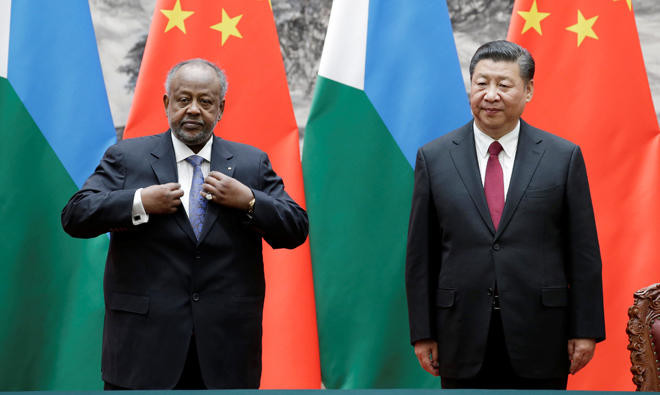
BEIJING: China on Thursday offered loans to Djibouti, the site of its first overseas military base, as the Horn of Africa state’s leader told President Xi Jinping he considered himself a great friend of the Asian giant.
With a population of less than one million, Djibouti has long punched above its weight, thanks to a strategic location on the Gulf of Aden, one of the world’s busiest shipping routes linking Europe to Asia and the Middle East.
China formally opened the base, which it calls a logistics facility, on Aug. 1, the 90th birthday of the People’s Liberation Army. Djibouti also hosts large US and French bases.
Djibouti was politically stable, Xi told its president, Ismail Omar Guelleh, at a meeting in Beijing’s Great Hall of the People.
“China sets great store by its relations with Djibouti,” he added.
Guelleh, who has been in power since 1999, said he considered himself a “great friend of China’s” and could not count the number of times he had visited.
“Djibouti is known for being a country of peace, exchanges and meetings,” Guelleh said.
“I would like to recall the geostrategic position of Djibouti and its importance in this part of the world as an island of stability for Asia, Africa and the Middle East.”
The two, who did not mention the military base in comments to reporters, later oversaw the signing of a framework pact for preferential loans.
Chinese Assistant Foreign Minister Chen Xiaodong declined to reveal the amount of loans offered, saying he could not remember.
“In this area both countries have always had good cooperation,” Chen told reporters.
Xi and Guelleh did discuss the military base, Chen added.
“What I want to stress is that China building a logistics base in Djibouti benefits China to even better fulfil its naval protection, peace-keeping, disaster relief and other international work,” he said.
The base will be used to resupply navy ships participating in peacekeeping, humanitarian and anti-piracy missions off the coasts of Yemen and Somalia, in particular.
The Chinese base is just a few miles from Camp Lemonnier, the US’ only permanent base in Africa.
A Pentagon report said the strategically-sited camp, “along with regular naval vessel visits to foreign ports, both reflects and amplifies China’s growing influence, extending the reach of its armed forces.”
China also has deep economic interests in Djibouti.
Last week, China’s POLY-GCL Petroleum Group Holdings Ltd. signed a memorandum of understanding to invest $4 billion in a natural gas project in Djibouti.
In January, the government launched construction of a project billed as Africa’s largest free trade zone, as part of China’s massive Belt and Road infrastructure initiative stretching to Asia, Europe and beyond.

China forges strategic ties with Djibouti after opening base
2025 among world’s three hottest years on record, WMO says
- All eight datasets confirmed that the last three years were the planet’s three hottest since records began, the WMO said
- The slight differences in the datasets’ rankings reflect their different methodologies and types of measurements
BRUSSELS: Last year was among the planet’s three warmest on record, the World Meteorological Organization said on Wednesday, as EU scientists also confirmed average temperatures have now exceeded 1.5 degrees Celsius of global warming for the longest since records began.
The WMO, which consolidates eight climate datasets from around the world, said six of them — including the European Union’s European Center for Medium-Range Weather Forecasts (ECMWF) and the British national weather service — had ranked 2025 as the third warmest, while two placed it as the second warmest in the 176-year record.
All eight datasets confirmed that the last three years were the planet’s three hottest since records began, the WMO said. The warmest year on record was 2024.
THREE-YEAR PERIOD ABOVE 1.5 C AVERAGE WARMING LEVEL
The slight differences in the datasets’ rankings reflect their different methodologies and types of measurements — which include satellite data and readings from weather stations.
ECMWF said 2025 also rounded out the first three-year period in which the average global temperature was 1.5 C above the pre-industrial era — the limit beyond which scientists expect global warming will unleash severe impacts, some of them irreversible.
“1.5 C is not a cliff edge. However, we know that every fraction of a degree matters, particularly for worsening extreme weather events,” said Samantha Burgess, strategic lead for climate at ECMWF.
Burgess said she expected 2026 to be among the planet’s five warmest years.
CHOICE OF HOW TO MANAGE TEMPERATURE OVERSHOOT
Governments pledged under the 2015 Paris Agreement to try to avoid exceeding 1.5 C of global warming, measured as a decades-long average temperature compared with pre-industrial temperatures.
But their failure to reduce greenhouse gas emissions means that target could now be breached before 2030 — a decade earlier than had been predicted when the Paris accord was signed in 2015, ECMWF said. “We are bound to pass it,” said Carlo Buontempo, director of the EU’s Copernicus Climate Change Service. “The choice we now have is how to best manage the inevitable overshoot and its consequences on societies and natural systems.”
Currently, the world’s long-term warming level is about 1.4 C above the pre-industrial era, ECMWF said. Measured on a short-term basis, average annual temperatures breached 1.5 C for the first time in 2024.
EXTREME WEATHER
Exceeding the long-term 1.5 C limit would lead to more extreme and widespread impacts, including hotter and longer heatwaves, and more powerful storms and floods. Already in 2025, wildfires in Europe produced the highest total emissions on record, while scientific studies confirmed specific weather events were made worse by climate change, including Hurricane Melissa in the Caribbean and monsoon rains in Pakistan which killed more than 1,000 people in floods.
Despite these worsening impacts, climate science is facing political pushback. US President Donald Trump, who has called climate change “the greatest con job,” last week withdrew from dozens of UN entities including the scientific Intergovernmental Panel on Climate Change.
The long-established consensus among the world’s scientists is that climate change is real, mostly caused by humans, and getting worse. Its main cause is greenhouse gas emissions from burning fossil fuels like coal, oil and gas, which trap heat in the atmosphere.