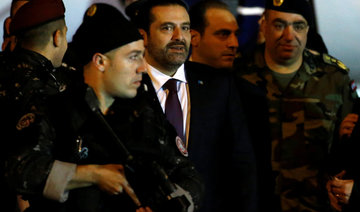
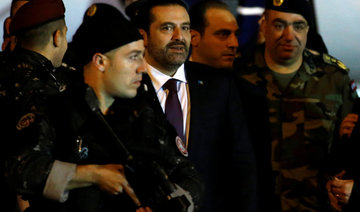
BEIRUT/JEDDAH: Lebanese Prime Minister Saad Hariri, who returned to Beirut on Wednesday to a hero’s welcome, said he was putting his resignation on hold at President Michel Aoun’s request — a move analysts described as a positive outcome of Saudi Arabia's high-octane diplomacy.
Hours after his arrival in Beirut, Hariri met with Aoun, who had refused to accept the premier’s resignation until he returned to Lebanon.
“Today, I presented my resignation to the president, who wished that I would suspend it to allow more time for further deliberations on its political causes and background,” Hariri said.
“I accepted his request in the hope that it would pave the way for a serious dialogue that would renew our will to hold on to the Taif Agreement (which ended the civil war) and the national consensus, and to address controversial issues and their implications on Lebanon’s relations with the Arab brothers.”
Hariri said Lebanon must remain neutral concerning external wars, regional conflicts, and anything that might harm its stability or its relations with Arab countries.
“I am looking forward to a real partnership with all political forces in order to put Lebanon’s higher interest above any other, preserve the safety of coexistence among Lebanese, and the right path to rebuilding our nation,” he said.
Lebanon was plunged into a political crisis after Hariri’s shock Nov. 4 announcement from the Saudi capital that he was stepping down.
While announcing the resignation live on TV, he accused Hezbollah, which is part of the Lebanese government, and Iran of taking over Lebanon and destabilizing the region.
He said he had been forced to leave Lebanon because of threats to his safety, invoking the 2005 assassination of his father.
Hariri accused Hezbollah of violating Lebanon’s policy of “neutrality” from regional conflicts by fighting alongside Syria’s government and assisting Houthi rebels in Yemen.
Wednesday was historically significant as the 74th anniversary of Lebanon’s independence from France.
Hariri expressed his full commitment to cooperating with Aoun to continue pushing Lebanon forward and protecting it from surrounding conflicts and turmoil.
Hariri thanked Parliament Speaker Nabih Berri, who he said “showed wisdom, adherence to the constitution and stability in Lebanon, and sincere empathy toward me personally.”
In the days following the resignation, there was a flurry of activity involving the Arab League, Saudi Arabia, Egypt, the US, France, and even Lebanese Maronite Patriarch Bechara Boutros Al-Rahi.
Jean Aziz, adviser to Aoun, said he would not comment on Hariri’s suspension of his resignation, telling Arab News: “Today we’re celebrating Independence Day, and we won’t discuss anything else.”
Former MP Fares Souaid of the March 14 Alliance, which includes Hariri's Future Movement political party, said the suspension was to give Aoun additional time to communicate with Hezbollah.
“Maybe Aoun will be able to convince Hezbollah to abide by Lebanon’s policy of neutrality,” Souaid told Arab News. “Hariri handed this mission to Aoun.”
Souaid said there is an Arab consensus regarding Iran’s regional interference. “The question is: Will Egypt, France and Cyprus succeed in asking Iran to withdraw from the Arab world after its interference in Yemen, Syria, Iraq and Lebanon? That will end the Lebanese crisis,” he said.
“We’ll wait for the next move by Aoun, who is responsible for upholding the constitution and Lebanon's stability.”
Analysts described the developments as a positive indicator of Saudi influence. “Hariri’s shock resignation, and his clear identification of Hezbollah as the primary and sole reason for all the troubles in Lebanon, put the terrorist organization on the defensive,” Hamdan Al-Shehri, a Saudi political analyst and international relations scholar, told Arab News.
High-level Saudi diplomacy on multiple fronts forced Hezbollah chief Hassan Nasrallah to tone down his rhetoric and announce that his movement was withdrawing “their men” from Iraq, Al-Shehri said.
He added that the entire Arab world and the international community, thanks to Saudi efforts, had rallied in support of Hariri.
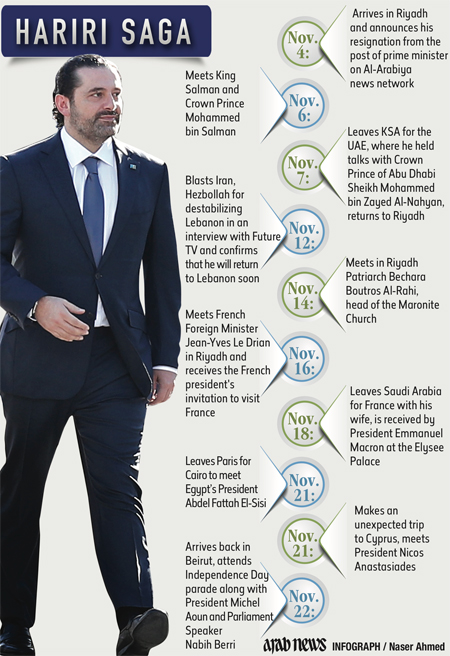 “The US and France came out in support of Hariri. Then the Arab League, at its extraordinary session convened at Saudi Arabia’s request in Cairo, backed his stand against Hezbollah and Iranian interference,” said Al-Shehri.
He said that Hariri’s return to Beirut and the suspension of his resignation was part of a calculated strategy.
“Hariri’s return has checkmated Hezbollah. If he hadn’t returned, that would’ve given Hezbollah carte blanche to do as it desired,” Al-Shehri said.
“Hezbollah would’ve chosen some other pliable person as prime minister, who would then have been at its complete mercy,” he added.
“With the international community behind him and Hezbollah on the defensive, Hariri can now call the shots and manage the situation from a position of strength and solid international and Arab backing.”
Al-Shehri said Hezbollah’s game would be up once a solution to the Syrian conflict is found. “Any solution will necessarily entail the expulsion of Hezbollah and Iran from Syria,” he said.
“Once Hezbollah is forced out of Syria and sent back to Lebanon, the terrorist militia will be under siege.”
Al-Shehri said Saudi efforts had been geared toward isolating Hezbollah and marking it as the real mischief-maker in Lebanon. “All those objectives have been achieved,” he added.
Aoun’s statement on Tuesday was seen as a sign of reconciliation. On the eve of Lebanon’s Independence Day on Tuesday, he said: “In my inaugural speech, I declared that one of our top priorities was to prevent any spark from the raging flames around us to move into Lebanon’s inner space. I affirmed the need for Lebanon to distance itself from external conflicts, and to be committed to respecting the Arab League Charter.
“We therefore have adopted a totally independent policy, we have avoided entering into disputes, and we have called — and are still calling — for dialogue and harmony among Arab brothers, because in internal wars there is inevitable loss for the victorious as well as for the defeated, and the two statuses are meaningless because the great loss befalls the nation.”