Mugabe ousted as ruling party chief as end nears

1 / 2
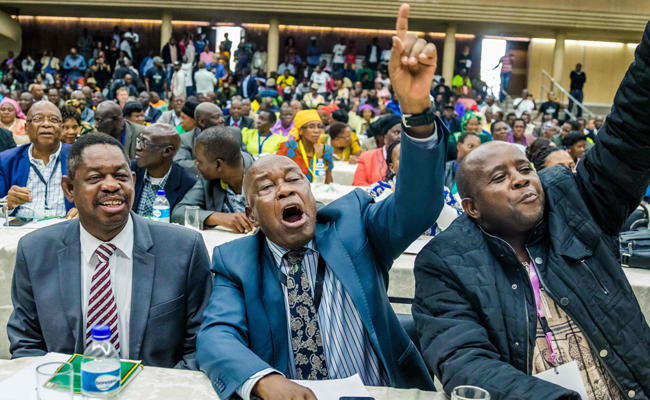
War Veterans leader Christopher Mutsvangwa (C) celebrates the dismissal of the president of the ruling ZANU-PF party on November 19, 2017 in Harare. (AFP)
2 / 2
President Robert Mugabe meets with senior members of the Zimbabwe Defense Forces and police at State House in Harare, Zimbabwe, on November 19, 2017. (ZIMPAPERS/Joseph Nyadzayo/Handout via REUTERS)
Updated 19 November 2017
Follow

Mugabe ousted as ruling party chief as end nears

HARARE: Zimbabwe’s President Robert Mugabe was on Sunday facing the end of his 37-year rule, as the once-loyal ZANU-PF party sacked him as its leader and told him to resign as head of state.
Mugabe’s grip on power was broken last week when the military took over, angered at his wife Grace’s emergence as the leading candidate to succeed the 93-year-old president.
As ZANU-PF delegates cheered wildly, a party official announced at a meeting in Harare that Mugabe had been ousted as party chief.
He was replaced by former vice president Emmerson Mnangagwa, who had been Grace Mugabe’s chief rival.
In a stunning reversal of allegiances, the party added that it would impeach Mugabe if he did not resign by Monday, Mnangagwa would be its candidate in 2018 elections, and that Grace was expelled from the ZANU-PF ranks.
Robert Mugabe — the world’s oldest head of state — remained national president but faces overwhelming opposition from the generals, much of the Zimbabwean public and from his own party.
“(Mugabe’s) wife and close associates have taken advantage of his frail condition to usurp power and loot state resources,” party official Obert Mpofu told the ZANU-PF meeting.
Army chief Constantino Chiwenga held further talks with Mugabe on Sunday at State House, the president’s official residence.
Official photographs of the meeting showed one officer saluting the president, who stood behind his desk, and several senior officers sitting in a formal room with white sofas and a bright red carpet.
No details of the meeting were released.
The two sides first met on Thursday, in an attempt to present dignified image of the tense process of negotiating Mugabe’s departure.
Veterans of the independence war — who were also formerly key Mugabe allies — added their voice in support of him resigning, demanding that he leave office immediately.
Zimbabweans have experienced a historic week in which the military seized power and put Mugabe under house arrest in response to his sacking of vice president Mnangagwa, who has close military ties.
On Saturday, in scenes of public euphoria not seen since Zimbabwe’s independence in 1980, huge crowds marched and sang their way through Harare and other cities in peaceful celebrations marking the apparent end of his long, authoritarian rule.
The demonstrations drew citizens of all ages, jubilant that Mugabe appeared to be on his way out.
In central Harare, a group of young men tore down a green metal street sign bearing Robert Mugabe’s name and smashed it repeatedly on the road.
Such open dissent would have would have been routinely crushed by security forces before this week’s shock events.


“What you saw yesterday, it shows that the people have spoken,” Mordecai Makore, 71, a retired teacher told AFP after attending a Sunday morning service at the Catholic cathedral in central Harare.
“All we want is peace, a good life with a working economy that creates jobs for our people. We will continue praying for that. I want my children and grandchildren to live a normal good life.”
The majority of Zimbabweans have only known life under Mugabe’s rule, which has been defined by violent suppression, economic collapse and international isolation.
Sources suggest Mugabe has been battling to delay his exit and to secure a deal guaranteeing future protection for him and his family.
The factional succession race that triggered Zimbabwe’s sudden crisis was between party hard-liner Mnangagwa — known as the Crocodile — and a group called “Generation 40,” or “G40,” because its members are generally younger, which campaigned for Grace’s cause.
“She is very acceptable. Very much accepted by the people,” Mugabe said of Grace in a faltering interview to mark his 93rd birthday last February.
The president, who is feted in parts of Africa as the continent’s last surviving independence leader, is in fragile health.
But he previously said he would stand in elections next year that would see him remain in power until he was nearly 100-years-old.
He became prime minister on Zimbabwe’s independence from Britain in 1980 and then president in 1987.
Zimbabwe’s economic output has halved since 2000 when many white-owned farms were seized, leaving the key agricultural sector in ruins.


Trump takes unconventional approach to communicating to the public about war in Iran

Updated 03 March 2026
Follow

Trump takes unconventional approach to communicating to the public about war in Iran

  • The communications strategy opened Trump to criticism that he hadn’t done enough to explain the rationale and objectives of the war

Typical of an unconventional presidency, the Trump administration waited more than 48 hours to make any live, public communication to the American people about why it had decided to go to war with Iran.
President Donald Trump discussed why he launched the attack prior to a White House ceremony honoring military heroes on Monday but took no questions from reporters. Earlier in the day, Defense Secretary Pete Hegseth and Joint Chiefs of Staff Chairman Dan Caine briefed journalists at the Pentagon.
The two days previous, Trump delivered two pretaped statements that were released on Truth Social, the social media site owned by the president’s media company, and granted telephone interviews to more than a dozen journalists — several of which produced fragmented responses that, to some, clouded as much as they cleared up.
The communications strategy opened Trump to criticism that he hadn’t done enough to explain the rationale and objectives of the war, even as the American military suffered its first casualties. By contrast, Israeli Prime Minister Benjamin Netanyahu, who has teamed with the US against Iran, delivered two statements the day the war began and addressed reporters Monday at the site of a missile attack that killed nine people. The Israeli military has held multiple press briefings each day.
“The American people need a commander in chief, and he has been absent in that role,” Rahm Emanuel, White House chief of staff under President Barack Obama, said on CNN Monday. Emanuel, a Democrat, is contemplating a run for the presidency in 2028.
An unconventional strategy leads to criticism
Peter Baker, chief White House correspondent for The New York Times, wrote on social media that “after Trump launched a new war on Iran, he did not rush back to the White House to make an Oval Office address to rally the nation as other presidents have done. He stayed at Mar-a-Lago to attend a glitzy political fundraiser.”
That post provoked a response from Steven Cheung, White House communications director. “Imagine being a reporter so consumed with Trump Derangement Syndrome that he wants President Trump to mimic the failed policies of the past. The truth is that President Trump spent the majority of his time monitoring the situation in a secure facility, in constant contact with world leaders, and made multiple addresses to the nation that garnered hundreds of millions of views. He also took dozens of calls with reporters.”
The calls included one with Baker’s colleague at The Times, Zolan Kanno-Youngs. Trump’s mobile phone number is known to many of the reporters who cover him, and the president often takes their calls for on-the-spot interviews. Besides The Times, he spoke in the aftermath of the attack to journalists for ABC, CBS, NBC, CNN, CNBC, Fox News Channel, The Atlantic, The Washington Post, Axios, Politico and an Israeli television station.
Most of the calls were brief and marginally illuminating; Politico’s Dasha Burns said Trump answered but said he was too busy to talk. The public couldn’t hear what Trump said in the interviews and was dependent upon what the journalists chose to report on the conversations.
“I spoke to President Trump today and he told me that the operation in Iran is going to go very fast,” Libby Alon, a reporter for Channel 14 News in Israel, wrote about her interview on X. “It’s doing very well, and (will) make the people of Israel very happy, and the people of the world very happy.”
The Times reported that in its six-minute chat, Trump “offered several seemingly contradictory visions of how power might be transferred to a new government — or even whether the existing Iranian power structure would run that government or be overthrown.”
In one of his two conversations with Trump, ABC News’ Jonathan Karl said when he asked about the death of Iranian Ayatollah Ali Khamenei, the president said: “I got him before he got me. They tried twice. Well I got him first.” CNN’s Jake Tapper went on the air minutes after his conversation Monday, saying Trump told him “the big one is coming soon,” an apparent reference to a future attack.
Asked for comment, White House spokeswoman Anna Kelly said: “President Trump is the most transparent and accessible president in American history. The American people have never had a more direct and authentic relationship with a president of the United States than they have with President Trump.”
Hegseth briefing concentrates on friendly reporters
Pentagon reporters learned late Sunday about Hegseth’s briefing. Reporters from The Associated Press, Reuters, ABC, CBS, NBC, CNN, Fox News Channel and Stars & Stripes were permitted into the briefing room, but Hegseth did not call on them. Instead, he took questions from NewsNation and Trump-friendly outlets like the Daily Caller, Daily Wire, One America News and the Christian Broadcasting Network. Most mainstream news outlets left their regular stations at the Pentagon last fall rather than agree to Hegseth’s rules restricting their work.
Hegseth denounced the “foolishness” of people wanting to know details of the operation in advance, such as whether Americans would commit to more than air power, and said the operation would continue as long as it took to achieve objections. He initially ignored NBC News’ Courtney Kube when she called out a question: “President Trump put a four-week time limit on it. Are you saying he’s wrong?”
Later, Hegseth denounced Kube for asking “the typical NBC sort of gotcha-type question. President Trump has all the latitude in the world to talk about how long it might take — four weeks, two weeks, six weeks, it could move up, it could move back. We’re going to execute at his command the objectives he set out to achieve.”
Unlike Pentagon briefings in past administrations, reporters were given assigned seats, with the Trump-friendly outlets seated in front. Jennifer Griffin, Hegseth’s former colleague at Fox News Channel who left the Pentagon with other reporters after not accepting his new rules, was seated in the last row.