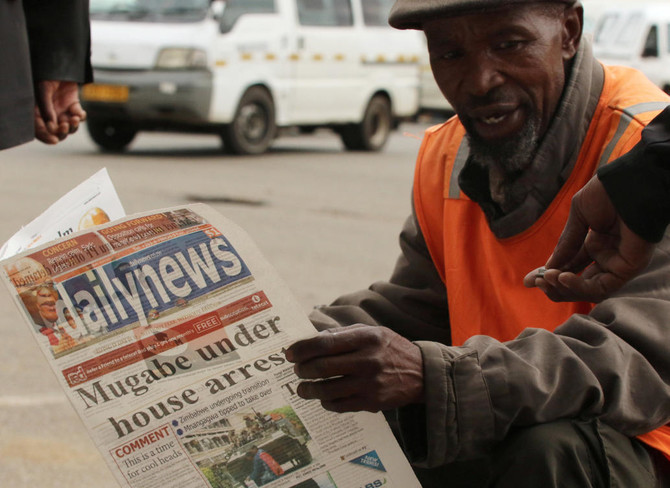
HARARE: Zimbabwean President Robert Mugabe’s fate hung in the balance on Friday as he apparently resisted efforts to make him step down following a seizure of power by the army, until this week a key pillar of his 37-year-rule.
The military said on national television it was holding talks with Mugabe on the way forward and that it would advise the nation on their outcome as soon as possible.
The US, a longtime critic of Mugabe over allegations of human rights abuses and election rigging, is seeking “a new era” for Zimbabwe, the State Department’s top official for Africa said, an implicit call for the nonagenarian leader to quit.
The unfolding drama in the capital, Harare, was thrown into confusion when a smiling Mugabe was pictured shaking hands with Zimbabwe’s military chief, the man behind the coup, raising questions about whether or not the end of an era was near.
Mugabe unexpectedly drove on Thursday from his lavish “Blue Roof” compound, where he had been confined, to State House, where official media pictured him meeting military boss Constantino Chiwenga and South African mediators.
The official Herald newspaper carried no reports of the meeting’s outcome, leaving Zimbabwe’s 13 million people in the dark about the situation.
In an interview with Reuters, acting US Assistant Secretary of State for African Affairs Donald Yamamoto appeared to dismiss the idea of Mugabe remaining in a transitional or ceremonial role.
“It’s a transition to a new era for Zimbabwe, that’s really what we’re hoping for,” Yamamoto said.
The army may want Mugabe, who has ruled Zimbabwe since independence from Britain in 1980, to go quietly and allow a smooth and bloodless transition to Emmerson Mnangagwa, the vice president Mugabe sacked last week, triggering the crisis.
The main goal of the generals is to prevent Mugabe from handing power to his wife, Grace, 41 years his junior, who has built a following among the ruling party’s youth wing and appeared on the cusp of power after Mnangagwa was pushed out.
Mugabe, who at 93 has appeared increasingly frail in public, is insisting he remains Zimbabwe’s only legitimate ruler and is refusing to quit. But pressure was mounting on the former guerrilla to accept offers of a graceful exit, political sources said.
Zimbabwe’s former head of intelligence, Dumiso Dabengwa, was to hold a news conference in Johannesburg at 1200 GMT. A South African government source said he expected Dabengwa, a close ally of the ousted Mnangagwa, to discuss the events in Zimbabwe. “It seems there is some sort of agreement,” the source said.
The army’s takeover signaled the collapse in less than 36 hours of the security, intelligence and patronage networks that sustained Mugabe through almost four decades in power and built him into the “Grand Old Man” of African politics.
Mugabe is still seen by many Africans as a liberation hero. But he is reviled in the West as a despot whose disastrous handling of the economy and willingness to resort to violence to maintain power pauperized one of Africa’s most promising states.
Once a regional breadbasket, Zimbabwe saw its economy collapse after the seizure of white-owned farms in the early 2000s, followed by runaway money-printing that catapulted inflation to 500 billion percent in 2008.


Fate of Zimbabwe’s Mugabe hangs in the balance amid coup confusion
Fate of Zimbabwe’s Mugabe hangs in the balance amid coup confusion

Haldiram’s: India’s beloved snack maker eyed by foreign investors Blackstone, UAE wealth fund
- Haldiram’s started in 1937 from “tiny shop” in Bikaner in desert state of Rajasthan
- Haldiram’s has almost a 13% share of India’s $6.2 billion savoury snacks market
From fried Indian snacks to local sweet delicacies, family-run Indian snack maker Haldiram’s has long been one of the country’s most popular food brands. Now, foreign investors like Blackstone and Abu Dhabi Investment Authority want a big bite of it.
Haldiram’s was last year also an acquisition target for India’s Tata Group, one of the country’s biggest conglomerates.
Here are some facts about the popular Indian brand:
* Haldiram’s started in 1937 from a “tiny shop” in Bikaner in the western desert state of Rajasthan. It later expanded to New Delhi in 1983.
* The company’s website says it has 1,000 distributors and its products are available in 7 million outlets. It also exports to many foreign countries including Japan, Russia, United Kingdom and Australia.
* One of its most popular snacks is “bhujia,” a crispy fried Indian snack made with flour, herbs and spices and sold for as little as 10 rupees (12 US cents) across mom-and-pop stores. Haldiram’s calls it “an irresistible Indian snack” which can “captivate your taste buds.”
* Haldiram’s started exporting products in 1993. The US was its first market, where it began with 15 savoury products, and later, in 2016, opened its first overseas factory in the UK.
* Beyond snacks, Haldiram’s also sells ready-to-eat and frozen foods such as Indian curries and rice items. It also runs more than 150 restaurants which sell street-style Indian food, as well as Chinese and western cuisine.
* Last year, during deal talks with Tata, Haldiram’s was seeking a $10 billion valuation. Reuters has previously reported Haldiram’s annual revenues are around $1.5 billion.
* Haldiram’s has almost a 13% share of India’s $6.2 billion savoury snacks market, Euromonitor International estimates.
($1 = 83.5200 Indian rupees)

Internally displaced people reached 76 million in 2023 – monitoring group
- Almost 90 percent of the total displacement was attributed to conflict and violence
- The group reported a total of 3.4 million movements within Gaza in the last quarter of 2023
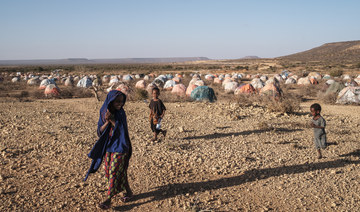
GENEVA: Conflicts and natural disasters left a record nearly 76 million people displaced within their countries last year, with violence in Sudan, Congo and the Middle East driving two-thirds of new movement, a top migration monitoring group said Tuesday.
The Internal Displacement Monitoring Center report found that the number of internally displaced people, or IDPs, has jumped by 50 percent over the past five years and roughly doubled in the past decade. It doesn’t cover refugees — displaced people who fled to another country.
The report tracks two major sets of information. It counted 46.9 million physical movements of people in 2023 — sometimes more than once. In most of those cases, such as after natural disasters like floods, people eventually return home.
It also compiles the cumulative number of people who were living away from their homes in 2023, including those still displaced from previous years. Some 75.9 million people were living in internal displacement at the end of last year, the report said, with half of those in sub-Saharan African countries.
Almost 90 percent of the total displacement was attributed to conflict and violence, while some 10 percent stemmed from the impact of natural disasters.
The displacement of more than 9 million people in Sudan at the end of 2023 was a record for a single country since the center started tracking such figures 16 years ago.
That was an increase of nearly 6 million from the end of 2022. Sudan’s conflict erupted in April 2023 as soaring tensions between the leaders of the military and the rival Rapid Support Forces broke out into open fighting across the country.
The group reported a total of 3.4 million movements within Gaza in the last quarter of 2023 amid the Israeli military response to the Oct. 7 attacks in Israel. That means that many people moved more than once within the territory of some 2.2 million. At the end of the year, 1.7 million people were displaced in Gaza.
Group director Alexandra Bilak said the millions of people forced to flee in 2023 were the “tip of the iceberg,” on top of tens of millions displaced from earlier and continuing conflicts, violence and disasters.
The figures offer a different window into the impact of conflict, climate change and other factors on human movement. The UN refugee agency monitors displacement across borders but not within countries, while the UN migration agency tracks all movements of people, including for economic or lifestyle reasons.


Pakistan PM unveils broader plan to sell most state-owned firms
- Announcement comes amid talks on new IMF loan
- There can’t be any strategic commercial SOEs, says ex-minister
ISLAMABAD: Pakistan will privatise all state-owned enterprises, with the exception of strategic entities, Prime Minister Shehbaz Sharif said on Tuesday, broadening its initial plans to sell only loss-making state firms to shore up its shaky finances.
The announcement came after Sharif headed a review meeting of the privatization process of loss-making state enterprises (SOEs), according to a statement from his office, which discussed a roadmap for privatization from 2024 to 2029.
“All of the state-owned enterprises will be privatised whether they are in profit or in losses,” Sharif said, adding that offloading the SOEs will save taxpayers’ money.
The statement didn’t clarify which sectors would be deemed strategic and non-strategic.
The announcement came a day after an International Monetary Fund (IMF) mission opened talks in Islamabad for a new long-term Extended Fund Facility (EFF), following Pakistan’s completion of a $3 billion standby arrangement last month, which had averted a sovereign debt default last summer.
Privatization of loss-making SOEs has long been on the IMF’s list of recommendations for Pakistan, which is struggling with a high fiscal shortfall and a huge external financing gap. Foreign exchange reserves are hardly enough to meet up to a couple of months of controlled imports.
The IMF says SOEs in Pakistan hold sizable assets inn comparison with most Middle East countries, at 44 percent of GDP in 2019, yet their share of employment in the economy is relatively low. The Fund estimates almost half of the SOEs operated at a loss in 2019.
Patchy success so far
Past privatization drives have been patchy, mainly due to a lack of political will, market watchers say.
Any organization that is involved in purely commercial work can’t be strategic by its very nature, which means there can’t be any strategic commercial SOEs, former Privatization Minister Fawad Hasan Fawad told Reuters on Tuesday.
“So to me there are really no strategic SOEs,” he said.
“The sooner we get rid of them the better. But this isn’t the first time we have heard a PM say this and this may not be the last till these words are translated into a strategic action plan and implemented.”
Islamabad has for years been pumping billions of dollars into cash-bleeding SOEs to keep them afloat, including one of the largest loss-making enterprises
Pakistan International Airline, which is in its final phase of being sold off, with a deadline
later this week to seek expressions of interest from potential buyers.
The pre-qualification process for PIA’s selloff will be completed by end-May, the privatization ministry told Tuesday’s meeting, adding discussions were underway to sell the airline-owned Roosevelt Hotel in New York.
It also said a government-to-government transaction on First Women Bank Ltd. was being discussed with the United Arab Emirates, and added that power distribution companies had also been included in the privatization plan for 2024-2029.
“The loss-making SOEs should be privatised on a priority basis,” Sharif said.


Russian president Putin to make a state visit to China this week
- The Kremlin in a statement confirmed the trip and said Putin was going on Xi’s invitation
BEIJING: Russian President Vladimir Putin will make a two-day state visit to China this week, the Chinese Foreign Ministry said Tuesday.
Putin will meet Chinese leader Xi Jinping during his visit starting on Thurday, it said.
The Kremlin in a statement confirmed the trip and said Putin was going on Xi’s invitation. It said that this will be Putin’s first foreign trip since he was sworn in as president and began his fifth term in office.
The two continent-sized authoritarian states, increasingly in dispute with democracies and NATO, seek to gain influence in Africa, the Middle East and South America. China has backed Russia’s claim that President Vladimir Putin launched his assault on Ukraine in 2022 because of Western provocations, without producing any solid evidence.


Pro-Palestinian protesters cleared from Geneva university
- Geneva university officials had asked the protesters on Monday to vacate the premises and protest in a different manner.
About 20 officers entered the UniMail building around 0300 GMT, a journalist from the Keystone-ATS news agency said.
“Most of the students were sleeping. After being gathered they were led to the underground parking garage,” Julie Zaugg, a journalist with LemanbleuTV channel, said on X.
She said they shouted pro-Palestinian slogans before being handcuffed and taken away in vans.
Geneva university officials had asked the protesters on Monday to vacate the premises and protest in a different manner.
Students demonstrations have gathered pace across Western Europe in recent weeks with protesters demanding an end to the Gaza bloodshed and to cut ties with Israel, taking their cue from demonstrations that have swept US campuses.
There have been similar protests in other Swiss universities and polytechnic schools including Lausanne, Berne, Basel and Zurich.
The bloodiest ever Gaza war began with Hamas’s October 7 attack on Israel, which resulted in the deaths of more than 1,170 people, mostly civilians, according to an AFP tally based on Israeli official figures.
Militants also seized hostages, of whom Israel estimates 128 remain in Gaza, including 36 the military says are dead.
Israel’s bombardment and offensive in Gaza have killed at least 35,091 people, mostly women and children, according to the health ministry in the Hamas-run territory.