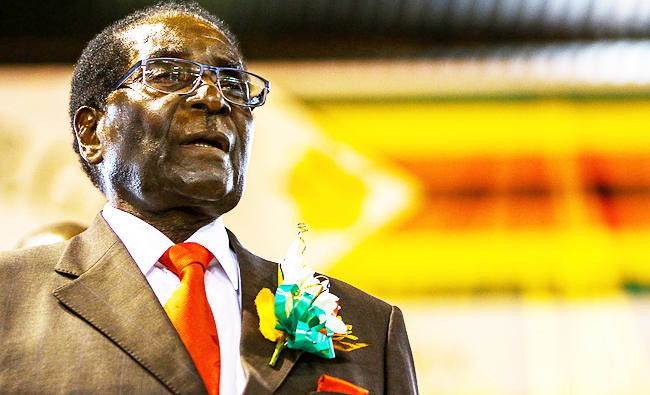
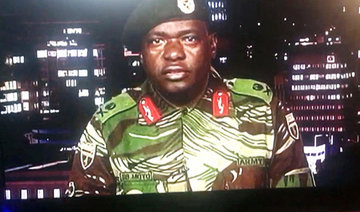
HARARE: Zimbabwe was on a knife’s edge on Thursday after the military seized power in what it dubbed a targeted operation against “criminals” in the entourage of President Robert Mugabe, who has ruled the southern African nation for almost four decades.
It was not clear whether the apparent military coup would bring a formal end to the 93-year-old Mugabe’s rule. The main goal of the generals appeared to be preventing Mugabe’s wife Grace, 41 years his junior, from succeeding him.
Local media reported South Africa’s defense and state security ministers, dispatched by President Jacob Zuma as regional envoys, arrived in Zimbabwe’s capital, Harare, on Wednesday night and were expected to meet both Mugabe and the military. Their ultimate goal was not clear.
Zuma earlier called for “calm and restraint” and asked the defense forces “to ensure that peace and stability are not undermined in Zimbabwe,” South Africa’s neighbor, which has lurched from crisis to crisis over the past two decades.
The South African presidency said Mugabe had told Zuma over the phone that he was confined to his home but was otherwise fine and the military said it was keeping him and his family safe.
Mugabe, still seen by many Africans as a liberation hero, is reviled in the West as a despot whose disastrous handling of the economy and willingness to resort to violence to maintain power destroyed one of Africa’s most promising states.
He plunged Zimbabwe into a fresh political crisis last week by firing his vice president and presumed successor, Emmerson Mnangagwa, 75 — known as the “crocodile” — for showing “traits of disloyalty.”
The generals believed that move was aimed at clearing a path for Grace Mugabe to take over and said on Monday they were prepared to “step in” if purges of their allies did not end.
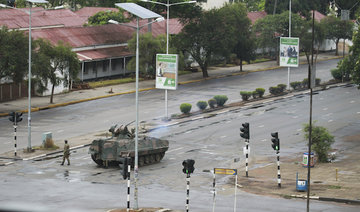
Tanks blocked roads after dark and soldiers with automatic weapons kept up their patrols, but the situation appeared calm.
Whatever the final outcome, the events could signal a once-in-a-generation change for the former British colony, a regional breadbasket reduced to destitution by economic policies Mugabe’s critics have long blamed on him.


Zimbabwe on knife’s edge after military seizes power
Zimbabwe on knife’s edge after military seizes power

Bangladesh’s religio-political party open to unity govt
- Opinion polls suggest that Jamaat-e-Islami will finish a close second to the Bangladesh Nationalist Party in the first election it has contested in nearly 17 years
DHAKA: A once-banned Bangladeshi religio-political party, poised for its strongest electoral showing in February’s parliamentary vote, is open to joining a unity government and has held talks with several parties, its chief said.
Opinion polls suggest that Jamaat-e-Islami will finish a close second to the Bangladesh Nationalist Party in the first election it has contested in nearly 17 years as it marks a return to mainstream politics in the predominantly Muslim nation of 175 million.
Jamaat last held power between 2001 and 2006 as a junior coalition partner with the BNP and is open to working with it again.
“We want to see a stable nation for at least five years. If the parties come together, we’ll run the government together,” Jamaat chief Shafiqur Rahman said in an interview at his office in a residential area in Dhaka, days after the party created a buzz by securing a tie-up with a Gen-Z party.
Rahman said anti-corruption must be a shared agenda for any unity government.
The prime minister will come from the party winning the most seats in the Feb. 12 election, he added. If Jamaat wins the most seats, the party will decide whether he himself would be a candidate, Rahman said.
The party’s resurgence follows the ousting of long-time Prime Minister Sheikh Hasina in a youth-led uprising in August 2024.
Rahman said Hasina’s continued stay in India after fleeing Dhaka was a concern, as ties between the two countries have hit their lowest point in decades since her downfall.
Asked about Jamaat’s historical closeness to Pakistan, Rahman said: “We maintain relations in a balanced way with all.”
He said any government that includes Jamaat would “not feel comfortable” with President Mohammed Shahabuddin, who was elected unopposed with the Awami League’s backing in 2023.