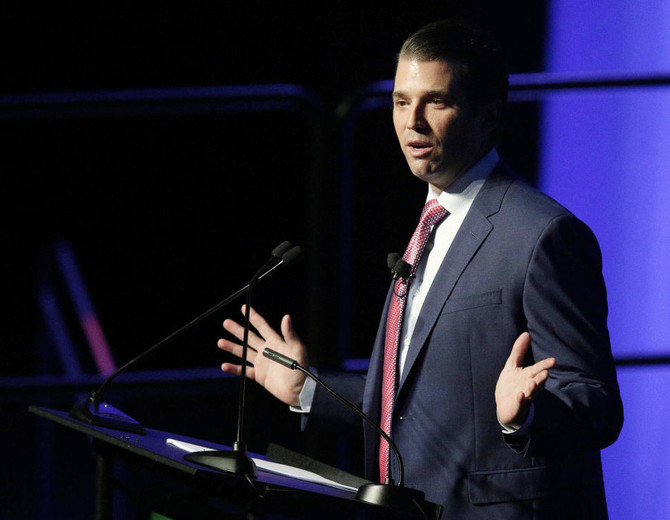
WASHINGTON: President Donald Trump’s oldest son on Monday released a series of private Twitter exchanges between himself and WikiLeaks during and after the 2016 election, including pleas from the website to publicize its leaks.
Donald Trump Jr.’s release of the messages on Twitter came hours after The Atlantic first reported them. In the exchanges — some of them around the time that the website was releasing the stolen emails from Democrat Hillary Clinton’s campaign chairman — WikiLeaks praises his father’s positive comments about WikiLeaks and asks Trump Jr. to release his father’s tax returns to the site.
The revelations are sure to increase calls in Congress to have Trump Jr. testify publicly as part of several committee probes into Russian interference in the 2016 election. And they add a new element to the investigations that have been probing for months whether Trump’s campaign colluded in any way with the Russian government.
In an intelligence assessment released last January, the NSA, CIA and FBI concluded that Russian military intelligence provided hacked information from the DNC and “senior Democratic officials” to WikiLeaks. WikiLeaks has denied that Russia was the source of emails it released, including those from Clinton’s campaign chairman, John Podesta.
The private messages released by Trump Jr. show him responding to the WikiLeaks account three times, at one point agreeing to “ask around” about a political action committee WikiLeaks had mentioned. He also asked the site about a rumor about an upcoming leak. The messages began in September 2016 and ran through July.
Trump Jr. downplayed the exchanges as he released them.
“Here is the entire chain of messages with @wikileaks (with my whopping 3 responses) which one of the congressional committees has chosen to selectively leak,” he tweeted. “How ironic!“
Trump Jr.’s lawyers had released the exchanges to three congressional committees that have been investigating Russian intervention in the 2016 election and whether there were any links to Trump’s campaign.
In a statement, Trump Jr.’s lawyer said thousands of documents had been turned over to the committees.
“Putting aside the question as to why or by whom such documents, provided to Congress under promises of confidentiality, have been selectively leaked, we can say with confidence that we have no concerns about these documents and any questions raised about them have been easily answered in the appropriate forum,” said Alan Futerfas.
Futerfas didn’t say which forum he was referring to, but Trump Jr. was interviewed behind closed doors by Senate Judiciary Committee staff in September. A person familiar with that meeting said the private Twitter messages were discussed. The person declined to be identified because the transcript of that interview hasn’t been made public.
In one message dated Oct. 3, 2016, the WikiLeaks Twitter account sent Trump Jr. an article that included critical comments Clinton had made about WikiLeaks editor Julian Assange and said “it’d be great if you guys could comment on/push this story.”
Trump Jr. replied: “Already did that earlier today. It’s amazing what she can get away with.”
Two minutes later, Trump Jr. sent another message: “What’s behind this Wednesday leak I keep reading about?“
Longtime Trump associate Roger Stone had tweeted the day before that on Wednesday, “Hillary Clinton is done,” referencing WikiLeaks.
The WikiLeaks Twitter account never responded, but days later WikiLeaks started rolling out Podesta’s stolen emails. After the emails were released, WikiLeaks sent Trump Jr. a searchable link of the emails. Trump Jr. tweeted that link two days later, on Oct. 14, 2016, The Atlantic noted.
The rest of the messages are one-sided, with WikiLeaks sending Trump Jr. messages through July 2017. They include praise for his father for mentioning them on the campaign trail, a plea to release Trump’s taxes to the site and advice on Election Day that Trump should not concede if he lost. One message suggested Trump encourage Australia to appoint Assange as US ambassador.
In July, the Twitter account messaged Trump Jr. to ask him to give the site emails surrounding a meeting he and other Trump associates held with Russians during the campaign. Trump Jr. then released them himself.
Vice President Mike Pence responded quickly to the revelations, issuing a statement through his press secretary that he knew nothing about the situation.
“The vice president was never aware of anyone associated with the campaign being in contact with WikiLeaks,” said spokeswoman Alyssa Farah. “He first learned of this news from a published report earlier tonight.”
Assange tweeted after The Atlantic report that he couldn’t confirm the messages but then defended them after Trump Jr. released them.
“WikiLeaks appears to beguile some people into transparency by convincing them that it is in their interest,” Assange tweeted.
Democrats swiftly reacted to the report, saying Trump Jr. should provide more information. California Rep. Adam Schiff, the top Democrat on the House intelligence committee, says it “demonstrates once again a willingness by the highest levels of the Trump campaign to accept foreign assistance.”
Schiff also pointed to Cambridge Analytica, a data firm that worked for Trump’s campaign and reached out to WikiLeaks before the election about obtaining emails related to Clinton, according to the company’s CEO.
Democratic Sen. Richard Blumenthal, a member of the Senate Judiciary Committee, said that panel should subpoena the documents and force Trump Jr. to publicly testify.
“There seems to be no reasonable explanation for these messages,” Blumenthal said.
Senate Judiciary Committee Chairman Chuck Grassley had said he would call Trump Jr. to publicly testify after the private interview in September. But negotiations over witnesses broke down last month amid disagreements with Democrats on the panel.
The House and Senate intelligence committees are also expecting to interview Trump Jr., but those interviews are expected to be behind closed doors.

Trump Jr. messaged with WikiLeaks during 2016 campaign
War powers resolution fails in Senate as 2 Republicans bow to Trump pressure
WASHINGTON: Senate Republicans voted to dismiss a war powers resolution Wednesday that would have limited President Donald Trump’s ability to conduct further attacks on Venezuela after two GOP senators reversed course on supporting the legislation.
Trump put intense pressure on five Republican senators who joined with Democrats to advance the resolution last week and ultimately prevailed in heading off passage of the legislation. Two of the Republicans — Sens. Josh Hawley of Missouri and Todd Young of Indiana — flipped under the pressure.
Vice President JD Vance had to break the 50-50 deadlock in the Senate on a Republican motion to dismiss the bill.
The outcome of the high-profile vote demonstrated how Trump still has command over much of the Republican conference, yet the razor-thin vote tally also showed the growing concern on Capitol Hill over the president’s aggressive foreign policy ambitions.
Democrats forced the debate after US troops captured Venezuelan leader Nicolás Maduro in a surprise nighttime raid earlier this month
“Here we have one of the most successful attacks ever and they find a way to be against it. It’s pretty amazing. And it’s a shame,” Trump said at a speech in Michigan Tuesday. He also hurled insults at several of the Republicans who advanced the legislation, calling Sen. Rand Paul of Kentucky a “stone cold loser” and Sens. Lisa Murkowski of Alaska and Susan Collins of Maine “disasters.” Those three Republicans stuck to their support for the legislation.
Trump’s latest comments followed earlier phone calls with the senators, which they described as terse. The president’s fury underscored how the war powers vote had taken on new political significance as Trump also threatens military action to accomplish his goal of possessing Greenland.
The legislation, even if it had cleared the Senate, had virtually no chance of becoming law because it would eventually need to be signed by Trump himself. But it represented both a test of GOP loyalty to the president and a marker for how much leeway the Republican-controlled Senate is willing to give Trump to use the military abroad. Republican angst over his recent foreign policy moves — especially threats of using military force to seize Greenland from a NATO ally — is still running high in Congress.
Two Republicans reconsider
Hawley, who helped advance the war powers resolution last week, said Trump’s message during a phone call was that the legislation “really ties my hands.” The senator said he had a follow-up phone call with Secretary of State Marco Rubio Monday and was told “point blank, we’re not going to do ground troops.”
The senator added that he also received assurances that the Trump administration will follow constitutional requirements if it becomes necessary to deploy troops again to the South American country.
“We’re getting along very well with Venezuela,” Trump told reporters at a ceremony for the signing of an unrelated bill Wednesday.
As senators went to the floor for the vote Wednesday evening, Young also told reporters he was no longer in support. He said that he had extensive conversations with Rubio and received assurances that the secretary of state will appear at a public hearing before the Senate Foreign Relations Committee.
Young also shared a letter from Rubio that stated the president will “seek congressional authorization in advance (circumstances permitting)” if he engaged in “major military operations” in Venezuela.
The senators also said his efforts were also instrumental in pushing the administration to release Wednesday a 22-page Justice Department memo laying out the legal justification for the snatch-and-grab operation against Maduro.
That memo, which was heavily redacted, indicates that the administration, for now, has no plans to ramp up military operations in Venezuela.
“We were assured that there is no contingency plan to engage in any substantial and sustained operation that would amount to a constitutional war,” according to the memo signed by Assistant Attorney General Elliot Gaiser.
Trump’s shifting rationale for military intervention
Trump has used a series of legal arguments for his campaign against Maduro.
As he built up a naval force in the Caribbean and destroyed vessels that were allegedly carrying drugs from Venezuela, the Trump administration tapped wartime powers under the global war on terror by designating drug cartels as terrorist organizations.
The administration has claimed the capture of Maduro himself was actually a law enforcement operation, essentially to extradite the Venezuelan president to stand trial for charges in the US that were filed in 2020.
Paul criticized the administration for first describing its military build-up in Caribbean as a counternarcotics operation but now floating Venezuela’s vast oil reserves as a reason for maintaining pressure.
“The bait and switch has already happened,” he said.
Trump’s foreign policy worries Congress
Lawmakers, including a significant number of Republicans, have been alarmed by Trump’s recent foreign policy talk. In recent weeks, he has pledged that the US will “run” Venezuela for years to come, threatened military action to take possession of Greenland and told Iranians protesting their government that ” help is on its way.”
Senior Republicans have tried to massage the relationship between Trump and Denmark, a NATO ally that holds Greenland as a semi-autonomous territory. But Danish officials emerged from a meeting with Vance and Rubio Wednesday saying a “fundamental disagreement” over Greenland remains.
“What happened tonight is a roadmap to another endless war,” Senate Democratic leader Chuck Schumer said at a news conference following the vote.
More than half of US adults believe President Donald Trump has “gone too far” in using the US military to intervene in other countries, according to a new AP-NORC poll.
House Democrats have also filed a similar war powers resolution and can force a vote on it as soon as next week.
How Republican leaders dismissed the bill
Last week’s procedural vote on the war powers resolution was supposed to set up hours of debate and a vote on final passage. But Republican leaders began searching for a way to defuse the conflict between their members and Trump as well as move on quickly to other business.
Once Hawley and Young changed their support for the bill, Republicans were able to successfully challenge whether it was appropriate when the Trump administration has said US troops are not currently deployed in Venezuela.
“We’re not currently conducting military operations there,” said Senate Majority Leader John Thune in a floor speech. “But Democrats are taking up this bill because their anti-Trump hysteria knows no bounds.”
Democratic Sen. Tim Kaine, who has brought a series of war powers resolutions this year, accused Republicans of burying a debate about the merits of an ongoing campaign of attacks and threats against Venezuela.
“If this cause and if this legal basis were so righteous, the administration and its supporters would not be afraid to have this debate before the public and the United States Senate,” he said in a floor speech.