Aftershocks in Iraq and cracks appear in dam

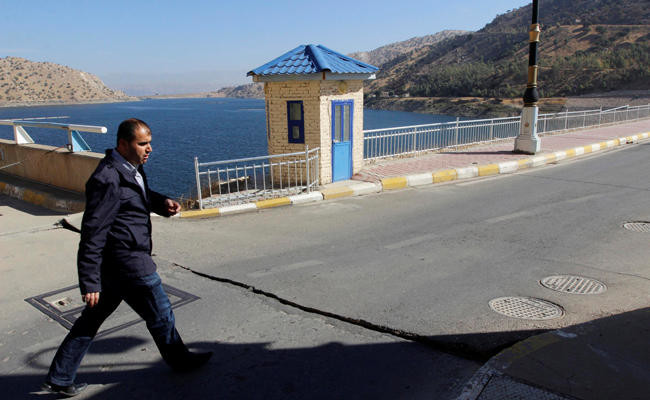
A crack is seen on a road after an earthquake at the Darbandikhan Dam, near the city of Sulaimaniyah, in the semi-autonomous Kurdistan region, Iraq, on November 13, 2017. (REUTERS/Ako Rasheed)
Updated 14 November 2017
Follow

Aftershocks in Iraq and cracks appear in dam

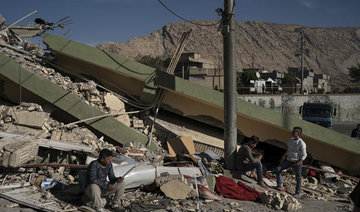
BAGHDAD: Iraq recorded more than 60 aftershocks following Sunday’s powerful main earthquake, in which many people died, hundreds were injured and dozens of homes were destroyed.

Cracks also appeared in the Darbandikhan Dam on the Diyala River in northern Sulaymaniyah governorate, but the local mayor said the risk of its collapsing was “remote.”

Darbandikhan town in Iraqi Kurdistan is the closest inhabited area to the quake’s epicenter and suffered most of the casualties. More than 35 homes and a three-floor complex were severely damaged, and people were asked to move to safety as the area is still at risk from aftershocks.

“The situation is under control now but there is a fear of aftershocks, as many of the houses are located beneath the dam,” Nasseh Mulla Hassan, the mayor, told Arab News on Monday.

“The technical committee sent by Baghdad today to examine the dam showed that the quake caused damage, but there is no risk of its collapse at the moment.”

Other dams in Iraq were also damaged, but Prime Minister Haider Al-Abadi’s office said: “The dams are safe and there is no danger.”

Al-Abadi held a series of meetings with concerned departments on Monday to address potential threats, and formed committees to assess the damage. Civil defense teams, local police and hospitals across the country were put on high alert.

Fadhil Ibrahim, general director of meteorology and seismic monitoring in the Kurdistan Region, told Arab News that aftershocks continued to be felt with a magnitude of 3 to 4.5, compared with the initial tremor’s 7.3.

“They are not expected to be any stronger but they will continue for two weeks or a month until the region is stabilized,” he said.

“The danger still exists because the aftershocks are near the seismic center in the region.”


Morocco’s energy ministry puts gas pipeline project on hold

Updated 4 sec ago
Follow

Morocco’s energy ministry puts gas pipeline project on hold

  • The country’s natural gas demand is expected to rise to 8 billion cubic meters in 2027 from around ‌1 bcm currently, according to ministry estimates

RABAT: Morocco’s energy ministry said on Monday it has paused a tender launched last month ​for a gas pipeline project, without giving details on the reasons for the suspension.
The tender sought bids to build a pipeline linking a future gas terminal at the Nador West Med port ‌on the Mediterranean ‌to an existing ‌pipeline ⁠that ​allows ‌Morocco to import LNG through Spanish terminals and supply two power plants.
It also covered a section that would connect the existing pipeline to industrial zones on the Atlantic in ⁠Mohammedia and Kenitra.
“Due to new parameters and assumptions ‌related to this project... the ‍ministry of ‍energy transition and sustainable development is ‍postponing the receipt of applications and the opening of bids received as of today,” the ministry said in a statement.
Morocco ​is looking to expand its use of natural gas to diversify ⁠away from coal as it also accelerates its renewable energy plan, which aims for renewables to account for 52 percent of installed capacity by 2030, up from 45 percent now.
The country’s natural gas demand is expected to rise to 8 billion cubic meters in 2027 from around ‌1 bcm currently, according to ministry estimates.