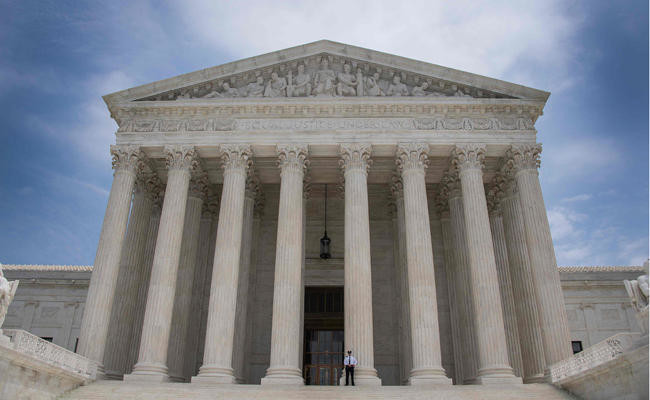
WASHINGTON: Surely but slowly, the Supreme Court is entering the 21st century. The court is making new legal filings available online starting Monday, years behind the rest of the federal court system.
Can livestreamed audio of arguments and even televised sessions be far behind? Yes, they can.
But advocates of court openness will take what they can get for now, especially because the Supreme Court will not charge for documents. The federal courts’ PACER system does charge fees.
“Though the Supreme Court has moved glacially to join the rest of the judiciary in permitting online filing, that’s better than not at all, and the institution should be commended for creating an e-filing system that, unlike PACER, will be free and easily accessible to the public,” said Gabe Roth, executive director of Fix the Court.
Over the years, the justices have at times shown a glancing familiarity with technology. Some carry computer tablets with high court briefs loaded on them. But notes between justices are routinely sent on paper, definitely not by email.
Chief Justice John Roberts himself noted a few years back that the court stuck with pneumatic tubes to transmit newly released opinions from the courtroom to reporters waiting one floor below until 1971, long after their heyday.
Roberts said that it’s appropriate for courts “to be late to the harvest of American ingenuity” because their primary role is to resolve disputes fairly.
Many Supreme Court legal briefs already are available online and for free from several sources. Scotusblog.com obtains and posts many of them, along with opinions. The Justice Department has an easily accessible archive of its extensive high court filings on its website, and the American Bar Association posts briefs in the 70 to 80 cases the court agrees to hear each term.
But the public may not know to look elsewhere. When the justices issued their highly anticipated decision upholding President Barack Obama’s health care overhaul in 2012, the court’s website was overwhelmed.
It, too, has recently been overhauled to make it friendlier to the public.
The Supreme Court updates come amid criticism of the PACER system as outmoded and unfair. “The PACER system used by the lower federal courts is hopelessly outdated and cumbersome. And, to add insult to injury, the PACER system charges people fees to access court records that should be made freely available,” said Deepak Gupta, the lead attorney in a class-action lawsuit challenging PACER fees.
The judiciary says the fees provide the only money to pay for the system.
The cost to users was just one among several reasons the court opted not to join the PACER system, court spokeswoman Kathy Arberg said.
“The court elected to design its system in-house so that it would have the capability to customize and continuously update to meet the distinctive needs of the court and counsel,” Arberg said.
Until now, lawyers have not been required to submit their filings to the court electronically. Beginning Monday, those documents should appear quickly on the court’s website. People who can’t afford to pay court costs will be allowed to file paper copies, which Supreme Court employees will scan and post online.
Not everything is changing. Lawyers still will be required to submit up to 40 paper copies of every brief, and the court’s color-coding system to distinguish types of briefs also will remain.
There’s no timetable for electronic filings to supplant paper as the official court record.
And there’s also no expectation that the justices will drop their prohibition on cameras in the courtroom anytime soon.
Justice Sonia Sotomayor, who once sounded open to cameras, recently told a New York audience that cameras might detract from the robust exchanges during arguments.
The Supreme Court also refuses to livestream audio of its arguments, even as the federal appeals court just down Capitol Hill recently has allowed live audio access to its hearings. The high court posts transcripts within hours of arguments, but doesn’t release the audio for days.

US Supreme Court enters 21st Century, takes a technological step forward
Afghans mourn villagers killed in Pakistani strikes
- Afghans gathered around a mass grave Sunday to bury villagers killed in overnight air strikes by Pakistan, which said its military targeted militants
BIHSUD: Afghans gathered around a mass grave Sunday to bury villagers killed in overnight air strikes by Pakistan, which said its military targeted militants.
The overnight attacks killed at least 18 people and were the most extensive since border clashes in October, which left more than 70 dead on both sides and wounded hundreds.
“The house was completely destroyed. My children and family members were there. My father and my sons were there. All of them were killed,” said Nezakat, a 35-year-old farmer in Bihsud district, who only gave one name.
Islamabad said it hit seven sites along the border region targeting Afghanistan-based militant groups, in response to suicide bombings in Pakistan.
The military targeted the Pakistani Taliban and its associates, as well as an affiliate of the Daesh group, a statement by the Ministry of Information and Broadcasting said.
Afghan government spokesperson Zabihullah Mujahid said “people’s homes have been destroyed, they have targeted civilians, they have committed this criminal act” with the bombardment of Nangarhar and Paktika provinces.
Residents from around the remote Bihsud district in Nangarhar joined searchers to look for bodies under the rubble, an AFP journalist said, using shovels and a digger.
“People here are ordinary people. The residents of this village are our relatives. When the bombing happened, one person who survived was shouting for help,” said neighbor Amin Gul Amin, 37.
Nangarhar police told AFP the bombardment started at around midnight and hit three districts, with those killed all in a civilian’s house.
“Twenty-three members of his family were buried under the rubble, of whom 18 were killed and five wounded,” said police spokesperson Sayed Tayeeb Hammad.
Strikes elsewhere in Nangarhar wounded two others, while in Paktika an AFP journalist saw a destroyed guesthouse but there were no immediate reports of casualties.
- ‘Calculated response’ -
Afghanistan’s defense ministry said it will “deliver an appropriate and calculated response” to the Pakistani strikes.
The two countries have been locked in an increasingly bitter dispute since the Taliban authorities retook control of Afghanistan in 2021.
Pakistani military action killed 70 Afghan civilians between October and December, according to the UN mission in Afghanistan.
Several rounds of negotiations followed an initial ceasefire brokered by Qatar and Turkiye, but they have failed to produce a lasting agreement.
Saudi Arabia intervened this month, mediating the release of three Pakistani soldiers captured by Afghanistan in October.
The deteriorating relationship has hit people in both countries, with the land border largely shut for months.
Pakistan said Sunday that despite repeated urging by Islamabad, the Taliban authorities have failed to act against militant groups using Afghan territory to carry out attacks in Pakistan.
The Afghan government has denied harboring militants.
Islamabad launched the strikes after a suicide blast at a Shiite mosque in Islamabad two weeks ago and other such attacks more recently in northwestern Pakistan.
The Daesh group had claimed responsibility for the mosque bombing, which killed at least 40 people and wounded more than 160 in the deadliest attack in Islamabad since 2008.
The militant group’s regional chapter, Islamic State-Khorasan, also claimed a deadly suicide bombing at a Kabul restaurant last month.
The overnight attacks killed at least 18 people and were the most extensive since border clashes in October, which left more than 70 dead on both sides and wounded hundreds.
“The house was completely destroyed. My children and family members were there. My father and my sons were there. All of them were killed,” said Nezakat, a 35-year-old farmer in Bihsud district, who only gave one name.
Islamabad said it hit seven sites along the border region targeting Afghanistan-based militant groups, in response to suicide bombings in Pakistan.
The military targeted the Pakistani Taliban and its associates, as well as an affiliate of the Daesh group, a statement by the Ministry of Information and Broadcasting said.
Afghan government spokesperson Zabihullah Mujahid said “people’s homes have been destroyed, they have targeted civilians, they have committed this criminal act” with the bombardment of Nangarhar and Paktika provinces.
Residents from around the remote Bihsud district in Nangarhar joined searchers to look for bodies under the rubble, an AFP journalist said, using shovels and a digger.
“People here are ordinary people. The residents of this village are our relatives. When the bombing happened, one person who survived was shouting for help,” said neighbor Amin Gul Amin, 37.
Nangarhar police told AFP the bombardment started at around midnight and hit three districts, with those killed all in a civilian’s house.
“Twenty-three members of his family were buried under the rubble, of whom 18 were killed and five wounded,” said police spokesperson Sayed Tayeeb Hammad.
Strikes elsewhere in Nangarhar wounded two others, while in Paktika an AFP journalist saw a destroyed guesthouse but there were no immediate reports of casualties.
- ‘Calculated response’ -
Afghanistan’s defense ministry said it will “deliver an appropriate and calculated response” to the Pakistani strikes.
The two countries have been locked in an increasingly bitter dispute since the Taliban authorities retook control of Afghanistan in 2021.
Pakistani military action killed 70 Afghan civilians between October and December, according to the UN mission in Afghanistan.
Several rounds of negotiations followed an initial ceasefire brokered by Qatar and Turkiye, but they have failed to produce a lasting agreement.
Saudi Arabia intervened this month, mediating the release of three Pakistani soldiers captured by Afghanistan in October.
The deteriorating relationship has hit people in both countries, with the land border largely shut for months.
Pakistan said Sunday that despite repeated urging by Islamabad, the Taliban authorities have failed to act against militant groups using Afghan territory to carry out attacks in Pakistan.
The Afghan government has denied harboring militants.
Islamabad launched the strikes after a suicide blast at a Shiite mosque in Islamabad two weeks ago and other such attacks more recently in northwestern Pakistan.
The Daesh group had claimed responsibility for the mosque bombing, which killed at least 40 people and wounded more than 160 in the deadliest attack in Islamabad since 2008.
The militant group’s regional chapter, Islamic State-Khorasan, also claimed a deadly suicide bombing at a Kabul restaurant last month.
© 2026 SAUDI RESEARCH & PUBLISHING COMPANY, All Rights Reserved And subject to Terms of Use Agreement.