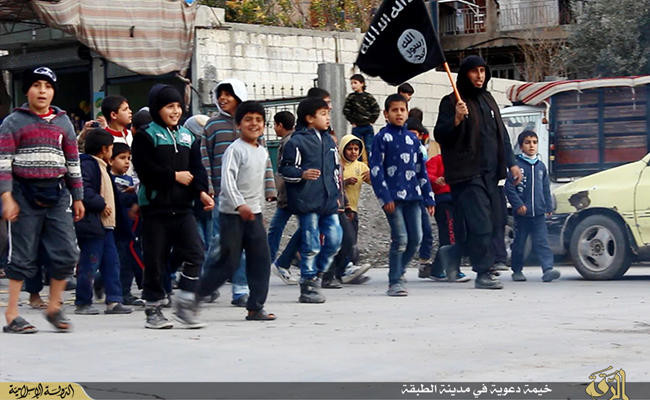
LONDON: A 9-year-old boy who stood up in class to declare his support for Daesh after seeing execution videos online is among more than 2,000 British children, including over 500 girls, identified as potential extremists according to data released by the UK government on Thursday.
The London schoolboy, given the pseudonym Haaruun, watched videos of beheadings and people being burned by Daesh after searching for extremist material online in the wake of the Paris attacks two years ago, the Home Office told Arab News.
Government figures released yesterday, the most detailed so far on the number of people referred to the government’s de-radicalization program Prevent, revealed that nearly a third of referrals were of people under the age of 15 and more than half under the age of 20.
In total, 7,631 were referred to the scheme during a 12-month period up to the end of March last year, 5,000 of whom were reported in relation to concerns about extremist sympathies toward groups like Daesh and Al-Qaeda, while 759 were linked to right-wing extremism, according to UK media.
More young people than ever are now being reported, heightening concerns about the access to online extremist material. In some cases, children as young as 5 or 6 have been sent for help due to the involvement of older siblings in terrorist activity.
Amber Rudd, the home secretary, is currently meeting tech giants in the US to discuss concerns about the availability of extremist content on the Internet.
Social media companies have come under fire in recent months for failing to take a more aggressive stance in tackling online extremism.
Commentators say a much more proactive commitment is needed from tech companies to combat the mounting threat.
“Terrorists and violent extremists rely heavily on social media and online communication platforms such as YouTube, Telegram and Twitter to spread their ideologies. As a result, disrupting those networks and removing terrorist propaganda are vital steps towards preventing radicalization and its consequences,” Mark Wallace, CEO of the Counter Extremist Project (CEP), told Arab News.
“We have seen some progress from certain companies on this front, but that has come only after significant criticism, reputational damage and threats from lawmakers. Tech companies have been far too reluctant to meet their ethical obligations to better protect their users and customers, who number among those killed by terrorist violence,” he added.
A recent report from the World Economic Forum’s human rights council warned that tech companies could be subject to government regulation limiting freedom of speech unless they “assume a more active self-governance role.”
Earlier this year, British Prime Minister Theresa May and French premier Emmanuel Macron met in Paris to launch a joint campaign to tackle online radicalization.
“In the UK we are already working with social media companies to halt the spread of extremist material and poisonous propaganda that is warping young minds,” May said.
The prime minister has also urged Internet companies to be quicker in identifying and taking down extremist content, calling for the average 36-hour removal period to be reduced to two hours.
In June, tech companies including Facebook, YouTube, Twitter and Microsoft teamed up to launch the Global Internet Forum to Counter Terrorism, pledging to share best practices and “define standard transparency reporting methods for terrorist content removals.”
A Twitter report revealed that the platform suspended 935,589 accounts for promoting terrorism between the beginning of August 2015 to end of June 2017. Data shared with Arab News also highlighted Twitter's use of “faster, more efficient, and smarter” anti-spam tools to get terrorist content off the platform.
A spokesperson from YouTube said: “Online extremism is a complex problem and addressing it is a critical challenge for us all … We are making significant progress through machine-learning technology, partnerships with experts, and collaboration with other companies through the Global Internet Forum — and we know there is more to be done.”
With the disintegration of Daesh’s self-proclaimed caliphate, concerns are mounting over the thousands of extremists expected to return home and the increasing presence of terror groups online.
“The defeat of Daesh on the battlefield will only make the group’s online engagement all the more important to its continued relevance and ability to inspire acts of violence,” Hany Farid, a professor of computer science at Dartmouth College in the US, told Arab News.
At an Intelligence and National Security Summit in September, top terror chiefs from the US, Britain, Germany and Canada called for greater cooperation from social media platforms to combat the growing threat from lone-wolf attacks perpetrated by self-radicalized individuals.
“We know that social-media platforms and video-sharing sites are the main avenues for terrorist content corrupting vulnerable individuals. And we know that the technological means exist to better thwart the spread of this content. So why isn’t more being done?” Farid said.
Terrorists are using the online sphere for a variety of functions, including recruitment, plotting, sourcing materials and coordinating attacks.
“Terrorist content continues to be prominent in the online space, as it is easily accessible and free to those seeking it. Platforms like YouTube, Facebook, Twitter, and Telegram are just some of the places, but not the only places, where content can be shared,” Farid continued.
“They are also frequently the first point of exposure for individuals who will subsequently seek out more content.
“If the tech giants do not earnestly take action against this development, online radicalization will become an even greater threat than it is today.”


![]()
9-year-old British boy ‘pledged support for Daesh after watching terror videos’
9-year-old British boy ‘pledged support for Daesh after watching terror videos’

Latest updates


Recommended


© 2026 SAUDI RESEARCH & PUBLISHING COMPANY, All Rights Reserved And subject to Terms of Use Agreement.