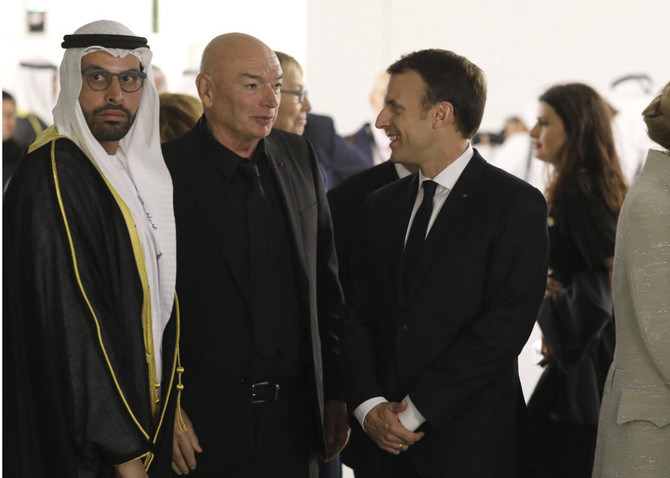

DUBAI: The Louvre Abu Dhabi saw its official opening on Wednesday, drawing French President Emmanuel Macron to the Middle East on his first official visit.
Pausing to shake hands on a red carpet lining the all-white path leading to the museum, Macron and France’s First Lady walked side by side with Abu Dhabi Crown Prince Sheikh Mohammed bin Zayed and Vice President and Prime Minister of the UAE and Ruler of Dubai Sheikh Mohammed bin Rashid.
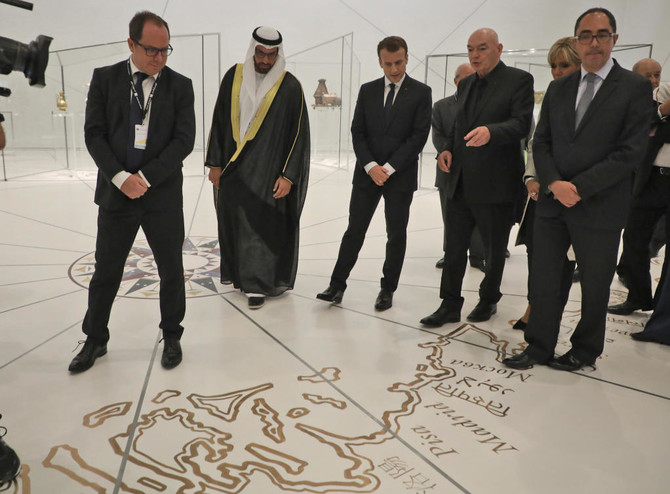
Macron, who is also scheduled to hold talks with UAE officials, toured the 12-gallery museum – the first to carry the famed Louvre brand outside France – shortly after touching down in Abu Dhabi, along with the heads of state of Morocco and Afghanistan.
The new museum was a “bridge between civilizations,” he said at the opening. “Those who seek to say that Islam is the destruction of other religions are liars.”
Sheikh Mohammed said: “The Louvre Abu Dhabi will be a meeting point for lovers of art, culture and beauty all around the world. With the opening of this museum, Abu Dhabi has become the capital of art, architecture and mankind’s heritage.”
The opening comes a decade after France and the UAE agreed to a 30-year partnership initially reported to be worth $1.1 billion, including nearly half a billion dollars for the rights to the Louvre brand alone. It is the first to the carry the Louvre brand outside of France.
However Jean-Luc Martinez, president-director of the Louvre Museum in Paris, said at an earlier press conference that the Louvre Abu Dhabi was an Emirati museum.
“This is an Emirati project, in keeping with the UAE leaders’ vision of a knowledge movement in the 21st century, and France shares its knowledge,” he said.
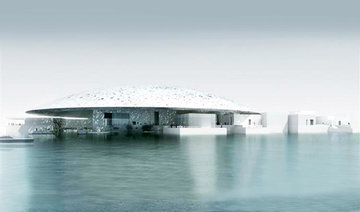
The design of the building is the work of by France’s Pritzker prize-winning architect Jean Nouvel.
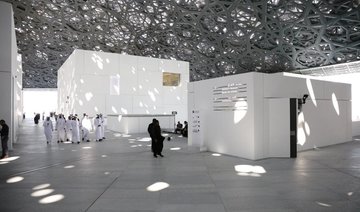
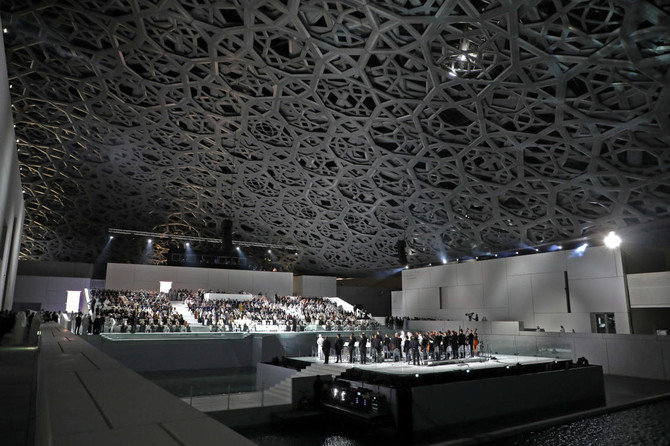
A silver-toned dome with perforated arabesque patterns appears to float over the white galleries, creating what Nouvel describes as a “rain of light.”
To reach the ground, each ray of light must cross eight layers of perforations, creating a constantly shifting pattern that mimics the shadows cast by palm trees or the roof of a traditional Arab market.
The Louvre Abu Dhabi is the first of three museums to open on Saadiyat Island, where the UAE plans to launch the Guggenheim Abu Dhabi, designed by Frank Gehry, and Norman Foster’s Zayed National Museum.
About five percent of the museum, which opens to the public on Saturday, Nov. 11, is dedicated to contemporary and modern art, including a piece by China’s Ai Weiwei.
His 23-foot-high “Fountain of Light” is a spiraling structure draped in crystals inspired by communist plans for a massive monument that never actually saw the light of day.
But the museum’s main focus is world history and religions. Among the exhibits are an early Qur’an, a gothic Bible and a Yemenite Torah, facing each other and open at verses carrying the same message.
Sheikh Mohammed later tweeted: “The dome of the Louvre Abu Dhabi contains a collection of astounding art collated from various cultures over thousands of years. The light it shines beckons civilizations to come together again in this cradle of humanity.”
The dome of the Louvre Abu Dhabi contains a collection of astounding art collated from various cultures over thousands of years. The light it shines beckons civilisations to come together again in this cradle of humanity. pic.twitter.com/pVrkaOaDXZ
— HH Sheikh Mohammed (@HHShkMohd) November 8, 2017
Martinez said the new museum was designed “to open up to others, to understand diversity” in “a multipolar world.”
There are 300 pieces on loan, including an 1887 self-portrait by Vincent van Gogh and Leonardo da Vinci’s “La Belle Ferronniere.”
But the Emirates have also built its own permanent collection.
The Louvre Abu Dhabi is displaying more than 235 works of art from the Emirati collection, including Edouard Manet’s “The Gypsy” and works by Dutch abstract artist Piet Mondrian and Turkey’s Osman Hamdi Bey.
The authorities have put in place strict measures to protect the art from the heat as summer temperatures soar well above 40 degrees Celsius.
The artworks are also guarded by Emirati forces in coordination with French experts.
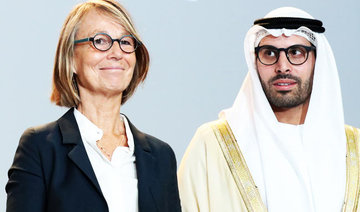
The museum is expecting somewhere in the region of 5,000 visitors in the first few days, according to Mohammed Al-Mubarak, chairman of the Abu Dhabi Culture and Tourism Authority.
“Because this is an international museum, we’re expecting visitors from around the world,” Mubarak had said at a media preview on Tuesday.
“So a museum visitor from China will find something that speaks to her, to her history. A visitor from India will find the same.”
Our thanks to the people of France and to Sheikh Mohammed bin Zayed, whose vision has pushed beyond the limits of architecture and culture, consolidating Sheikh Zayed’s proud legacy of enlightenment and cultural understanding. pic.twitter.com/TNM91wwqQ7
— HH Sheikh Mohammed (@HHShkMohd) November 8, 2017
The Louvre Abu Dhabi reminds us that our strength lies in our ability to communicate, share and learn from different global cultures. In our quest for knowledge and development, we build connections around the world. pic.twitter.com/7RCPapfZfo
— HH Sheikh Mohammed (@HHShkMohd) November 8, 2017
Today we inaugurated the Louvre Abu Dhabi with pride. This key cultural and architectural monument is a celebration for all Arabs, bridging East and West and introducing Abu Dhabi as a bright new global cultural hub. pic.twitter.com/XZ89SeSk4d
— HH Sheikh Mohammed (@HHShkMohd) November 8, 2017
(With AFP)