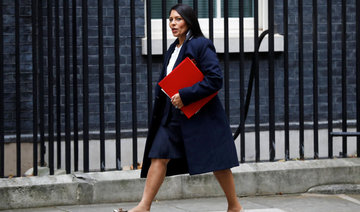
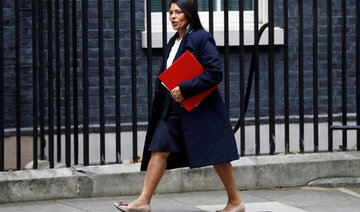
LONDON: Britain’s International Development Secretary Priti Patel quit on Wednesday over unauthorized meetings in Israel, becoming the latest Cabinet member caught up in a whirlwind of scandals rocking Prime Minister Theresa May’s government.
The issue has raised fresh questions about the UK government’s impartiality in mediating conflict in the Middle East, according to the Palestinian ambassador in London.
A total of 14 previously undisclosed engagements between Patel and Israeli representatives, including Prime Minister Benjamin Netanyahu, cast doubt on the UK’s integrity as a peace broker, Ambassador Manuel Hassassian told Arab News.
“The consequences of (Patel’s) act will definitely now make the Palestinians question the intentions of the British government,” he told Arab News.
Aside from Patel failing to disclose to the public her contact with Israeli officials, Hassassian said the unevenness of her trip spoke volumes about the British government’s priorities.
“She did not even meet with any of the Palestinian authorities,” he said, accusing Downing Street of “not playing a fair hand” in its approach to the two sides.
“I question the sincerity of this government (when it comes to) a two-state solution,” he added.
The scandal came to a head on Wednesday when it was revealed that Patel had visited a field hospital run by the Israeli Army in the occupied Golan Heights.
While Israel seized the region from Syria in the 1967 War, the British government does not recognize the Jewish state’s claim to the territory, which has been condemned as illegal by the UN. British diplomats are not normally permitted to travel there under official Israeli auspices.
Following her visit to the disputed territory, Patel suggested that British aid money be allocated to a humanitarian project there managed by the Israeli Defense Forces.
Number 10 was forced to deny knowledge of the plan.
Prime Minister Theresa May summoned Patel back from Kenya to answer questions about the unofficial trip.
By the time Patel’s flight landed on Wednesday afternoon, analysts and pundits were already debating her most likely replacements.
Revelations about Patel’s meetings, 12 of which took place during a family trip to Israel, raise serious questions about May’s ability to maintain discipline in her Cabinet, said Yossi Mekelberg, a professor of international relations at Regent’s University, London.
“There probably should have been someone from the embassy involved … If you’re talking about serious matters with implications for the foreign policy of the United Kingdom, you can’t have (these meetings) on the side,” he said.
The incident comes just a week after the resignation of Defense Secretary Michael Fallon, who had been mired in allegations of sexual harassment. Fallon was known as a staunch ally of Prime Minister May.
Mekelberg joined a chorus of voices who questioned whether May’s government would be able to survive another resignation. “The balance within the government is so delicate right now,” he added. “The prime minister is in dire straits.”
The diplomatic debacle comes as the British government is already under fire for hosting Netanyahu as guest of honor at an event marking the centenary of the Balfour Declaration last week.
Hassassian has said that the 1917 Balfour Declaration, in which Britain officially lent its support to the creation of a Jewish homeland in Palestine, was the first step in dispossessing the Palestinian people of their land.

UK aid minister Patel resigns over secret Israel meetings
Minister walks out of film festival after accusations of German role in Gaza ‘genocide’
BERLIN: A German minister walked out of the awards ceremony of the Berlin Film Festival after a prize-winning director accused Germany of complicity in the “genocide” committed by Israel in Gaza.
Social Democratic Environment Minister Carsten Schneider left the ceremony on Saturday evening because of “unacceptable” remarks, his ministry said.
Syrian-Palestinian director Abdallah Al-Khatib, who picked up a prize for Best First Feature Award with his “Chronicles from the Siege,” said in his speech that the German government “are partners in the genocide in Gaza by Israel. I believe you are intelligent enough to recognize this truth.”
Schneider was the only member of the German government attending the ceremony though he was not representing it, his ministry told AFP.
The Ministry of Culture, contacted by AFP to find out the reason for the absence of its minister Wolfram Weimer, did not respond immediately.
A leading member of Chancellor Friedrich Merz’s conservative party, Alexander Hoffmann, denounced what he said were “repugnant scenes” of “antisemitic” during the ceremony.
“The accusations of genocide, the antisemitic outbursts, and the threats against Germany at the Berlinale are absolutely unacceptable,” Hoffmann, head of the Christian Social Union, the Bavarian party allied with Merz’s Christian Democratic Union, told the Bundestag.
The CDU mayor of Berlin Kai Wegner told newspaper Bild that “The open display of hatred toward Israel is in direct contradiction with what this festival represents.”
The backdrop of the conflict in the Middle East led to a tense 76th edition of the festival.
More than 80 film professionals criticized the Berlinale’s “silence” on the war in Gaza in an open letter, accusing the festival of censoring artists “who reject the genocide” they believe Israel has committed in Gaza.
Award-winning Indian writer Arundhati Roy withdrew from the festival after jury president Wim Wenders said cinema should “stay out of politics” when asked about Gaza.
Social Democratic Environment Minister Carsten Schneider left the ceremony on Saturday evening because of “unacceptable” remarks, his ministry said.
Syrian-Palestinian director Abdallah Al-Khatib, who picked up a prize for Best First Feature Award with his “Chronicles from the Siege,” said in his speech that the German government “are partners in the genocide in Gaza by Israel. I believe you are intelligent enough to recognize this truth.”
Schneider was the only member of the German government attending the ceremony though he was not representing it, his ministry told AFP.
The Ministry of Culture, contacted by AFP to find out the reason for the absence of its minister Wolfram Weimer, did not respond immediately.
A leading member of Chancellor Friedrich Merz’s conservative party, Alexander Hoffmann, denounced what he said were “repugnant scenes” of “antisemitic” during the ceremony.
“The accusations of genocide, the antisemitic outbursts, and the threats against Germany at the Berlinale are absolutely unacceptable,” Hoffmann, head of the Christian Social Union, the Bavarian party allied with Merz’s Christian Democratic Union, told the Bundestag.
The CDU mayor of Berlin Kai Wegner told newspaper Bild that “The open display of hatred toward Israel is in direct contradiction with what this festival represents.”
The backdrop of the conflict in the Middle East led to a tense 76th edition of the festival.
More than 80 film professionals criticized the Berlinale’s “silence” on the war in Gaza in an open letter, accusing the festival of censoring artists “who reject the genocide” they believe Israel has committed in Gaza.
Award-winning Indian writer Arundhati Roy withdrew from the festival after jury president Wim Wenders said cinema should “stay out of politics” when asked about Gaza.
© 2026 SAUDI RESEARCH & PUBLISHING COMPANY, All Rights Reserved And subject to Terms of Use Agreement.