MOSCOW/ NEW YORK: Russia opposes a draft UN resolution to extend the mandate of an international inquiry into chemical weapons attacks in Syria, Russian Deputy Foreign Minister Sergei Ryabkov said on Wednesday.
Ryabkov’s comments came hours after Russia rejected a report by the international inquiry blaming the Syrian regime for a deadly toxic gas attack, casting doubt on the UN Security Council’s ability to extend the investigation’s mandate before it expires next week.
The debate in the Security Council during a meeting on the report reflected the sharp differences between Russia, Syria’s most important ally, and Western countries that have backed Assad’s opponents.
Russia and the US have circulated rival resolutions to extend the experts’ body, known as the Joint Investigative Mechanism, or JIM. Its mandate expires Nov. 14.
The investigation found that Syrian President Bashar Assad’s regime was to blame for a chemical attack on the opposition-held town of Khan Sheikhoun that killed dozens of people in April, according to a report sent to the Security Council on Oct. 26.
Russia, whose air force and special forces have bolstered the Syrian regime’s army, has said there is no evidence to show Damascus was responsible for the attack. Moscow maintains that the chemicals that killed civilians belonged to the opposition, not the regime.
Russia last month cast a veto at the UN Security Council against renewing the investigation’s mandate.
“I stress that we are in no way raising the question of ending this structure’s activities,” RIA state news agency quoted Ryabkov as saying. “We are in favor of its maintenance, but on a different basis.”
The draft UN resolution by the US says Syria must not develop or produce chemical weapons, and it calls on all parties in Syria to provide full cooperation with the international probe.
US Ambassador Nikki Haley told the Security Council that a revised US draft circulated on Tuesday included some points from the Russian draft, including the importance of high standards and sound evidence.
But she said Russia continues “to push unacceptable language only meant to undermine the investigators and divide this council.”
Assistant Secretary-General Edmond Mulet, who heads the JIM, told the council how experts reached their conclusions, including finding that the chemistry of the sarin used in Khan Sheikhoun was very likely to have been made from the same precursor, called DF, as the sarin in Syria’s original stockpile.
In September 2013, Syria accepted a Russian proposal to relinquish its chemical weapons stockpile and join the Chemical Weapons Convention. That averted a US military strike in response to an alleged chemical weapons attack that killed hundreds in the Damascus suburb of Ghouta.
Mulet said the Security Council has “a unique responsibility” to deter all those using chemical weapons and “end the use of such weapons forever.”
"I understand the political issues surrounding the situation in the Syrian Arab Republic,” he said. “However, this is not a political issue about the lives of innocent civilians. Impunity must not prevail.”
Russia’s Deputy UN Ambassador Vladimir Safronkov was sharply critical of the JIM and the report, especially the experts’ failure to visit Khan Sheikhoun, which Mulet said was for security reasons.
Safronkov derided the JIM for not pinpointing specific responsibility, asking: Is “an entire state responsible?” He also complained that “while some continue to try to find this mythical or invented chemical weapons in Damascus, the region is seeing an increasing threat of chemical terrorism” that is not being addressed.
Deputy British Ambassador Jonathan Allen said Russia has advanced multiple theories about the Khan Sheikhoun attack, and when one gets debunked Moscow goes with something else.
“It’s one of the great tragedies that Russia is a country with hugely respected and impressive scientists, but also a country of great fiction writers,” he told several reporters. “And unfortunately, the scientists of Russia are being ignored and the fiction writers are being indulged.”
Allen called Russia’s draft resolution to renew the JIM mandate “a cynical ploy to discredit a professional, independent and impartial body.”
“Russia is trying to shoot the messenger to cover up for the crimes of the Syrian regime,” he said.


![]()
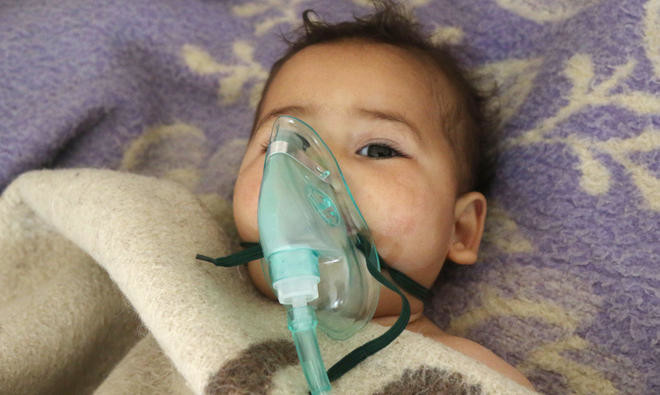
Russia and West clash over where blame lies for Syrian chemical weapons usage
Russia and West clash over where blame lies for Syrian chemical weapons usage


Latest updates




Recommended


© 2026 SAUDI RESEARCH & PUBLISHING COMPANY, All Rights Reserved And subject to Terms of Use Agreement.