

Afghanistan probes reported deaths of dozens of civilians in air strikes

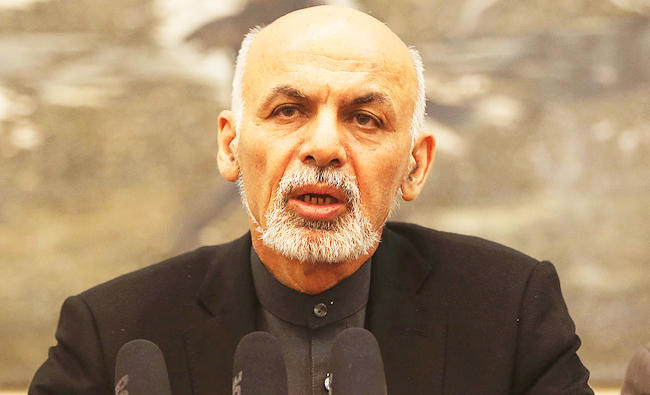
Afghanistan's President Ashraf Ghani. (AP)
Updated 06 November 2017
Follow

Afghanistan probes reported deaths of dozens of civilians in air strikes

KABUL: Afghanistan’s government is said to have ordered an investigation into reports of dozens of civilian deaths in an anti-Taliban joint offensive by Afghan and US troops in northern Kunduz province.

The US-led coalition said it was assessing the reports of heavy civilian casualties in the province that lies near the border with Tajkistan and is regarded as the most volatile in the north.

The operations on Friday and Saturday targeted suspected Taliban positions in various villages of Char Dara district, infested for long by the guerrillas, according to villagers and lawmakers from Kunduz.
There were conflicting figures about the number of civilians killed, with few putting the toll as high as 60.

“Civilians were forced to retrieve the bodies of the Taliban and were hit. There are casualties among civilians,” Amruddin, a member of the provincial council, told Arab News from Kunduz by phone.

The defense ministry confirmed locals' accounts on the launch of operations on Friday and Saturday but, citing the top army general from the area, said more than 50 militants had been killed.

The ministry’s chief spokesman Dawlat Waziri said if there had been civilian deaths, the Taliban may have taken shelter in their homes during the operations.

The US-led military said it knew about the allegations of potential civilian casualties and was assessing it.

One health official from Kunduz who spoke on condition of anonymity told Arab News that the aerial attacks were more sustained and powerful than 2015 and 2016, when the Taliban captured the center of Kunduz twice from the government forces.

Scores of civilians, including more than 40 staff and patients of the French-run hospital, lost their lives in the US aerial attacks in 2015 and last year. And since, there have been reports of more civilian deaths in various others sporadic operations.

The US has further increased its aerial attacks this year in Afghanistan, with civilian casualties jumping by 52 percent in the first nine months of 2017, according to a United Nations report.
Civilian casualties have been one of the biggest friction points between the former President Hamid Karzai and the coalition since the ousting of the Taliban in 2001 as the losses create further bridges between the public and the government.

In a tweet he called the attacks "an atrocity against the Afghan people."

But President Ashraf Ghani’s government has largely remained silent about the matter since assuming power more than three years ago.

Trump officials say Israel’s plans helped lead the US into Iran war

Updated 4 sec ago
Follow

Trump officials say Israel’s plans helped lead the US into Iran war

WASHINGTON: The Trump administration and its allies in Congress presented a shifting new justification Monday for the US attack on Iran, with House Speaker Mike Johnson suggesting that the White House believed Israel was determined to act on its own, leaving the president with a “very difficult decision.”
The Republican was speaking late Monday after a classified briefing at the Capitol, the first for congressional leaders since the start of the war, a joint US-Israel military campaign that killed Iran’s Supreme Leader Ayatollah Ali Khamenei and has quickly spiraled into a widening Middle East conflict. Hundreds have died, including at least six US military service personnel.
Johnson said the attack on Iran was a “defensive operation” because Israel was ready to act against Iran, “with or without American support.” He said President Donald Trump and his team determined that Iran would immediately retaliate against US personnel and assets.
“The commander in chief has said this is going to be an operation that is short in duration,” Johnson said. “We certainly hope that’s true.”
The remarkable shift in the Trump administration’s stated rationale comes as the hostilities deepen and widen across the region. The president himself estimated the war could drag on for weeks. The administration plans to seek supplemental funds from Congress to support the military effort, lawmakers said, in stark contrast to the president’s America First campaign not to entangle the US in actions abroad.
Secretary of State Marco Rubio said the “hardest hits are yet to come” as the US is determined to continue attacking Iran for as long as it takes with an “even more punishing” next phase in the war.
Rubio described what was essentially a potentially ripple effect that he said posed an “imminent threat” to the US
“We knew that there was going to be an Israeli action,” he said. “And we knew that if we didn’t preemptively go after them before they launched those attacks, we would suffer higher casualties.”
Rubio said that while the US would like to see the Iranian people rise up and be rid of the regime, “that’s not the objective,” he said. “The objective of this mission is to make sure they don’t have these weapons that can threaten us and our allies in the region.”
Trump’s shifting rationale sparks detractors
Rubio, Defense Secretary Pete Hegseth and other administration officials delivered the classified briefing as Congress weighs a war powers resolution that would restrain Trump’s ability to keep waging war without approval from the House and Senate.
Trump himself, speaking at the White House, laid out four objectives for the war, saying US forces are out to destroy Iran’s missile capabilities, wipe out its naval capacity, stop the country from obtaining a nuclear weapon and ensure “that the Iranian regime cannot continue to arm, fund and direct terrorist armies outside of their borders.”
“This was our last, best chance to strike — what we’re doing right now — and eliminate the intolerable threats posed by this sick and sinister regime,” Trump said.
Trump met repeatedly with Israeli Prime Minister Benjamin Netanyahu as they sought to curb Iran’s nuclear program, including last month at the White House.
Hegseth earlier Monday vowed this is not an “endless war,” even as he warned more US casualties are likely in the weeks ahead.
But Sen. Mark Warner, the top Democrat on the Intelligence Committee, said: “There was no imminent threat to the United States of America by the Iranians. There was a threat to Israel.”
Warner said he has now heard four or five stated reasons for the attack. He demanded that Trump “come before Congress, and for that matter, the American people,” to make his case for war — and the exit plan.
Several Democrats delivered blistering speeches against the war. “Are we now such an enfeebled nation that Israel decides when we go to war?” said Sen. Jeff Merkley of Oregon, voice rising.
War powers as a check on presidential power
The moment is a defining one for Congress, which alone has the authority under the US Constitution to declare war, and for the Republican president, who has consistently seized power during his second term with his own executive reach.
Trump took the nation to war at a particularly vulnerable time, as the Department of Homeland Security is operating without routine funds because of a standoff with Democrats over their demands to restrain his immigration enforcement operations. The potential wartime costs in terms of lives lost and dollars spent are dividing the parties, and potentially Americans themselves.
Unlike the run-up to the Iraq War in 2003, which included long debates in Congress in the aftermath of the Sept. 11, 2001, attacks, or the more recent US military strikes on Venezuela that proved to be limited, the joint US-Israel military attack on Iran, called Operation Epic Fury, is well underway, with no foreseeable end in sight.
“It’s worrisome,” Rep. Adam Smith, the top Democrat on the House Armed Services Committee, told The Associated Press.
Smith said of Trump: “He is not trying to making his case to the Congress or the American people. He unilaterally decided to do this.”
In fact, Congress has declared war just five times in the nation’s history, most recently in 1941, to enter World War II a day after the Pearl Harbor attack. Over time, presidents of both major political parties have accumulated vast authority to engage in what are often more limited US military strikes.
Johnson said tying Trump’s hands right now would be “frightening” as he works to defeat the war powers resolution.
Even if Congress is able to pass the measure this week, the House and the Senate would be unlikely to tally the two-thirds majority needed to overcome a presidential veto.
Next steps for Iranian people uncertain
As the Trump administration encourages the Iranian people to rise up and choose new leaders, there did not appear to be widespread US support for any effort at democracy- or nation-building.
“We would love to see this regime be replaced,” Rubio said. “If there’s something we can do to help them down the road, we’d obviously be open to it. But that’s not the objective.”
A top Trump ally, Sen. Lindsey Graham, R-S.C., said he never bought into the you-break-it-you-own-it concept in wartime.
“If there’s a threat to America, deal with it,” he said over the weekend. “That doesn’t mean you own everything that follows.”