Tunisian policeman dies after knife attack outside parliament

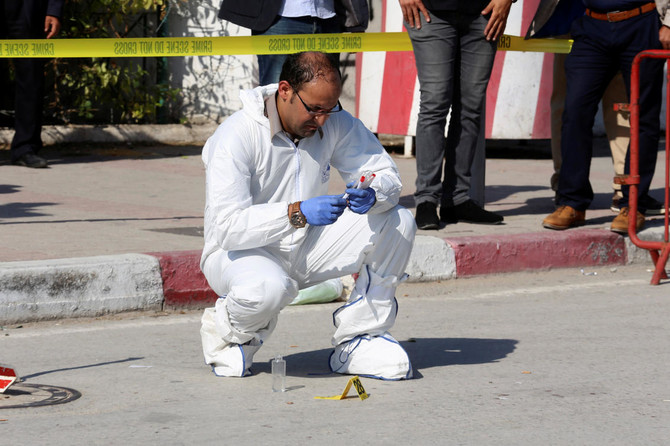
A forensic personnel from the Tunisian police works at the site where a suspected Islamist militant was arrested after wounding two policemen in a knife attack near the parliament building in Tunis, Tunisia Nov. 1, 2017. (Reuters/Zoubeir Souissi)
Updated 02 November 2017
Follow

Tunisian policeman dies after knife attack outside parliament

TUNIS: A Tunisian policeman died Thursday a day after he was stabbed by an Islamist extremist outside parliament in a bustling part of the capital Tunis, the authorities said.
Commander Riadh Barrouta, who was knifed in the neck during the attack on Wednesday, “has died,” interior ministry spokesman Yasser Mesbah said.
A second officer was lightly wounded in the forehead in the early morning assault before the attacker in his mid-20s was quickly arrested.
In the wake of the incident the interior ministry said the assailant had confessed to having adopted an “extremist” ideology three years ago.
“Killing them (police), he believes, is a form of jihad,” it said.
Prosecutors on Thursday said the man — an unemployed computer science graduate born in 1992 — appeared to be a lonewolf who did not belong to any cell, but “intended to join terrorist groups” in neighboring Libya.
The attacker, who comes from a suburb of Tunis, would be taken before anti-terrorist prosecutors on Friday, said Sofiene Sliti, a spokesman for the prosecutors’ office.
Since its 2011 revolution, which sparked the Arab Spring, Tunisia’s security forces have faced a series of jihadist attacks that have claimed the lives of more than 100 soldiers and police.
Wednesday’s attack happened next door to the famed National Bardo Museum that was the site of a deadly Daesh group attack in 2015 that killed 21 foreign tourists and a policeman.
In June the same year, 38 foreign tourists, including 30 from Britain, lost their lives in an IS attack in the coastal holiday resort of Sousse.
Tunisia has been under a state of emergency since November 2015, after another attack killed 12 presidential guards in the heart of the capital.


Libya says UK to analyze black box from crash that killed general

Updated 9 sec ago
Follow

Libya says UK to analyze black box from crash that killed general

TRIPOLI: Libya said on Thursday that Britain had agreed to analyze the black box from a plane crash in Turkiye on December 23 that killed a Libyan military delegation, including the head of its army.
General Mohammed Al-Haddad and four aides died after a visit to Ankara, with Turkish officials saying an electrical failure caused their Falcon 50 jet to crash shortly after takeoff.
Three crew members, two of them French, were also killed.
The aircraft’s black box flight recorder was found on farmland near the crash site.
“We coordinated directly with Britain for the analysis” of the black box, Mohamed Al-Chahoubi, transport minister in the Government of National Unity (GNU), said at a press conference in Tripoli.
General Haddad was very popular in Libya despite deep divisions between west and east.
The North African country has been split since a NATO-backed revolt toppled and killed longtime leader Muammar Qaddafi in 2011.
Haddad was chief of staff for the internationally recognized GNU, which controls the west. The east is run by military ruler Khalifa Haftar.
Chahoubi told AFP a request for the analysis was “made to Germany, which demanded France’s assistance” to examine the aircraft’s flight recorders.
“However, the Chicago Convention stipulates that the country analizing the black box must be neutral,” he said.
“Since France is a manufacturer of the aircraft and the crew was French, it is not qualified to participate. The United Kingdom, on the other hand, was accepted by Libya and Turkiye.”
After meeting the British ambassador to Tripoli on Tuesday, Foreign Minister Taher Al-Baour said a joint request had been submitted by Libya and Turkiye to Britain “to obtain technical and legal support for the analysis of the black box.”
Chahoubi told Thursday’s press briefing that Britain “announced its agreement, in coordination with the Libyan Ministry of Transport and the Turkish authorities.”
He said it was not yet possible to say how long it would take to retrieve the flight data, as this depended on the state of the black box.
“The findings will be made public once they are known,” Chahoubi said, warning against “false information” and urging the public not to pay attention to rumors.