

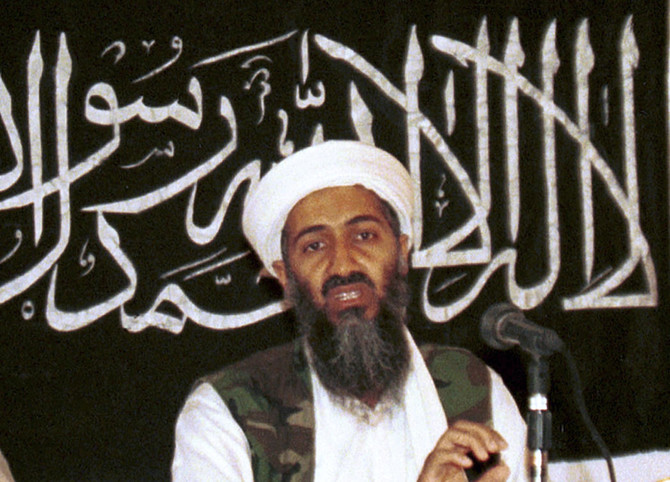
CIA releases vast Bin Laden archive seized in compound

Osama bin Laden (AP Photo/Mazhar Ali Khan, File)
Updated 02 November 2017
Follow

CIA releases vast Bin Laden archive seized in compound

WASHINGTON: The CIA on Wednesday released a vast archive of intimate Al-Qaeda documents, including Osama Bin-Laden’s handwritten diary, seized in the deadly 2011 raid on his Pakistani compound.
The huge trove includes images of diary pages left by the Saudi-born global extremist leader and a wedding video that includes the first public images of his son Hamza as an adult.
Controversially, scholars from a Washington think-tank who were given access to the now de-classified trove say the documents also shed new light on Al-Qaeda’s murky relationship with Iran.
“Today’s release ... provides the opportunity for the American people to gain further insights into the plans and workings of this terrorist organization,” said CIA director Mike Pompeo.
The CIA put online 470,000 additional files seized in May 2011 when US Navy SEALs burst into the Abbottabad compound and shot dead the leader of Al-Qaeda’s global extremist network.
According to Thomas Joscelyn and Bill Roggio, scholars from the Foundation for Defense of Democracies who were allowed to see the trove before it was made public, it provides new insights.

“These documents will go a long way to help fill in some of the blanks we still have about Al-Qaeda’s leadership,” Roggio said.
The inclusion of Hamza Bin Laden’s wedding video, for example, gives the world public the first image of Bin Laden’s favorite son as an adult — an image apparently shot in Iran.
Previous document releases, including letters revealed by AFP in May 2015, show that Bin Laden was grooming Hamza to succeed him as leader of Al-Qaeda’s global jihadist campaign.
But plans for him to come to Bin Laden’s Abbottabad hideout seem to have been abandoned after the deadly US raid, and the young man — now aged 27 or 28 — is presumed to be in Iran.
According to Joscelyn and Roggio, writing in the FDD’s Long War Journal, one of the newly released documents is a 19-page study of Al-Qaeda’s links to Iran written by a Bin Laden lieutenant.
Last month, at a seminar hosted by the same FDD that had an advance look at the files, Pompeo had promised to release Abbottabad documents that would show Iran-Al Qaeda ties.
“There have been relationships, there are connections. There have been times the Iranians have worked alongside Al-Qaeda,” the US spy chief argued.
“There have been connections where, at the very least, they have cut deals so as not to come after each other.”
This raised alarm bells among critics of President Donald Trump’s new strategy to counter Iranian influence, wary that hawks like Pompeo may be making a case for war.
The full extent and true nature of this relationship is unclear and a matter of dispute among scholars and policy-makers.
On the one hand, Tehran and its largely Shiite proxy forces in the Middle East often fight against Sunni movements aligned with Al-Qaeda’s deeply sectarian ideology.
The Iranian backed Hezbollah, for example, is locked in conflict against Al-Qaeda linked Syrian rebels.
But the very fact that Hamza and other senior figures appear to be able to live under Iranian protection or custody supports claims that Tehran and Bin Laden had a working relationship.
One document, Joscelyn and Roggio write, recounts how Iran offered training, money and arms to some of Al-Qaeda’s “Saudi brothers” on condition they attack US interests in the Gulf.
But the files also show Tehran and Al-Qaeda sometimes had stark disagreements, and Bin Laden once wrote to Iranian leader the Ayatollah Ali Khamenei to demand his relatives be released.
“Other files show that Al-Qaeda kidnapped an Iranian diplomat in order to force an exchange,” Joscelyn writes.
“Osama bin Laden’s correspondence shows that he and his lieutenants were also concerned that the Iranians would track Hamza or other family members after they were released.”

In addition, Roggio and Joscelyn say, “Bin Laden himself considered plans to counter Iran’s influence throughout the Middle East, which he viewed as pernicious.”
Nevertheless, they argue, analysis of the intelligence points to Al-Qaeda having been able to maintain a “core facilitation pipeline” on Iranian soil.
Some in Washington are skeptical about the motives behind the release, coming after what the intelligence community had previously said was the last dump from the Bin Laden files.
Ned Price, a former CIA official who was seconded as a national security adviser to former president Barack Obama, said the new documents “don’t tell us anything we didn’t already know.”
Instead, he argued on Twitter, Pompeo may have released the files to bolster the case against Iran as a sponsor of terror, pushing the United States closer to open conflict with Tehran.
“These moves suggest he’s reverting to the Bush administration’s playbook: Emphasize terrorist ties as a rationale for regime change,” Price warned.


Israel’s Somaliland gambit: what’s at risk for the region?

Updated 7 sec ago
Follow

Israel’s Somaliland gambit: what’s at risk for the region?

  • Somaliland’s strategic location near the Bab Al-Mandab raises fears an Israeli security presence could turn the Red Sea into a powder keg
  • Critics argue the decision revives Israel’s “periphery” strategy, encouraging fragmentation of Arab and Muslim states for strategic advantage

RIYADH: It perhaps comes as no surprise to seasoned regional observers that Israel has become the first and only UN member state to formally recognize the Republic of Somaliland as an independent and sovereign nation.

On Dec. 26, Israel’s Prime Minister Benjamin Netanyahu and Foreign Minister Gideon Sa’ar signed a joint declaration of mutual recognition alongside Somaliland’s President Abdirahman Mohamed Abdullahi.

For a region that has existed in a state of diplomatic limbo since declaring independence from Somalia in 1991, this development is, as Abdullahi described it, “a historic moment.” But beneath the surface lies a calculated and high-stakes geopolitical gamble.

While several nations, including the UK, Ethiopia, Turkiye, and the UAE, have maintained liaison offices in the capital of Hargeisa, none had been willing to cross the Rubicon of formal state recognition.

Israel’s Prime Minister Benjamin Netanyahu, assisted by Foreign Minister Gideon Sa’ar, signs the document formally recognizing Somalia's breakaway Somaliland region on Dec. 26, 2025. (AFP)

Israel’s decision to break this decades-long international consensus is a deliberate departure from the status quo.

By taking this step, Israel has positioned itself as the primary benefactor of a state that has long sought a seat at the international table. As Dya-Eddine Said Bamakhrama, the ambassador of Djibouti to Saudi Arabia, told Arab News, such a move is deeply disruptive.

“A unilateral declaration of separation is neither a purely legal nor an isolated political act. Rather, it carries profound structural consequences, foremost among them the deepening of internal divisions and rivalries among citizens of the same nation, the erosion of the social and political fabric of the state, and the opening of the door to protracted conflicts,” he said.

Critics argue that Israel has long lobbied for the further carving up of the region under various guises.

This recognition of Somaliland is seen by many in the Arab world as a continuation of a strategy aimed at weakening centralized Arab and Muslim states by encouraging peripheral secessionist movements.

Somaliland’s President Abdirahman Mohamed Abdullahi. (AFP file photo)

In the Somali context, this path is perceived not as a humanitarian gesture, but as a method to undermine the national understandings reached within the framework of a federal Somalia.

According to Ambassador Bamakhrama, the international community has historically resisted such moves to prioritize regional stability over “separatist tendencies whose dangers and high costs history has repeatedly demonstrated.”

By ignoring this precedent, Israel is accused of using recognition as a tool to fragment regional cohesion.

In the past, Israel has often framed its support for non-state actors or separatist groups under the pretext of protecting vulnerable minorities — such as the Druze in the Levant or Maronites in Lebanon.

This “Periphery Doctrine” served a dual purpose: it created regional allies and supported Israel’s own claim of being a Jewish state by validating the idea of ethnic or religious self-determination.

However, in the case of Somaliland, the gloves are off completely. The argument here is not about protecting a religious minority, as Somaliland is a staunchly Muslim-majority territory. Instead, the rationale is nakedly geopolitical.

Israel appears to be seeking strategic depth in a region where it has historically been isolated. Netanyahu explicitly linked the move to “the spirit of the Abraham Accords,” signaling that the primary drivers are security, maritime control, and intelligence gathering rather than the internal demographics of the Horn of Africa.

The first major win for Israel in this maneuver is the expansion of its diplomatic orbit. It could be argued that the refusal of the federal government in Mogadishu to join the Abraham Accords was an artificial barrier.

The evidence for this claim, from the Israeli perspective, is that Somaliland — a territory with a population of nearly six million and its own functioning democratic institutions — was eager to join.

Abdullahi said Somaliland would join the Abraham Accords as a “step toward regional and global peace.” Yet, this peace comes with a clear quid pro quo — formal recognition.

Residents wave Somaliland flags as they gather in downtown Hargeisa on December 26, 2025, to celebrate Israel's announcement recognizing Somaliland's statehood. (AFP)

Israel can now argue that the “Somaliland model” proves that many other Arab and Muslim entities are willing to normalize relations if their specific political or territorial interests are met.

This challenges the unified stance of the Arab League and the Organization of Islamic Cooperation, which maintain that normalization must be tied to the resolution of the Palestinian conflict.

The second major gain for Israel is the potential for a military presence in the Horn of Africa. Somaliland’s strategic position on the Gulf of Aden, near the Bab Al-Mandab Strait, makes it a prime location for monitoring maritime traffic.

This is a ticking time bomb given that just across the narrow sea lies Yemen, where the Houthi movement — whose slogan includes “Death to Israel” — controls significant territory.

Israel may claim that a military or intelligence presence in Somaliland will boost regional security by countering Houthi threats to shipping. However, regional neighbors fear it will likely inflame tensions.

Ambassador Bamakhrama warned that an Israeli military presence would “effectively turn the region into a powder keg.”

Ambassador Dya-Eddine Said Bamakhrama, Djibouti's envoy to Saudi Arabia. (Supplied)

“Should Israel proceed with establishing a military base in a geopolitically sensitive location... such a move would be perceived in Tel Aviv as a strategic gain directed against the Arab states bordering the Red Sea — namely Egypt, Saudi Arabia, Somalia, Yemen, Sudan, and Djibouti,” he said.

The Red Sea is a “vital international maritime corridor,” and any shift in its geopolitical balance would have “repercussions extending far beyond the region,” he added.

The recognition is also a clear violation of international law and the principle of territorial integrity as enshrined in the UN Charter.

While proponents point to exceptions like South Sudan or Kosovo, those cases involved vastly different circumstances, including prolonged genocidal conflicts and extensive UN-led transitions.

In contrast, the African Union has been firm that Somaliland remains an integral part of Somalia.

The backlash has been swift and severe. The Arab League, the Gulf Cooperation Council, and the OIC have all decried the move. Even US President Donald Trump, despite his role in the original Abraham Accords, has not endorsed Israel’s decision.

When asked whether Washington would follow suit, Trump replied with a blunt “no,” adding, “Does anyone know what Somaliland is, really?”

This lack of support from Washington highlights the isolation of Israel’s position. The OIC and the foreign ministers of 21 countries have issued a joint statement warning of “serious repercussions” and rejecting any potential link between this recognition and reported plans to displace Palestinians from Gaza to the African region.

Israel’s recognition of Somaliland appears to be a calculated gamble to trade diplomatic norms for strategic advantage.

While Hargeisa celebrates a long-awaited milestone, the rest of the world sees a dangerous precedent that threatens to destabilize one of the world’s most volatile corridors.

As Ambassador Bamakhrama says, the establishment of such ties “would render (Israel) the first and only state to break with the international consensus” — a move that prioritizes “narrow strategic calculations” over the stability of the international system.