LONDON: As the UK marks the 100th anniversary of the Balfour Declaration, an Arab News survey of students in London showed widespread support for the establishment of an independent Palestinian state.
Marna Judson, a student at the New College of the Humanities, said the 1917 declaration was “careless.”
“We didn’t stop to think who might suffer because of (the Balfour Declaration),” she said. “It was a gesture that had such huge repercussions that weren’t properly evaluated at the time. The Palestinian people are not getting the voice they deserve,” she said.
Leslie, a computer science PhD student at University College London (UCL), who declined to give his full name, said his sympathies came down on the side of the Palestinians. “They have suffered a great deal and they are at rock-bottom,” he said.
“When (the British) wanted to relinquish control of what was known then as the Mandate for Palestine, they should have technically involved all parties in the discussion, which they did not do.”
Others said there had been wrongdoing on both sides of the conflict. “Both are doing things wrong to one another. They’re both killing, and I don’t think either side should be excused,” said Ahmed, a physics student at UCL.
At the School of Oriental and African Studies (SOAS), where a tangled Palestinian flag adorns a tree in the main thoroughfare, students were strongly pro-Palestinian. “Putting (Palestinians) in jail when your soldiers are killing people with submachine guns is ridiculous,” said Phoebe Craig.
She dismissed criticism that anti-Semitism was a problem at SOAS, saying: “We have no problem with Israel. It’s Israel’s policy toward Palestine.”
Many students expressed sympathy with the Palestinian people. “There should be a Palestinian state. At least that way they could be treated as equals on the international stage,” said Anwar, an MA student at the London School of Economic (LSE).
There was little agreement about what the UK should do to bring about a solution. Some called for the UK to impose economic sanctions against Israel as a way of bringing about Palestinian nationhood.
Liam Anderson, a Birkbeck student, said: “Part of you thinks, well, of course (the UK) needs to intervene and sort these things out, but then again intervention is the thing that caused the situation in the first place. But at the same time you can’t leave a nation like Palestine to sort itself out because it’s so poor. How is it going to do that in the face of Israel?”


![]()
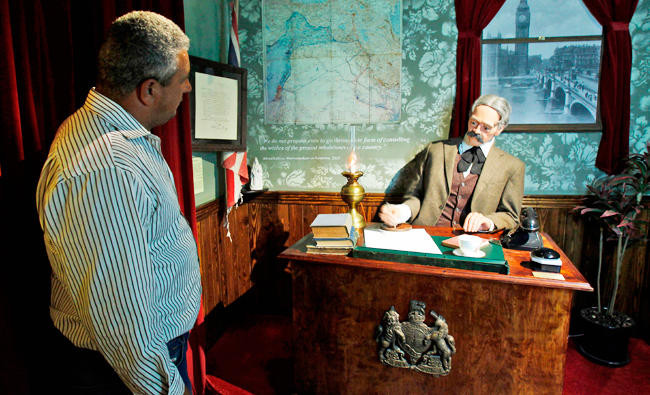
The view from campus 100 years after Balfour
The view from campus 100 years after Balfour

Latest updates


© 2026 SAUDI RESEARCH & PUBLISHING COMPANY, All Rights Reserved And subject to Terms of Use Agreement.