AMMAN: Most politicians’ and historians’ commentaries on the 67-word Balfour Declaration have focused largely on the first part of the letter sent by the former British Foreign Secretary Arthur Balfour to the Jewish Zionist businessman Lord Rothschild.
One of the most memorable lines about this infamous letter came from the Hungarian-born Jewish writer Arthur Koestler. With it, he stated eloquently, “one nation solemnly promised to a second nation the country of a third.”
The short but influential letter by Balfour, which was later endorsed by the British Cabinet, also included this conditionality: “It being clearly understood that nothing shall be done which may prejudice the civil and religious rights of existing non-Jewish communities in Palestine or the rights and political status enjoyed by Jews in any other country.”
Johnny Mansour, a historian and lecturer from Haifa, told Arab News that the British and their Zionist friends wanted to stop the creation of a unified Arab country. “Britain recognized Jews as a people and Palestinian Arabs as communities, not as Arabs or Palestinians. The declaration didn’t talk about political rights but civil and religious rights.”
Mansour said that this is what Israel does now when it calls Palestinian citizens of Israel “Al-Wasat Al-Arabi” (the Arab community) a clear reference to Palestinians as a minority and not even a national minority.
Mansour said that the Israeli actions since the establishment in 1948 of the state of Israel do not even reflect the rights and sentiments of Palestinians, as badly as they were defined, in the Balfour Declaration. “Israel imposed military rule until 1966 and has prevented the development and expansion of Palestinian communities by not allowing Palestinian Arabs to have a say in town zoning plans.”
The Israeli policy of taking up only the first part of the Balfour Declaration continued after the Israeli occupation of the West Bank and Gaza Strip in 1967. “By denying Palestinian national rights and by dividing the West Bank, especially the Jordan Valley and Jerusalem, into regional zones that its people control, Israel has clearly violated the conditional promise made by Balfour of protecting Palestinian communities,” Mansour argued.
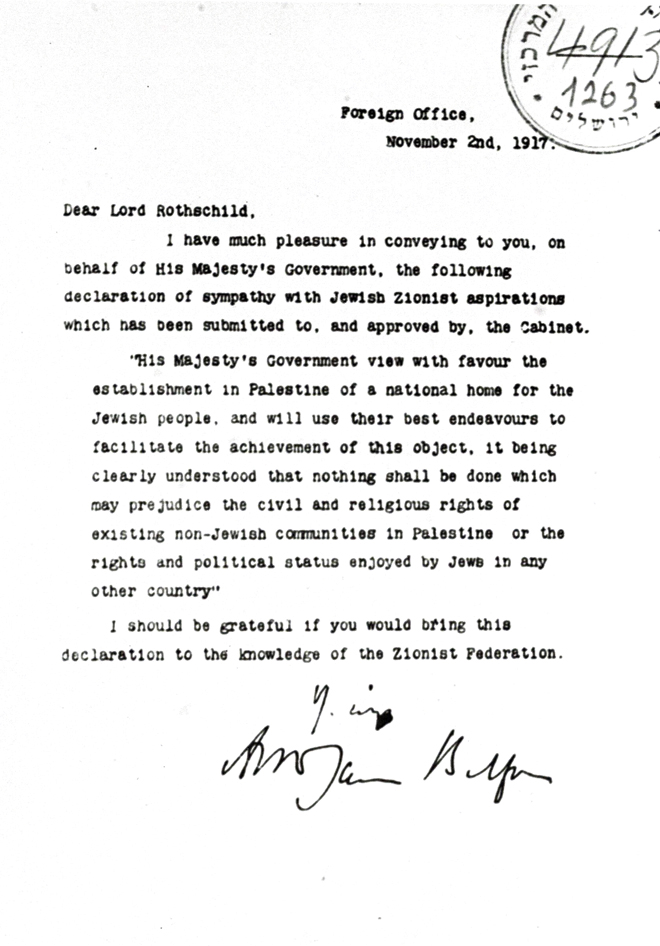
This handout file photo taken in 1925 shows a copy of the Balfour Declaration. (AFP)
By using the term “non-Jewish,” Balfour inflated a population that was no more than 10 percent of the total Palestinian population at the time, while deflating and minimizing Palestinian Arabs into the category of minority groups whose civil and religious rights need to be protected. Balfour did not use the term “political rights” for what he called non-Jewish communities, but defended the “political status enjoyed by Jews in any other country.”
One hundred years after Balfour’s support for a home (and not a homeland) for Jews in Palestine on condition that Palestinian Arabs also enjoy rights, little has been done to reverse discrimination against Arabs in Israel and the occupation of Palestinian land in the West Bank (including Jerusalem and the Gaza Strip).
Ben White, a Nazareth-based British author who has specialized in writing about Israel and Palestine, argues that Palestinian citizens of Israel “face systematic discrimination in law, and policy as well as in land and housing, family life and immigration demonstrate.”
The Association for Civil Rights in Israel reported that “the right to equality is not yet enshrined in law regarding most aspects of life.”
Aeyal Gross, a law professor at Tel Aviv University, elaborated that “equality cannot be recognized on the constitutional level since that would challenge “the inequality created by the complete identification of the state with only one group.”
While Britain has paid little attention to what Israel and Zionists have done following the Balfour Declaration, much can be said about what the UK has failed to do since then.
Ambassador Jonathan Allen, UK deputy permanent representative to the UN, admitted that there is what he calls “unfinished business” when it comes to the Balfour Declaration. “The UK understands and respects the sensitivities many have about the (Balfour) Declaration and the events that have taken place in the region since 1917,” Allen said in October.
“The occupation is a continued impediment to securing the political rights of the non-Jewish communities in Palestine. And let us remember, there are two halves of Balfour, the second half of which has not been fulfilled. There is therefore unfinished business.”
The UK diplomat added: “We have witnessed an unacceptable acceleration of settlement activity throughout 2017, both in the West Bank and East Jerusalem. To date, Israel has advanced plans for over 13,000 settlement units — the highest number of units since 1992.”
The fact that 130 UN member states have recognized Palestine on the 1967 borders and that the British Parliament has voted in favor of Palestinian statehood has done little to change the policies of 10 Downing Street when it comes to recognizing Palestine.


![]()

Balfour: 67 words, and the Palestinian people denied their political rights
Balfour: 67 words, and the Palestinian people denied their political rights


Latest updates








© 2026 SAUDI RESEARCH & PUBLISHING COMPANY, All Rights Reserved And subject to Terms of Use Agreement.