REYKJAVIK: Angry over a string of political scandals, Icelanders may usher a long dominant center-right party out of the exit door in national elections on Saturday, handing power to a charismatic center-left opposition leader.
Katrín Jakobsdóttir, 41, of the Left-Green Movement, has campaigned on a platform of restoring trust in government and leveraging an economic boom to increase public spending.
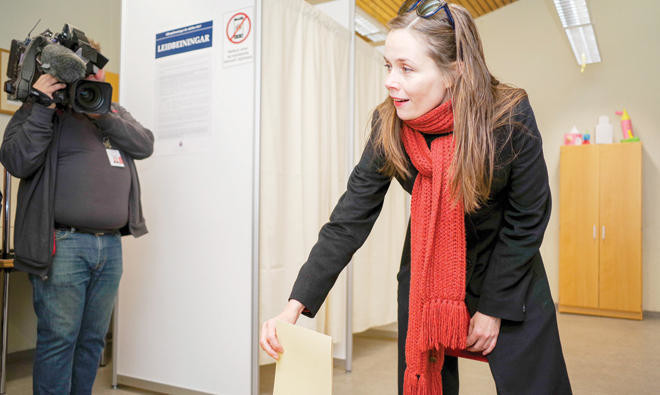
With hair slick down, red lipstick, black coat and heels, Jakobsdóttir cast her vote in sunny Reykjavik.
“I’m feeling very good about today, and I’ll have to be optimistic,” she told Reuters after casting her vote.
Accompanied by her husband and three sons, she cheerfully took time to mingle with voters, who headed to polls on a — for Iceland — warm autumn day of about 7 Celsius (45 Fahrenheit).
In the second snap parliamentary election in a year, the latest opinion polls showed her trailing Prime Minister Bjarni Benediktsson’s pro-business Independence Party by a small margin.
Both parties have polled around 20 percent for most of October. Whichever wins will likely nominate a prime minister who will then be invited to form a coalition government.
“I think this will be an exciting election night as there has been a lot of movement in the polls,” Jakobsdóttir said. “We’ll be waiting until the morning hours, I won’t go to bed until six in the morning.”
The Independence Party has been part of every government since 1980, except the coalition that served during the crisis years of 2009-2013, which included the Left-Greens, with Jakobsdottir as education minister.
In her favor this time is the fact that the left-leaning Social Democrats are likely to become the third-biggest party, and that Icelanders appear as primed for change as at any time in recent memory.
The Nordic island of 340,000 people, one of the countries hit hardest by the 2008 global financial crisis, has staged a remarkable economic turnaround spurred by tourism.
But scandals, a growing sense of inequality and worries over immigration threaten stability in one of the world’s most homogeneous nations.
Benediktsson has been weakened by fallout from an attempt by his father to vouch for the character of a convicted paedophile.
The previous snap election took place late in 2016, after the Panama Papers revelations showed several government figures involved in an offshore tax haven scandal. That gave a boost to the anti-establishment Pirate Party but its support has since waned.
Forming a government this time could take months, as polls show a further five parties winning more than the five percent of votes needed to enter parliament.
“I just hope something changes, and there’ll be more cooperation,” said Ingunn Erlendsdóttir, 73, a retired ministry employee.
“We are only a small nation of just over 300,000, and we need to stand together,” said the pensioner, adding that she has traditionally voted for the right but this time cast her ballot for a left-wing party.
Known for her even temper, Jakobsdottir quickly became a popular figure in Iceland after being elected to parliament in 2007, and is one of the few high-profile politicians who have avoided scandal.
“Our campaign has been fun, and we’ve taken it you could say back to the roots. Walking door to door, having meetings and meeting people in the real world,” she said.
While most parties agree that investment is needed in areas like welfare, infrastructure and tourism, the debate is around how it will be financed.
The left-leaning parties, including Jakobsdóttir’s, want to finance spending by raising taxes on the wealthy, real estate and the powerful fishing industry.
Having presided over the privatization of banks, financial sector liberalization and the economy’s collapse and eventual economic recovery during its several stints in power, the Independence Party has said it wants to fund infrastructure spending by taking money out of the banking sector.


![]()
Leftists on cusp of power as weary Icelanders go to polls
Leftists on cusp of power as weary Icelanders go to polls

Latest updates


Recommended


© 2026 SAUDI RESEARCH & PUBLISHING COMPANY, All Rights Reserved And subject to Terms of Use Agreement.