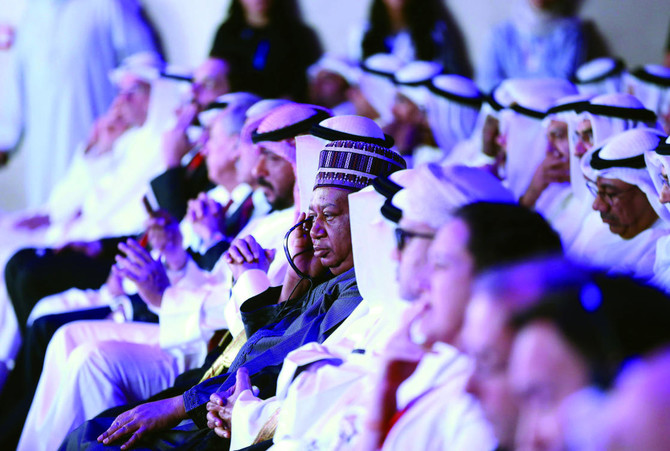
LONDON: The fog has cleared ahead of OPEC’s next meeting, with Saudi Arabia and Russia clearly stating support to extend a global deal to cut oil supply for another nine months, said the OPEC secretary-general.
OPEC, plus Russia and nine other producers, have cut oil output by about 1.8 million barrels per day (bpd) since January.
The pact runs to March 2018 and they are considering extending it.
Saudi Arabia’s Crown Prince Mohammed bin Salman said this week he supported keeping the deal in place for nine months, following on from similar remarks by Russian President Vladimir Putin.
“OPEC welcomes the clear guidance from the crown prince of Saudi Arabia on the need to achieve stable oil markets and sustain it beyond the first quarter of 2018,” OPEC’s Mohammed Barkindo told Reuters on the sidelines of a conference.
“Together with the statement expressed by President Putin this clears the fog on the way to Vienna on Nov. 30,” he said.
Oil prices fell on Friday after Brent rallied to just below $60 a barrel the previous session but support from the comments by the Saudi crown prince for extending OPEC-led output cuts created a floor.
Oil hit $59.55 on Thursday, its highest since July 2015 and more than 30 percent above its 2017 lows touched in June.
US crude prices have been capped by rising US production.
Oil prices have been hovering near their highest levels for this year amid recent signs of a tightening market, talk of an extension of production cuts and tensions in Iraq.
Friday’s announcement of a cease-fire between Iraqi forces and the Peshmerga from the country’s autonomous northern Kurdish region eased some concerns.
“Yesterday we saw the expiry of Brent options, and like last month it pushed up prices near $60 — now it’s just correcting lower,” Olivier Jakob of Petromatrix consultancy said, adding that the market reacted slowly to bullish Saudi comments.
— Reuters

Saudi Arabia and Russia ‘clear fog’ before OPEC meeting
China FM wants to work with Canadian counterpart to ‘eliminate interference’
- Wang, who met a slew of Western leaders during the Munich Security Conference, has been eager to paint Beijing as a more stable partner compared to the increasingly unpredictable United States
MUNICH: China’s foreign minister Wang Yi told his Canadian counterpart Anita Anand their two countries should work to “eliminate interference,” as they met on the sidelines of a security conference on Saturday.
Wang, who met a slew of Western leaders during the Munich Security Conference, has been eager to paint Beijing as a more stable partner compared to the increasingly unpredictable United States.
Canadian Prime Minister Mark Carney, who took office last year, visited China in January as part of his global effort to broaden Canada’s export markets and decrease trade reliance on the United States.
Under a preliminary trade deal announced, Beijing is expected to reduce tariffs on Canadian canola imports and grant Canadians visa-free travel to China.
But the United States — Canada’s traditional ally and largest trading partner — has threatened to impose 100-percent tariffs on Canadian products if the deal were to go ahead, saying it would allow China to “dump goods.”
Beijing’s top diplomat Wang told his Canadian counterpart Anita Anand on Saturday that their countries should jointly counter “interference,” without naming the United States.
“China is willing to work with Canada to eliminate interference, restart exchanges and cooperation in various fields,” Wang told Anand, according to a readout from Beijing’s foreign ministry.
China has overturned the death sentence of Canadian Robert Lloyd Schellenberg, who was detained on drug charges in 2014, a Canadian official told AFP in February.
China-Canada ties had nosedived following the 2018 arrest in Vancouver of Huawei chief financial officer Meng Wanzhou.
That arrest infuriated Beijing, which detained two Canadians — Michael Spavor and Michael Kovrig — on espionage charges that Ottawa condemned as retaliatory.
But on Saturday, Wang hailed Carney’s visit to China as “fruitful” and said the two countries should build a healthy and stable “new type of strategic partnership.”
Wang, who met a slew of Western leaders during the Munich Security Conference, has been eager to paint Beijing as a more stable partner compared to the increasingly unpredictable United States.
Canadian Prime Minister Mark Carney, who took office last year, visited China in January as part of his global effort to broaden Canada’s export markets and decrease trade reliance on the United States.
Under a preliminary trade deal announced, Beijing is expected to reduce tariffs on Canadian canola imports and grant Canadians visa-free travel to China.
But the United States — Canada’s traditional ally and largest trading partner — has threatened to impose 100-percent tariffs on Canadian products if the deal were to go ahead, saying it would allow China to “dump goods.”
Beijing’s top diplomat Wang told his Canadian counterpart Anita Anand on Saturday that their countries should jointly counter “interference,” without naming the United States.
“China is willing to work with Canada to eliminate interference, restart exchanges and cooperation in various fields,” Wang told Anand, according to a readout from Beijing’s foreign ministry.
China has overturned the death sentence of Canadian Robert Lloyd Schellenberg, who was detained on drug charges in 2014, a Canadian official told AFP in February.
China-Canada ties had nosedived following the 2018 arrest in Vancouver of Huawei chief financial officer Meng Wanzhou.
That arrest infuriated Beijing, which detained two Canadians — Michael Spavor and Michael Kovrig — on espionage charges that Ottawa condemned as retaliatory.
But on Saturday, Wang hailed Carney’s visit to China as “fruitful” and said the two countries should build a healthy and stable “new type of strategic partnership.”
© 2026 SAUDI RESEARCH & PUBLISHING COMPANY, All Rights Reserved And subject to Terms of Use Agreement.