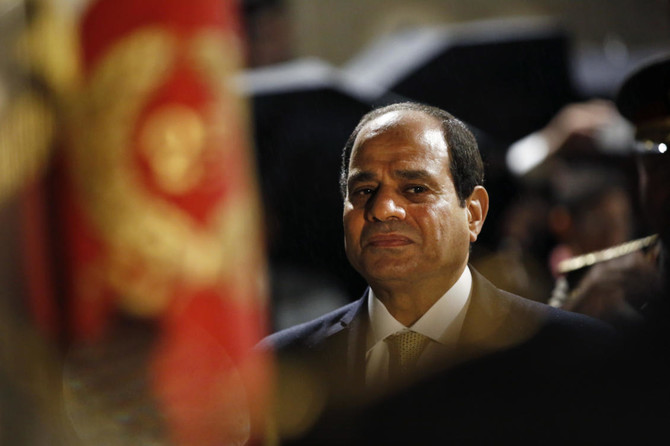
CAIRO: Six months before Egypt’s election, President Abdel Fattah El-Sisi’s supporters are petitioning for him to run, rallying around the former military commander whose popularity critics say has been dimmed by austerity reforms, security problems and a crackdown on dissidents.
Four years ago, Sissi won a landslide victory after he led the military ouster of then president Mohamed Mursi of the Muslim Brotherhood, promising stability following Egypt’s 2011 Arab Spring uprising.
Sissi, 62, has yet to declare if he will run, though he is unlikely to face strong opposition. He says he will follow the people’s will, and many in Egypt still see him as key to stability in a country where unrest since 2011 has battered the economy.
But some critics say that narrative has been undercut by tough austerity reforms and a currency flotation that has made even the middle-class poorer, and an Islamic insurgency that has extended outside its battleground in the northern Sinai,
The “So You Can Build It” petition campaign launched by a businessman, professors and pro-Sissi independent lawmakers is looking to whip up turnout for Sissi and show he still has the legitimacy of a popular mandate.
Less than a month into the campaign, its founders claim they will rally massive support. A host of celebrities have signed up, posing on social media with petition forms that show Egypt’s red, white and black flag, and a silhouette of the pyramids.
“We will find out from the numbers we have collected what the Egyptian people’s support looks like ... especially since there are rumors that there’s been a decline in popular support,” said Mohamed Shaaban, the campaign’s co-founder and an independent lawmaker allied with Sissi.
Some Sissi opponents say the scale of the campaign shows that Egyptians have few viable opposition candidates to choose from in the election likely to happen around April.
“All this negatively affects the political climate in Egypt and increases reluctance to run against Sissi,” Mohamed Anwar Al-Sadat, nephew of a former president who once backed Sissi but is now considering running against him, said last week.
“It will discourage voters and make them more reluctant to go out and vote in the upcoming elections.”
Detractors have taken to social media to poke fun at the petition, posting pictures of aliens and US President Donald Trump signing the form. Others have suggested a counter-movement calling instead for Sissi to step down.
Under Sissi’s presidency, thousands of dissidents have been jailed, the government has shut down independent media and heavily restricted the conducting of opinion polls. There have been no official polls on the upcoming election yet.
However, many Egyptians are wary of challenging the status quo after six years of living through a pro-democracy revolt, a military takeover and a prolonged state of emergency that has left people unwilling to protest or looking for stability.
Only two people — Sadat and Khaled Ali, a lawyer who challenged Sissi over a dispute about two islands in the Red Sea — have publicly aired the idea of challenging him and even they say Sissi is likely to win.
Last election, Sissi won about 97 percent of the vote on a turnout of 47.5 percent, after voting was extended for a day. This time, his backers want to show his legitimacy not been tarnished by economic and security problems.
“The issue is not whether Sissi will win the 2018 election; rather, it is about how much interest and buzz can be generated about the process,” said H.A. Hellyer, senior non-resident fellow at the Atlantic Council.
“The more public interest, the better — if turnout and interest is minimal, that won’t be catastrophic for the authorities, but is certainly not the image they wish to project domestically or internationally,” he added.
Spreading of campaign like wildfire
The campaign was inspired by the 2013 ‘Tamaroud’, or ‘Rebellion’, petition, that Sissi used as a mandate to topple the Muslim Brotherhood, said Shaaban.
The Tamaroud movement encouraged millions of Egyptians to take to the streets demanding the overthrow of Mursi. Sissi then led the military ouster of Mursi after those protests.
Organizers says they are already seeing results. What started off with only 10 offices has mushroomed into a large-scale operation with 178 offices nationwide, said Shaaban, and close to half a million likes on the campaign’s official Facebook page.
“The numbers are changing by the moment,” said parliamentarian Karim Salem, campaign spokesman and co-founder.
Organizers say the campaign is run by volunteers and funded by private donations.
Egypt’s state news agency reported that 14,000 people had signed the petition in the Nile delta province of Al-Beheira. Reuters could not independently confirm these numbers.
The petition form lists five reasons why Sissi should seek a second term — cleansing the country of terrorism, completing his megaprojects, ending corruption, education, and protecting its leadership.
Even some of Sissi’s supporters who helped propel him into power, such as former campaign officials Hazim Abdelazim and Nour Al-Huda Zaki, have turned against him over his handling of the economy and security. Critics point to a dispute that saw his government hand over two Red Sea islands to Saudi Arabia, touching a nationalistic nerve.
Egypt has fought an insurgency waged by a Daesh affiliate in North Sinai since 2013. Hundreds of members of the security forces have been killed. But the group has begun turning its guns toward the mainland in attacks this year.
Sissi has inaugurated mega infrastructure projects he promised would turn around the economy, and the IMF has praised the progress of measures it has backed that are meant to curb deficits and create long term growth.
But many Egyptians say they are frustrated with the immediate fallout of reforms. The currency devaluation a year ago has cut the Egyptian pound’s value in half — though it has stabilized now — and inflation is just off record highs of above 30 percent.
In Shaaban’s home district in Cairo, middle-class Sayeda Zeinab, where a petition campaign banner with an image of the smiling president hangs above a main square, Essam Moahmed, a baker, expressed discontent over the economy.
“Now things are even more expensive than under the Brotherhood. But people can’t stand against Sissi,” he said.
Sissi acknowledges the tough economic situation many Egyptians face, saying sacrifices like IMF-backed austerity reforms are needed “so we can take our true place.”