Taiwan leader hopes for ‘breakthrough’ with China

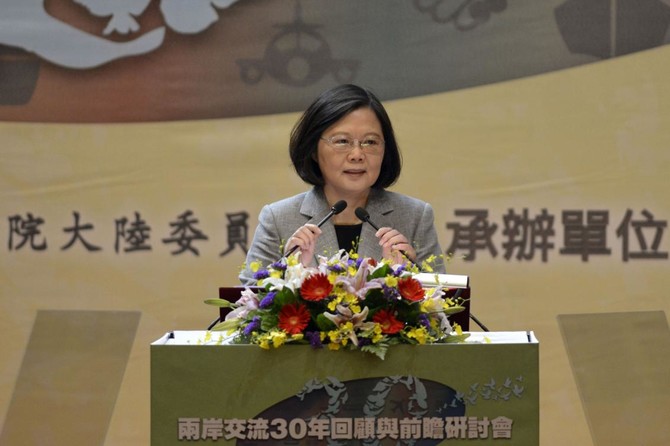
Taiwan’s President Tsai Ing-wen speaks during a conference between Taiwan and China relations organized by Taiwan’s Mainland Affairs Council (MAC) in Taipei on October 26, 2017. (AFP/Sam Yeh)
Updated 26 October 2017
Follow

Taiwan leader hopes for ‘breakthrough’ with China

Taipei: Taiwan’s president Tsai Ing-wen said Thursday that the end of China’s landmark party congress signals an “opportunity for change,” as she called for dialogue with Chinese leader Xi Jinping.
Tsai was speaking publicly for the first time since Xi was handed a second term during the 19th Communist Party meeting that concluded this week, which cemented the Chinese president’s grip on power.
Ties between Taiwan and China have become increasingly frosty since Tsai was elected president last year.
Beijing cut off official communication with her government shortly after it took office due to her refusal to publicly accept the principle that both sides belong to “one China.”
The rivals split after a civil war in 1949 and Taiwan is a self-governing democracy today, although it has never formally declared independence.
China still sees it as part of its territory to be reunified, by force if necessary.
At an event Thursday marking the 30th anniversary of cross-strait exchanges, Tsai said she hoped communications could now resume.
“I must once again call on leaders from both sides to uphold tact and balanced, traditional political wisdom, to find a breakthrough,” she said.
She added that they should also work toward “permanently abolishing fears of hostility and war.”
Tsai recalled that it had been 30 years since Taiwan began allowing Nationalist soldiers who fled to the island after the Communists’ victory on the mainland to return home to China to visit relatives.
It was a “milestone” in cross-strait development, Tsai said.
During the party congress, Xi stood by Beijing’s offer to restore communication with Taiwan if Tsai’s government readopts the “1992 consensus.”
The so-called consensus agrees that there is only “one China” without specifying which is its rightful representative.
It was acknowledged by Tsai’s predecessor Ma Ying-jeou, paving the way for an unprecedented thaw in relations.
But Tsai shows no sign of changing her stance — her Democratic Progressive Party is traditionally pro-independence.
Xi delivered a stern warning to Taiwan during the twice-a-decade congress, saying Beijing would thwart any attempts to push for Taiwan independence.
Since relations have worsened under Tsai, China has attempted to intimidate Taiwan by sailing its sole aircraft carrier and flying jets near the island during military exercises.
It has also blocked the island from participating in key international events.
Tsai has previously called on Beijing to find “new modes” for cross-strait interactions and has insisted Taipei will not cave into pressure.


Southeast Asian countries repatriate nationals from Cambodia as thousands flee scam centers

Updated 5 sec ago
Follow

Southeast Asian countries repatriate nationals from Cambodia as thousands flee scam centers

  • Almost 2,800 Indonesians have sought consular support to return home since mid-January
  • Malaysia, Philippines also repatriate citizens after Cambodian PM orders crackdown on crime networks

Southeast Asian countries are repatriating their nationals from Cambodia, as thousands are estimated to have fled scam compounds over recent weeks following Phnom Penh’s pledge for a fresh crackdown on the multibillion-dollar industry.

Scam centers have flourished in parts of Southeast Asia in recent years, with hundreds of thousands of people lured to work in illicit operations in countries like Cambodia and Myanmar, according to a 2023 report by the UN Office of the High Commissioner for Human Rights.

A wave of foreign nationals who were either released or have escaped from scam compounds across Cambodia since mid-January have returned to their home countries in the past week after seeking consular support from their respective embassies, officials said.

“The number of Indonesians formerly involved with online scam syndicates who are reporting to the Indonesian Embassy in Phnom Penh continues to increase. Since Jan. 16 to Jan. 30, we have recorded 2,795 Indonesian nationals,” the Indonesian Embassy in Phnom Penh said in a statement on Saturday.

At least 36 Indonesian nationals were repatriated on Friday, while another 30 are scheduled to return to Indonesia over the weekend.

Malaysia has also “rescued and repatriated” 29 Malaysians from Cambodia who were “victims of an online syndicate,” its embassy in Phnom Penh said earlier this week, while the Philippines repatriated 13 Filipinos identified as human trafficking victims last Sunday, the Department of Migrant Workers in Manila said in a statement.

Human rights organization Amnesty International estimated that thousands of people have been released or escaped from at least 17 scamming compounds across Cambodia in recent weeks, with interviews indicating that some were “subjected to grave abuses including rape and torture.”

The survivors are also from countries beyond the region, including Brazil, Nigeria, and Bangladesh, Amnesty said, as it called out the Cambodian government for ignoring the growing humanitarian crisis.

“This mass exodus from scamming compounds has created a humanitarian crisis on the streets that is being ignored by the Cambodian government. Amid scenes of chaos and suffering, thousands of traumatized survivors are being left to fend for themselves with no state support,” said Montse Ferrer, Amnesty International’s regional research director.

“This is an international crisis on Cambodian soil. Our researchers have met people from Asia, Africa, Europe, and the Americas. They are in urgent need of consular assistance in order to help get them home and out of harm’s way.”

The latest development comes after Cambodian Prime Minister Hun Manet ordered authorities to step up efforts to eradicate online scam networks in the country, a directive that was followed with the arrest of several key figures.

Among those arrested was Chen Zhi, a Chinese-born Cambodian tycoon, who was extradited to China earlier this month.

Chen was sanctioned by the UK and the US in October last year, with the US Department of Treasury accusing him of running “a transnational criminal empire through online investment scams targeting Americans and others worldwide.”

The Global Anti-Scam Alliance estimates that $442 billion was lost to scammers in 2025.