Iraqi Kurd parliament postpones elections for 8 months

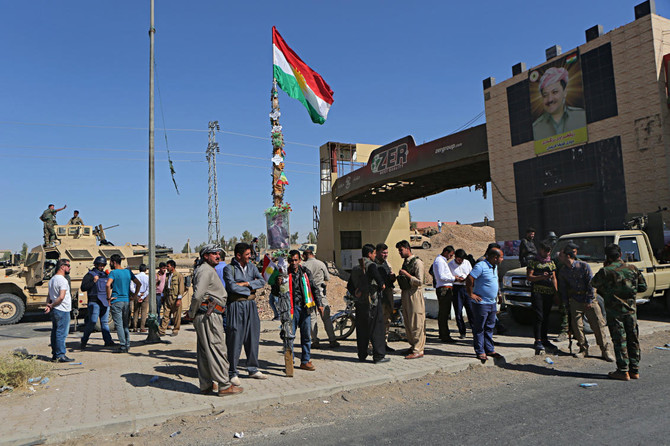
A picture of Massoud Barzani, the President of Iraq’s autonomous Kurdish region, and a Kurdish flag are displayed as Kurdish security forces stand guard in Altun Kupri, on the outskirts of Irbil, Iraq, on Thursday, October 19, 2017. (File photo by AP)
Updated 24 October 2017
Follow

Iraqi Kurd parliament postpones elections for 8 months

IRBIL, Iraq: Parliament in Iraq’s autonomous Kurdish region decided Tuesday to hold legislative elections in eight months after they were delayed amid tensions over disputed territory with the central government in Baghdad.
Simultaneous legislative and presidential elections in the Kurdish region had been due to take place on November 1 but were delayed. There was no immediate word on a date for a new presidential election.
The elections would have taken place just over a month after a September 25 referendum in the Kurdish areas resulted in a massive “yes” for independence.
The referendum, set in motion by long-time regional leader Masoud Barzani, was strongly opposed by Baghdad.
Iraqi forces last week swept into the oil-rich Kirkuk province in the north, restoring it and Kurdish-held parts of Nineveh and Diyala provinces to the control of the central government.
The rapid Kurdish retreat triggered recriminations among Kurdish politicians and prompted the regional parliament to postpone both elections.
On Sunday, Iraqi Kurdistan’s main opposition party called for Barzani to step down after the loss of Kurdish-controlled territory.
Shoresh Hajji of the Goran movement, which holds 24 out of 111 seats in the Iraqi Kurdistan parliament, said both Barzani and his deputy Kosrat Rasul should quit.
“The Kurdistan region’s president and his deputy no longer have any legitimacy and should resign,” he said.
Hajji called for the creation of a “national salvation government” to prepare for dialogue with Baghdad and organize new elections.
A month after scoring a major victory in the independence referendum, Barzani now finds himself isolated both at home and abroad.
The United States, a key ally of both Baghdad and Kurdish forces in the battle against the Daesh group, opposed the non-binding referendum, as did nations including Iraq’s neighbors Iran and Turkey.


US military visits contested area in northern Syria to defuse rising tensions

Updated 14 sec ago
Follow

US military visits contested area in northern Syria to defuse rising tensions

  • US has good relations with both sides and has urged calm

DEIR HAFER, Syria: A US military delegation arrived in a contested area of northern Syria on Friday following rising tensions between the Syrian government and a Kurdish-led force that controls much of the northeast.
The US has good relations with both sides and has urged calm. A spokesperson for the US military did not immediately respond to a request for comment.
Earlier in the day, scores of people carrying their belongings arrived in government-held areas in northern Syria ahead of a possible offensive by Syrian troops on territory held by Kurdish-led fighters east of the city of Aleppo.
Many of the civilians who fled were seen using side roads to reach government-held areas because the main highway was blocked by a checkpoint in the town of Deir Hafer normally controlled by the Kurdish-led and US-backed Syrian Democratic Forces, or SDF.
The Syrian army said late Wednesday that civilians would be able to evacuate through the “humanitarian corridor” from 9 a.m. to 5 p.m. Thursday and then extended the evacuation period another day. The announcement appeared to signal plans for an offensive against the SDF in the area.
There have been limited exchanges of fire between the two sides.
Men, women and children arrived in cars and pickup trucks that were packed with bags of clothes, mattresses and other belongings. They were met by local officials who directed them to shelters.
In other areas, people crossed canals on small boats and crossed a heavily damaged pedestrian bridge to reach the side held by government forces.
The SDF closed the main highway but more than 11,000 people were still able to reach government-held areas on other roads, Syrian state TV reported.
A US military convoy arrived in Deir Hafer in the early afternoon accompanied by SDF officials. Associated Press journalists saw SDF leaders and American officials enter one of the government buildings, where they met inside for more than an hour before departing the area.
Inside Deir Hafer, many shops were closed and people stayed home.
“When I saw people leaving I came here,” said Umm Talal, who arrived in the government-held area with her husband and children. She added that the road appeared safe and her husband plans to return to their home.
Abu Mohammed said he came from the town of Maskana after hearing the government had opened a safe corridor, “only to be surprised when we arrived at Deir Hafer and found it closed.”
SDF fighters were preventing people from crossing through Syria’s main east-west highway and forcing them to take a side road, he said.
Kortay Khalil, an SDF official at the Deir Hafer the checkpoint, said they had closed it because the government closed other crossings.
“This crossing was periodically closed even before these events, but people are leaving through other routes, and we are not preventing them,” he said. “If we wanted to prevent them, no one would be able to leave the area.”
The tensions in the Deir Hafer area come after several days of intense clashes last week in Aleppo, previously Syria’s largest city and commercial center, that ended with the evacuation of Kurdish fighters from three neighborhoods north of the city that were then taken over by government forces.
The fighting broke out as negotiations stalled between Damascus and the SDF over an agreement reached in March to integrate their forces and for the central government to take control of institutions including border crossings and oil fields in the northeast.
The US special envoy to Syria, Tom Barrack, posted on X on Friday that Washington remains in close contact with all parties in Syria, “working around the clock to lower the temperature, prevent escalation, and return to integration talks between the Syrian government and the SDF.”
The SDF for years has been the main US partner in Syria in fighting against the Daesh group, but Turkiye considers the SDF a terrorist organization because of its association with Kurdish separatist insurgents in Turkiye.