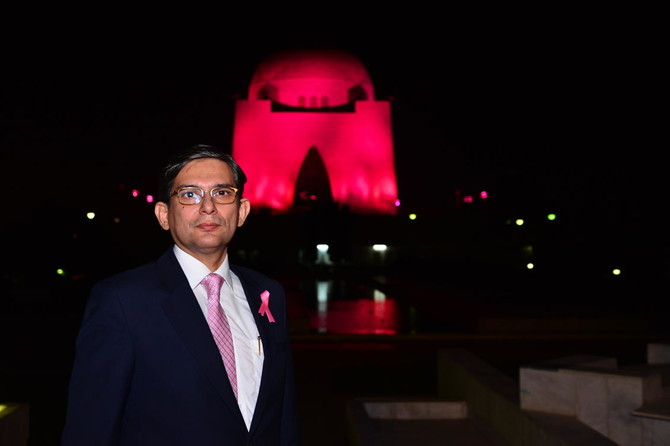
ISLAMABAD: There was no awareness of breast cancer in Pakistan until tragedy struck, and it is a man leading the fight after a very personal experience when he lost a friend and colleague to the killer disease.
Omer Aftab, founder of the Pink Ribbon Foundation – a leading initiative in the fight against breast cancer in Pakistan – was a youth activist in 2003 when he lost a female colleague to breast cancer. It was a wake-up call for Aftab, and it led to his decision to raise awareness of the killer disease.
He explained there were up to 90,000 breast cancer cases reported annually in Pakistan, while more than 40,000 women die each year from the disease due to late diagnosis.
Figures indicate that 10.2 million people are at a risk of developing it. Though extremely rare, it can develop at an early age, but advance screening and treatment of the disease has a 90 percent success rate.
“She knew that I was always up for volunteering so she started to discuss it with me. When I got involved, I realized that it’s a very big issue in Pakistan,” Aftab told Arab News.
“When she was undergoing treatment, she realized that even doctors lacked awareness of this issue. She used to read and (consult medical practitioners)… She didn’t survive and died with this disease.”
Pink Ribbon Foundation
Heartbroken, but determined, Aftab founded the Pink Ribbon Foundation in 2003. The initiative works to promote and support women’s empowerment focused on reducing breast cancer mortality through rigorous awareness campaigns, community projects, and access to treatment facilities. But despite his best efforts, he did not expect the stiff resistance he would face in Pakistan – a country that has such a conservative mindset.
“It was quite a challenge. At that time, it was a huge taboo. When we launched the campaign, all the television channels backed out (from supporting). They said the “B” word was too heavy to use on television. Its okay to write it in newspapers and magazines but you can’t talk about it on TV,” he added, pointing out that television, like most countries, enjoys the biggest audiences of all media platforms in Pakistan.
Today the Pink Ribbon Foundation has managed to save countless lives through advocacy, consultation, campaigns, and government-backed awareness programs across the country. The foundation has created a network of breast cancer survivors who can share stories of courage with women suffering from the disease.
Aftab’s efforts have inspired numerous volunteers to join his cause. He has even received the backing of the government that has allowed Pink Ribbon to light up a landmark each October by his initiative.
This year Islamabad’s Parliament House was the landmark that was chosen to be lit up.
Support is growing, with companies also lighting up their buildings in pink. But the journey is far from over for the foundation which continues to fight the myths, misconceptions, often misled cultural and gender beliefs of a country of 207 million people. It is also a country with few diagnosis and treatment facilities available to fight this disease.
Taboos and social stigmas
“There is a gender dimension of health, at a society, state, and household level,” Aftab explained, adding that in Pakistan male health still took priority over that of women. “Breast cancer is seen more as women’s sexuality than health.” Due to this, women are reluctant to get themselves’ checked and if diagnosed, rarely share with family members, who in turn are usually unsupportive he said.
“Unfortunately we have come across cases where women have been diagnosed and are viewed as a liability by their families – especially their husbands.
Genetics also play a key role, and this is another reason why women choose to stay silent. If a close relative has or has had, breast cancer, the risk is higher. Women who carry the BRCA1 and BRCA2 genes have a higher risk of developing breast or ovarian cancer, or both. These genes can be inherited. TP53 is another gene that is linked to a greater breast cancer risk. This leads women to believe that marriages within the family will be affected, Aftab said.
The fight goes on
Pink Ribbon has integrated the issue of breast cancer in the training of more than 100, 000 female health workers across Pakistan at a grass roots level. The initiative has engaged the state and its education commission, building an outreach to more than 200 colleagues and universities just during October.
“We are now setting up Pakistan’s first dedicated breast cancer hospital in Lahore,” Aftab told Arab News and it is in its initial stages of construction.
His personal investment has not been enough to see the medical facility materialize and the foundation seeks public contributions. His plan is to build four more across the country and provide cost free medical care to patients.
Pink Ribbon’s awareness program has seen an increase of 30 percent in patient turnout at breast screening clinics since 2004.
“I am really committed to the cause, and we need to save lives of all our women dying with breast cancer,” says Aftab.