LONDON: Giving an upbeat verdict on an inconclusive European Union summit, British Prime Minister Theresa May said Monday she has “a degree of confidence” that Brexit talks will be able to move to their decisive second phase by December.
She told lawmakers that the talks on Britain’s divorce from the EU had made “important progress,” despite a judgment by the 27 other EU leaders that more needs to be done before the two sides can discuss trade and their future relations.
May said she had “a degree of confidence we are going to get to a point of sufficient progress by December,” allowing talks to move on.
With Britain’s March 2019 departure from the EU moving closer, Britain is eager to start discussing trade and future relations with the bloc. But EU leaders say there has not yet been “sufficient progress” on divorce terms, including the size of the bill Britain must pay to settle its commitments to the bloc.
Britain’s initial offer to cover its previous EU commitments of around 20 billion euros ($24 billion) falls far short of the EU estimate of 60 billion euros ($70 billion) or more.
May refused to commit to a figure, saying “we are going through our potential commitments line by line.”
May has been in need of a boost from the 27 other EU leaders as she tries to hold together a government, a Conservative Party and a country deeply divided over Brexit. At the EU meeting in Brussels last week, she told fellow leaders that both sides needed “an outcome we can stand behind and defend to our people.”
An EU official said, after last week’s dinner, all the leaders were aware of the difficulties May is facing at home. The official, who spoke on condition of anonymity because the talks were confidential, said there was a sense among EU leaders that they didn’t want to make life more difficult for May.
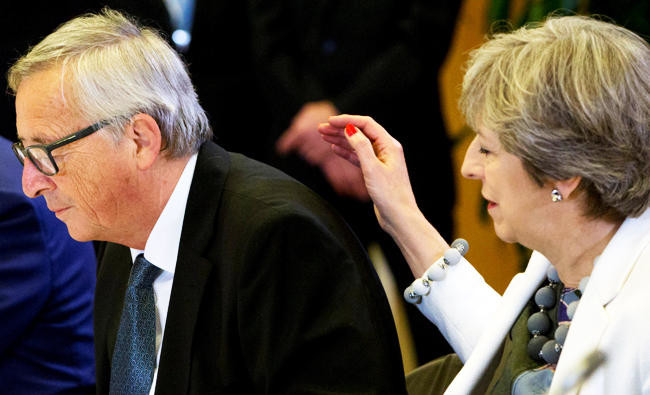
But May’s life was not made any easier by a German newspaper report claiming that EU Commission President Jean-Claude Juncker, who dined with May last week, saw her as “despondent” and “begging” the EU to help her make progress.
Juncker denied saying any such thing, insisting that his dinner with May in Brussels had not gone nearly as badly as the Frankfurter Allgemeine Sonntagszeitung suggested.
“She was neither tired nor beaten. She did her thing, and I did mine too,” Juncker said, speaking at the Institute of Political Studies in Strasbourg, France.
Juncker and his chief aide denied leaking the account of the meeting to the newspaper, and May’s spokesman declined to comment on it.
Meanwhile, Britain’s biggest business groups urged May’s Conservative government to quickly agree to a transition period of at least two years after Brexit to provide certainty about trade as companies make critical decisions about jobs and investment.
The letter sent to UK Brexit Secretary David Davis said an “agreement (on a transition) is needed as soon as possible, as companies are preparing to make serious decisions at the start of 2018, which will have consequences for jobs and investment in the UK“
May has requested a two-year transition period in which the two sides would trade on terms largely similar to current arrangements. But Britain and the EU have yet to discuss details of any such transition.


![]()
UK’s May says Brexit talks making progress; EU denies leak
UK’s May says Brexit talks making progress; EU denies leak

Latest updates


© 2026 SAUDI RESEARCH & PUBLISHING COMPANY, All Rights Reserved And subject to Terms of Use Agreement.