CAIRO: In his first remarks after a deadly attack on the country’s police force, Egypt’s president vowed on Sunday to press ahead with the country’s war against terrorism, secure its borders and hunt down militants.
President Abdel Fattah El-Sissi’s remarks came nearly 48 hours after authorities officially announced that at least 16 policemen were killed in a brazen ambush by militants southwest of Cairo. Security officials told the AP and other media outlets that the death toll reached 54, making it one of the worst attacks against Egypt’s police in years. However, it was not immediately possible to reconcile the conflicting reports.
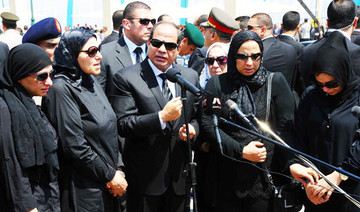
Chairing a meeting attended by the country’s top security officials, including defense and interior ministry representatives, El-Sissi said: “Egypt will continue its confrontation against terrorism and those financing and standing behind it, with strength, decisiveness and efficiency, until it’s curbed.”
His comments come as a cloud of ambiguity still hovers over the police raid gone wrong; a lack of information, charges of incompetence and conflicting accounts by officials to media outlets mark the incident.
The ambush began when security forces acting on intelligence moved against a purported militant hideout some 135 km outside Cairo. Backed by armored personnel carriers and led by senior counterterrorism officers, the police contingent drew fire and rocket-propelled grenades, according to the security officials. What happened next has not been clarified, but many officers were killed and others injured.
According to Egyptian media reports, the fallen policemen were given military funerals that were attended by a number of security officials.
The confusion around the incident sparked a debate on social media, with Egyptians divided over who to blame. Many suggested that the police force had been infiltrated by extremists given that some security officials said the ambush was carefully planned.
Along with conflicting reports of the death toll, authorities have also denied the authenticity of audio recordings, aired by pro-government media outlets, allegedly of policemen who took part in the operation. The speakers on the recordings can be heard pleading for help.
In a statement, the Interior Ministry said that the sources of the audio recordings are not known and that they carried “unrealistic details that have nothing to do with the reality.” It also warned against circulating such recordings and sowing confusion.
No militant group immediately claimed responsibility for the attack, which took place near Egypt’s vast western desert, where a previous series of attacks were blamed on militants pouring in from Libya. In addition to those militants, a local affiliate of Daesh is also spearheading an insurgency across the country and in the Sinai Peninsula.
Death sentences
In one of the latest trials involving extremists, an Egyptian criminal court on Sunday confirmed death sentences for 11 men and handed down life sentences to 14 others over charges including the attempted murder of policemen. The court ruling by Judge Mohammed Nagi Shehata — known for his severity — can be appealed. Five of those sentenced to death were tried in absentia.
The suspects were referred to court in 2015.


![]()

El-Sissi vows to quash terrorism after police ambush
El-Sissi vows to quash terrorism after police ambush

Latest updates


© 2026 SAUDI RESEARCH & PUBLISHING COMPANY, All Rights Reserved And subject to Terms of Use Agreement.