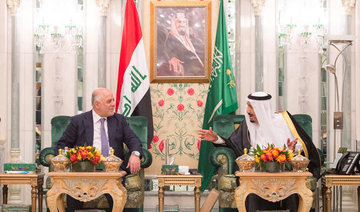
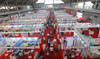
BAGHDAD: Under the title “We liberated our land and with your cooperation we will build it,” Iraqi Trade Minister, Salman Al-Jumaili, launched the 44th Baghdad International Fair running from 21-30 October with Saudi Minister of Energy, Industry and Mineral Resources, Khalid Al-Falih, attending. The opening ceremony was also attended by the governor of Baghdad, Hashem Mohammed Hatem, with the participation of 18 countries and 400 local and international companies.
Al-Jumaili welcomed guests participating in this important economic fair, which serves as a platform for strengthening friendship bonds between Iraq and other Arab, regional and international.
“The launch of the 44th Baghdad International Fair coincides with the complete liberation of many Iraqi areas, and this is a clear and true message that Iraq is ready to cooperate in the fields of investment and reconstruction and is capable of fighting and combating terrorism and strengthening its relationships through real and constructive partnerships,” he said.
Saudi minister, Al-Falih, expressed his delight to be present in his second country, Iraq, and said that Saudi participation was characterized by including more than 60 companies of different purposes in the largest section in the fair.
He also explained that there are strong, cultural, economic and historical bonds between Saudi Arabia and Iraq and said, “Today, the two countries share the same vision, which aims to build a promising future for their people through building national capacities, investing in resources and establishing business and industrial partnerships in order to build a strong, diversified economy.”
Al-Falih pointed out that the two countries share many factors, including a comprehensive economy, as well as true potential, such as human capital, a strategic geographical location, energy, water, mineral and agricultural resources, exceptional industrial capabilities and tourism potential.
“Investing in these sectors will allow for better cooperation between the two countries,” he added.
“A good example of the importance of a successful cooperation between the two countries is the stability and improvement the oil market has witnessed as a result of cooperation between OPEC countries,” Al-Falih added.
Saudi Exports Development Authority (SEDA) Secretary-General Saleh Al-Salami said that the participation of the authority in the Baghdad International Fair stems from its role in promoting Saudi products to reach international markets.
Al-Salami clarified that the Kingdom, through its participation, stresses the political and economic openness between the two countries; its concern to include its best companies in the Iraqi market in order to increase the exchange between the two countries; its determination to show the high quality of Saudi products and their competitiveness with international products; and the capacity of Saudi products to efficiently and effectively cover neighboring states.
This step also stresses the authority’s desire to “contribute in boosting the national economy by focusing on non-oil exports and diversifying the sources of income to achieve Vision 2030 and encourage national companies to participate in the exhibitions organized by the authority.”
Al-Salami said: “The choice of the Iraqi market is a result of many discussions held between the authority and a number of exporters to discuss and determine major challenges they have been facing, find solutions to overcome them, and find ways that facilitate the arrival of Saudi products on the Iraqi market.”
He added that the authority, through its participation, aims to discover new market opportunities for Saudi products in a promising market like the Iraq, and facilitate the export process to the country in cooperation with the relevant authorities.