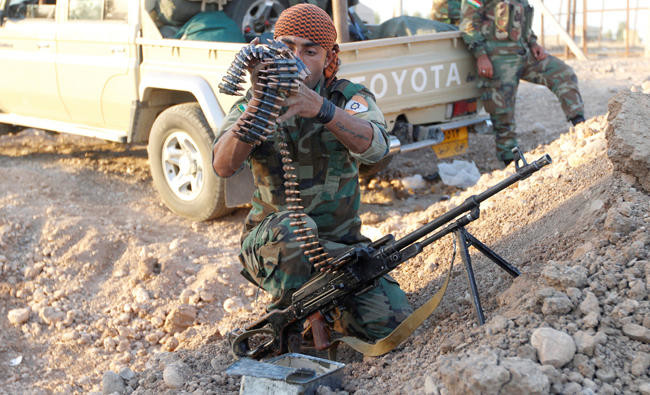
IRBIL/BAGHDAD: About 100,000 Kurds have fled Kirkuk for fear of sectarian reprisals since Iraqi government forces took over the city after a Kurdish independence referendum condemned by Baghdad, regional Kurdish officials said on Thursday.
Baghdad’s forces swept into the multi-ethnic city of more than 1 million people, hub of a major oil-producing area, largely unopposed on Monday after most Kurdish Peshmerga forces withdrew rather than fight.
Iraqi forces also took back control of Kirkuk oilfields, effectively halving the amount of output under the direct control of the autonomous Kurdistan Regional Government (KRG) in a serious blow to the Kurds’ independence quest.
Baghdad’s recapture of Kirkuk, situated just outside the KRG’s official boundaries on disputed land claimed by Kurds, ethnic Turkmen and Arabs, put the city’s Kurds in fear of attack by Shiite paramilitaries, known as Popular Mobilization, assisting government forces’ operations in the region.
Nawzad Hadi, governor of Irbil, the KRG capital, told reporters that around 18,000 families from Kirkuk and the town of Tuz Khurmato to the southeast had taken refuge in Irbil and Suleimaniyah, inside KRG territory. A Hadi aide told Reuters the total number of displaced people was about 100,000.
Hemin Hawrami, a top aide to KRG President Masoud Barzani, tweeted that people had fled “looting and sectarian oppression” inflicted by Popular Mobilization militia.
“Where is @UNIraq @UNHCRIraq?,” Hawrami said in another tweet, suggesting UN humanitarian agencies were doing little to help newly displaced people.
Lisa Grande, the UN humanitarian coordinator in Iraq, had urged all parties on Wednesday to do their utmost “to shield and protect all civilians impacted by the current situation.”
Iraqi Prime Minister Haider Al-Abadi said on Wednesday that security was being maintained in Kirkuk by local police backed by the elite Counter Terrorism Service, trained and equipped by the US mainly to fight Daesh militants. “All other armed group should not be allowed to stay,” Al-Abadi said.
Sunni Kurds comprise the largest community in Kirkuk followed by Shiite Turkmen, Sunni Arabs and Christians, according to the Iraqi Planning Ministry in Baghdad.
An Iraqi military statement on Wednesday said government forces had also taken control of Kurdish-held areas of Nineveh province, including the Mosul hydro-electric dam, after the Peshmerga pulled back.
Iran and Turkey joined the Baghdad government in condemning the Iraqi Kurds’ Sept. 25 referendum, worried it could worsen regional instability and conflict by encouraging their own Kurdish populations to push for homelands. The Kurds’ long-time big power ally, the US, also opposed the vote.
With the referendum having given Al-Abadi a political opening to regain contested land and shift the balance of power in his favor, it may prove a gamble that makes the KRG’s quest for statehood more elusive.
KRG Foreign Minister Fala Mustafa Bakir told broadcaster CNN that his side never meant to engage in war with the Iraqi Army. He said there was a need for dialogue between the KRG and Iraq to enable a common understanding. The dispute, he added, was not about oil or the national flag but the future of two nations.
Crude oil flows through the KRG pipeline to the Turkish port of Ceyhan have been disrupted by a gap between incoming and outgoing personnel since Baghdad’s retaking of Kirkuk.
An Iraqi Oil Ministry official in Baghdad said on Thursday that Iraq would not be able to restore Kirkuk’s oil output to levels before Sunday because of missing equipment at two fields.
The official accused the Kurdish authorities previously in control of Kirkuk of removing equipment at the Bai Hasan and Avana oilfields, northwest of the city.
Kurds have sought independence since at least the end of world war I when colonial powers carved up the Middle East after the multiethnic Ottoman Empire collapsed, leaving Kurdish-inhabited land split between Turkey, Iran, Iraq and Syria.


![]()
100,000 Kurds ‘have fled Kirkuk’ since Iraqi Army takeover
100,000 Kurds ‘have fled Kirkuk’ since Iraqi Army takeover


Latest updates


© 2026 SAUDI RESEARCH & PUBLISHING COMPANY, All Rights Reserved And subject to Terms of Use Agreement.