Ankara backs Baghdad in Kirkuk operation against PKK

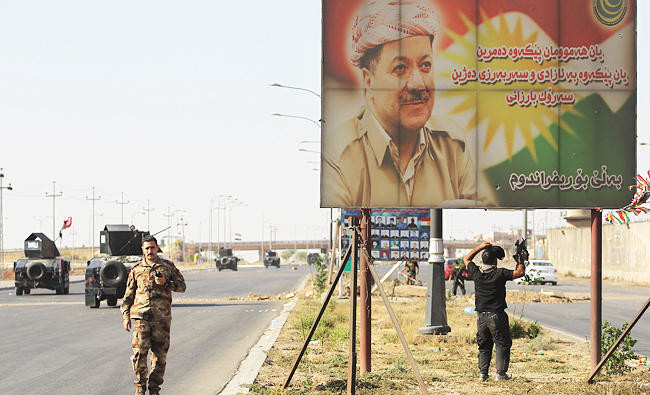
A banner bearing a portrait of Kurdish regional president Massoud Barzani is seen as Iraqi forces advance towards Kirkuk on Monday. (AFP)
Updated 17 October 2017
Follow

Ankara backs Baghdad in Kirkuk operation against PKK

ANKARA: The escalating tension between Baghdad and Irbil following Monday’s wide-ranging military operation launched by the Iraqi army to regain control of oil fields and military bases in Kirkuk could have serious repercussions for Turkey’s Iraq policy.
Reports and images showing members of the outlawed Kurdistan Workers’ Party (PKK) freely roaming the streets of the northern Iraqi city amid insistent calls from ethnic Turkmen groups to oust the militant group accelerated Ankara’s reaction.
Turkey’s Ministry of Foreign Affairs released a statement on Monday emphasizing that Ankara will stand with the central government in Baghdad “to end the presence of PKK in Iraqi territories.”
“We welcome the Iraqi government’s statement that no tolerance will be shown to PKK members in Kirkuk and that the mobilization of these groups will be considered an act of war,” the ministry said. The statement urged the Kurdistan Regional Government (KRG) “not to make another mistake” by allowing a PKK presence in the region because it “will be held responsible if it lets the PKK find shelter.”
Turkey’s interest in Kirkuk derives mainly from its ethnic, linguistic, religious, cultural and historical ties with the Turkmens, who are the third-largest ethnic group in the city, as well as from its perception of the threat from the expanding PKK presence there.
Bilgay Duman, an expert on Iraqi affairs at Ankara-based think tank ORSAM, said any step that Baghdad takes to eradicate the PKK will be warmly supported by Ankara.
“Turkey would not directly intervene in the region. But if the PKK becomes much more active in its positions in Sinjar, west of Mosul, Turkey may conduct a joint operation with the Iraqi central government,” Duman told Arab News.
“However,” he added, “Turkey would not prefer a deepening of the conflict in the region between the KRG and Baghdad because any security and power vacuum is likely to be filled by the PKK as well as by Daesh, which is still active in the region.
“For this reason, Ankara may play the role of mediator between the Iraqi government and the KRG in order to appease the tension. It may also raise the problems of Iraqi Turkmens in this process, especially following the change in demographics in the region,” Duman continued. “However, that would surely depend on (the KRG’s) willingness to meet Turkey’s main demand, which is the cancellation and withdrawal of all steps taken following the independence referendum held on Sept. 25.”
Turkey’s National Security Council also convened on Monday, under the chairmanship of President Recep Tayyip Erdogan, and recommended the government close airspace to flights from northern Iraq.
Ali Semin, a Middle East expert from Istanbul-based think tank Bilgesam, said Turkey should not stay silent and miss the opportunity to activate its Iraqi policy in line with the unfolding regional dynamics, although it has so far followed a “wait-and-see” policy by not closing its borders to Kurdistan even after the independence referendum.
“The regional balances are in favor of Ankara. In the first stage, Turkey may support Turkmens on political and diplomatic fronts. It can also provide military and logistical support to the Iraqi central government as part of joint counterterrorism efforts,” Semin told Arab News.
“The PKK’s presence in the region legitimizes Ankara’s use of its right to cross-border intervention in line with its decades-long security cooperation with Baghdad, like it did before several times in the Qandil mountains where PKK bases are located,” he added.
Semin also underlined that, in light of the shifting regional balance of power, Turkey may give its support to Iraq’s Al-Hashd Al-Shaabi (Popular Mobilization Units), a group of mainly Shiite militias that also incorporates Turkmen forces.
“Ankara has three priorities: Preventing oil-rich Kirkuk’s inclusion in the KRG, protecting Turkmen groups in the region, and stopping the independence process of Kurdistan,” Semin said. “Therefore, it can design new alliances that favor these three elements in consideration of its evolving relationship with political groups in Baghdad. Following the independence referendum, (Kurdish President Masoud) Barzani lost his major ally, Ankara, which now takes every possible opportunity to improve its ties with the Iraqi central government. Therefore, the escalation of tension in Kirkuk is disadvantageous for the Kurds who have ignited an ethnic conflict between Kurds, Arabs and Turkmens.”
Speaking to reporters at the Parliament on Monday, the deputy chairman of Turkey’s opposition Republican People’s Party (CHP), Ozturk Yilmaz, called for Kirkuk to be granted special status whereby Turkmen, Arabs and Kurds would be entitled to equal representation.


Iraq’s political future in limbo as factions vie for power

Updated 21 December 2025
Follow

Iraq’s political future in limbo as factions vie for power

  • The government that eventually emerges will be inheriting a security situation that has stabilized in recent years

BAGHDAD: Political factions in Iraq have been maneuvering since the parliamentary election more than a month ago to form alliances that will shape the next government.
The November election didn’t produce a bloc with a decisive majority, opening the door to a prolonged period of negotiations.
The government that eventually emerges will be inheriting a security situation that has stabilized in recent years, but it will also face a fragmented parliament, growing political influence by armed factions, a fragile economy, and often conflicting international and regional pressures, including the future of Iran-backed armed groups.
Uncertain prospects
Prime Minister Mohammed Shia Al-Sudani’s party took the largest number of seats in the election. Al-Sudani positioned himself in his first term as a pragmatist focused on improving public services and managed to keep Iraq on the sidelines of regional conflicts.
While his party is nominally part of the Coordination Framework, a coalition of Iran-backed Shiite parties that became the largest parliamentary bloc, observers say it’s unlikely that the Coordination Framework will support Al-Sudani’s reelection bid.
“The choice for prime minister has to be someone the Framework believes they can control and doesn’t have his own political ambitions,” said Sajad Jiyad, an Iraqi political analyst and fellow at The Century Foundation think tank.
Al-Sudani came to power in 2022 with the backing of the Framework, but Jiyad said that he believes now the coalition “will not give Al-Sudani a second term as he has become a powerful competitor.”
The only Iraqi prime minister to serve a second term since 2003 was Nouri Al-Maliki, first elected in 2006. His bid for a third term failed after being criticized for monopolizing power and alienating Sunnis and Kurds.
Jiyad said that the Coordination Framework drew a lesson from Al-Maliki “that an ambitious prime minister will seek to consolidate power at the expense of others.”
He said that the figure selected as Iraq’s prime minister must generally be seen as acceptable to Iran and the United States — two countries with huge influence over Iraq — and to Iraq’s top Shiite cleric, Grand Ayatollah Ali Al-Sistani.
Al-Sudani in a bind
In the election, Shiite alliances and lists — dominated by the Coordination Framework parties — secured 187 seats, Sunni groups 77 seats, Kurdish groups 56 seats, in addition to nine seats reserved for members of minority groups.
The Reconstruction and Development Coalition, led by Al-Sudani, dominated in Baghdad, and in several other provinces, winning 46 seats.
Al-Sudani’s results, while strong, don’t allow him to form a government without the support of a coalition, forcing him to align the Coordination Framework to preserve his political prospects.
Some saw this dynamic at play earlier this month when Al-Sudani’s government retracted a terror designation that Iraq had imposed on the Lebanese Hezbollah militant group and Yemen’s Houthi rebels — Iran-aligned groups that are allied with Iraqi armed factions — just weeks after imposing the measure, saying it was a mistake.
The Coalition Framework saw its hand strengthened by the absence from the election of the powerful Sadrist movement led by Shiite cleric Muqtada Sadr, which has been boycotting the political system since being unable to form a government after winning the most seats in the 2021 election.
Hamed Al-Sayed, a political activist and official with the National Line Movement, an independent party that boycotted the election, said that Sadr’s absence had a “central impact.”
“It reduced participation in areas that were traditionally within his sphere of influence, such as Baghdad and the southern governorates, leaving an electoral vacuum that was exploited by rival militia groups,” he said, referring to several parties within the Coordination Framework that also have armed wings.
Groups with affiliated armed wings won more than 100 parliamentary seats, the largest showing since 2003.
Other political actors
Sunni forces, meanwhile, sought to reorganize under a new coalition called the National Political Council, aiming to regain influence lost since the 2018 and 2021 elections.
The Kurdish political scene remained dominated by the traditional split between the Kurdistan Democratic Party and Patriotic Union of Kurdistan parties, with ongoing negotiations between the two over the presidency.
By convention, Iraq’s president is always a Kurd, while the more powerful prime minister is Shiite and the parliamentary speaker Sunni.
Parliament is required to elect a speaker within 15 days of the Federal Supreme Court’s ratification of the election result, which occurred on Dec. 14.
The parliament should elect a president within 30 days of its first session, and the prime minister should be appointed within 15 days of the president’s election, with 30 days allotted to form the new government.
Washington steps in
The incoming government will face major economic and political challenges.
They include a high level of public debt — more than 90 trillion Iraqi dinars ($69 billion) — and a state budget that remains reliant on oil for about 90 percent of revenues, despite attempts to diversify, as well as entrenched corruption.
But perhaps the most delicate question will be the future of the Popular Mobilization Forces, a coalition of militias that formed to fight the Daesh group as it rampaged across Iraq more than a decade ago.
It was formally placed under the control of the Iraqi military in 2016 but in practice still operates with significant autonomy. After the Hamas-led attack in southern Israel on Oct. 7, 2023 sparked the devastating war in Gaza, some armed groups within the PMF launched attacks on US bases in the region in retaliation for Washington’s backing of Israel.
The US has been pushing for Iraq to disarm Iran-backed groups — a difficult proposition, given the political power that many of them hold and Iran’s likely opposition to such a step.
Two senior Iraqi political officials, who spoke on condition of anonymity because they weren’t authorized to comment publicly, said that the United States had warned against selecting any candidate for prime minister who controls an armed faction and also cautioned against letting figures associated with militias control key ministries or hold significant security posts.
“The biggest issue will be how to deal with the pro-Iran parties with armed wings, particularly those... which have been designated by the United States as terrorist entities,” Jiyad said.