BAGHDAD: Iraqi Federal Police and allied Shiite-dominated paramilitary forces recaptured the northern city of Kirkuk with hardly a shot fired on Monday after Kurdish forces split in two and one group refused to fight.
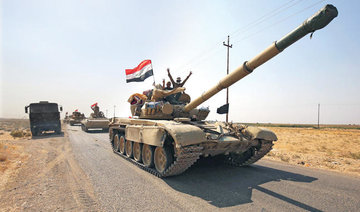
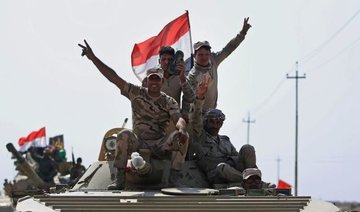
A convoy of troops, tanks and armored vehicles from Iraq’s elite Counter-Terrorism Force seized the provincial government headquarters, key military sites and an oil field on Monday afternoon, less than a day after the military operation began.
Thousands of Kurdish civilians fled the city of 1 million people for fear of reprisals, and a curfew was imposed from 7 p.m. to 7 a.m. A Kurdish father of four driving north out of Kirkuk toward the Kurdish regional capital Irbil said: “We no longer feel safe. We hope to return to our home but right now we feel it’s dangerous for us to stay.”
Crowds of ethnic Turkmen who opposed Kurdish control of the city were celebrating. Some drove in convoys with Iraqi flags and fired shots in the air.
The US called for calm. President Donald Trump said he regretted the conflict but would not take sides. The US Embassy in Baghdad called on all parties to “immediately cease military action.”
Kirkuk and its lucrative oil fields have been held by Kurdish forces since 2014, when the Iraqi Army fled in the face of an onslaught by Daesh militants.
Their recapture by Baghdad was simplified by internal strife among the Kurds, who have been divided for decades into two main factions; the PDK (Kurdistan Democratic Party) of regional government leader Masoud Barzani and the PUK (Patriotic Union of Kurdistan) of his longtime rival Jalal Talabani, who was Iraq’s president from 2003 to 2014 and died two weeks ago. Both parties control their own Peshmerga fighters.
Kurdish forces controlled by Baffal Talabani, the late president’s son, withdrew from their positions without fighting in an agreement with the federal government on Saturday night.
The PDK accused them of “treason” on Monday for allowing Baghdad’s forces to recapture Kirkuk unopposed. “We regret that some PUK officials helped in this plot,” it said. “They gave up some sensitive areas and withdrew from them without any fighting.”
PUK troops in Jalwlaa, Mandily and Qaratabbah towns in southern Diyala province were also withdrawn on Monday. More areas in Nineveh, Salahuddin, Diyala and Kirkuk provinces are expected to be handed over in the next 24 hours, military sources told Arab News.
“The Peshmerga of PUK were always in the forefront to defend the sons of Kirkuk and protect them from terrorism, but we will not sacrifice a drop of blood to maintain stolen oil fields,” said Alla Talabani, a senior Kurdish leader and head of the PUK federal parliamentary bloc.
Iraqi Prime Minister Haider Al-Abadi said: “We assure our people in Kurdistan and in Kirkuk in particular that we are keen on their safety and best interests. We have only acted to fulfill our constitutional duty to extend the federal authority and impose security and protect the national wealth in this city.”
The recapture of Kirkuk is the latest measure taken by Baghdad since Kurds in northern Iraq voted overwhelmingly for independence in a referendum last month condemned by the federal government as illegal and unconstitutional.
Iraqi federal officials and military officers told Arab News that their forces would not stop until they recapture all the disputed areas that have been controlled by Kurdish forces, some since 2003.
“The goal is all the disputed areas, not just Kirkuk and its surroundings,” said Ihssan Al-Shimari, one of Al-Abadi’s advisers. “We will gain back all these areas and liberate the western areas of Anbar seized by Daesh.”


![]()

Iraqi troops storm into Kirkuk without a fight
Iraqi troops storm into Kirkuk without a fight

Latest updates


© 2026 SAUDI RESEARCH & PUBLISHING COMPANY, All Rights Reserved And subject to Terms of Use Agreement.